
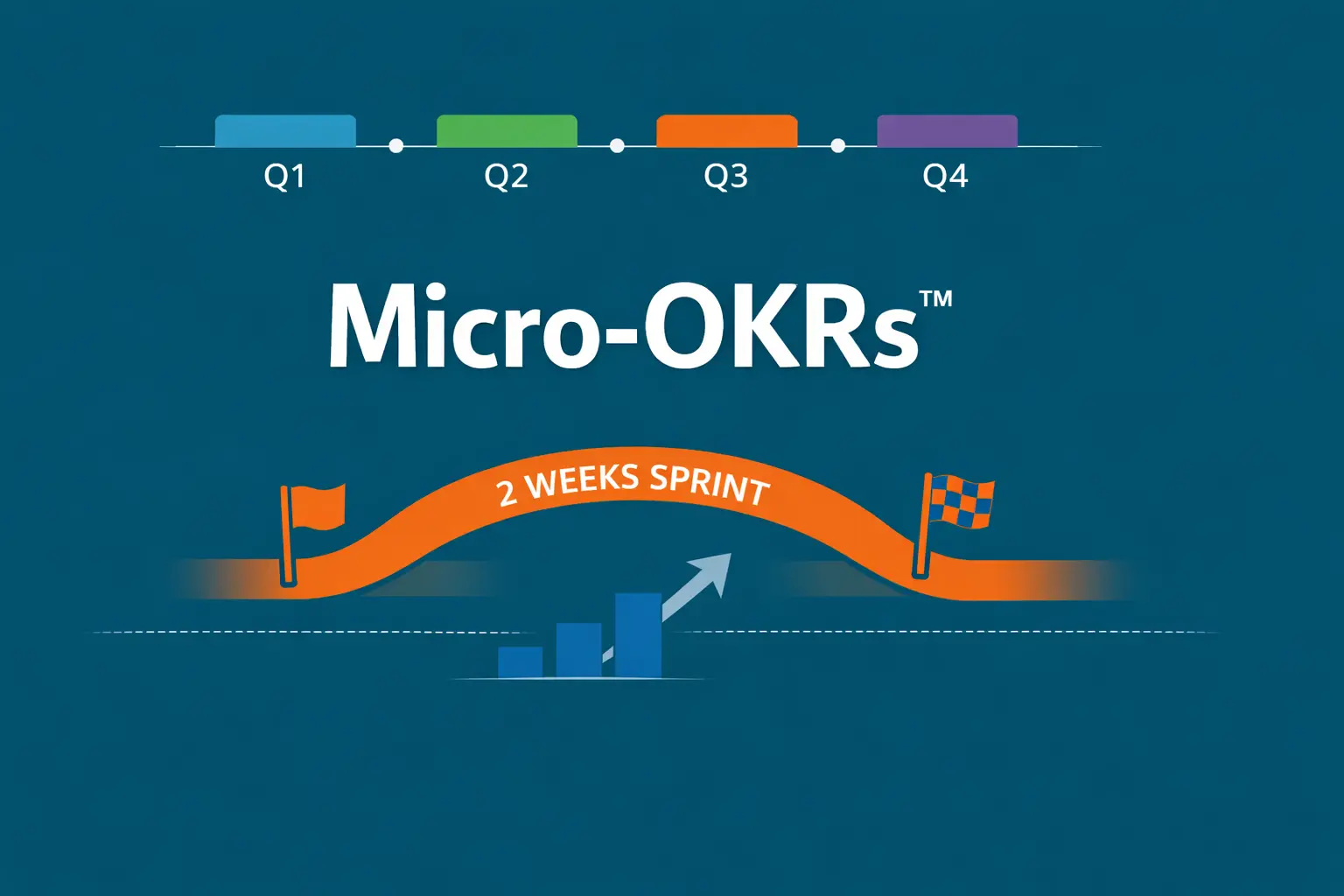
What Are Micro-OKRs™?
The Complete Practitioner Guide
Short-cycle, trigger-based OKR sprints that activate when a Key Result stalls or an opportunity emerges — without disrupting the quarterly OKR architecture you’ve already built.
Coined and formalized by Nikhil Maini, Founder & CEO, OKR International · August 2024
What’s in the Free Handbook?
- Complete 6-Step Writing Protocol
- KR Type calibration guide
- One-page template + Sprint Close standard
- Decision Tree: Micro-OKR™ vs. Initiative
- 5 functional worked examples
- Governance rules & common mistakes
- Coaching conversation guides
The Formal Definition
“A Micro-OKR™ is a short-cycle (1–4 week), trigger-based, outcome-committed OKR sprint that activates when an existing Key Result stalls, an unexpected opportunity emerges, or cross-functional teams need rapid alignment around a shared short-horizon outcome — nested within the existing OKR architecture as an adaptive overlay, not a new level.”
The Gap in Your OKR Architecture
Across 500+ OKR implementations globally, OKR International consistently observed three failure modes that no existing OKR instrument could address. Micro-OKRs™ were designed to close all three.
The Mid-Cycle Stall
A Tactical KR is underperforming at Week 5–6. The team sees it. Reviews surface it. But there is no structured mechanism to mount a focused, collective response within the current cycle.The Emergent Event Gap
An unexpected development demands rapid, coordinated action. Too significant for a simple initiative, too short-lived to wait for the next quarterly planning window.The Cross-Functional Void
Two or more teams need to align around a shared short-horizon outcome that sits between their existing Tactical OKRs. No structural mechanism exists without a full OKR planning cycle.Five Defining Characteristics of a Micro-OKR™
Micro-OKRs™ are not smaller OKRs or renamed sprints. Five characteristics distinguish them from every other execution instrument in the OKR ecosystem.
Trigger-Based, Not Schedule-Based
Activated by a signal — a stalling KR, an emergent opportunity, a cross-functional gap — not by the arrival of a planning window. You don’t plan Micro-OKRs™ in advance; you activate them when conditions warrant.
Sub-Quarter Duration (1–4 Weeks)
Never longer than four weeks. If the required response exceeds that window, a formal Tactical OKR revision is the appropriate instrument — not a Micro-OKR™.
Outcome-Committed, Not Output-Listed
Unlike Initiatives — which describe what will be done — Micro-OKRs™ carry an Objective and Key Results that measure a change in condition, not task completion. This distinction is critical.
Nested Within Existing OKR Architecture
Every Micro-OKR™ must trace to an existing Tactical or Strategic Key Result — the Anchor KR. It never introduces new strategic direction. It intensifies focus on an existing one.
Collectively Owned
Team instruments, not personal task lists or individual performance tools. They create shared accountability within the unit that activates them.
The Four Trigger Types
A Micro-OKR™ is always activated by a specific signal, not by the calendar. Four trigger types cover the full range of legitimate activation scenarios.
KR at Risk
A Tactical KR is materially off-track and an initiative-level response is insufficient to restore trajectory within the quarter.
Emergent Opportunity
An unexpected development demands rapid coordinated action. Too significant for an initiative, too short-lived for a quarterly OKR revision.
Cross-Functional Gap
Two or more teams need to align around a shared short-horizon outcome sitting between their existing Tactical OKRs.
Strategic Validation Sprint
A strategic bet requires rapid testing before full resource commitment. The sprint generates evidence to confirm, refute, or refine a direction.
Micro-OKRs™ vs. Initiatives
The most common confusion in Micro-OKR™ practice. The distinction is not cosmetic — it determines what happens in the room when a team responds to a challenge.
| Dimension | Initiative | Micro-OKR™ |
|---|---|---|
| Answers the question | What will we do? | What change in condition will we commit to? |
| Contains | Tasks and actions | Objective + 2–3 outcome-based Key Results + supporting Initiatives |
| Creates | A plan | A commitment |
| Success measured by | Completion of tasks | Movement on a condition-change KR |
| Team alignment | Individuals own tasks | The team owns the outcome |
| Right when | You know what to do and need structure to execute it | You need to align around a shared outcome and restore directional energy |
🧭 The Practitioner’s Test
“Does this situation need a plan or a commitment?”
If the team already knows what to do — write an Initiative.
If the team needs to align around a shared outcome and create measurable accountability — activate a Micro-OKR™.
A Complete Micro-OKR™: Sales Team Example
A KR at Risk scenario from a B2B sales function — from trigger identification through to sprint design. Notice where the tasks go, and where they don’t.
| Trigger Type | KR at Risk |
| Situation | Qualified pipeline at $21.2M vs $30M target at Week 6 of Q3 — 29% below linear trajectory. Two check-ins have surfaced the gap. Initiative revisions have not moved the number. |
| Anchor KR | Increase qualified B2B pipeline from $20M to $30M by Q3 close |
| Sprint Window | 14 days (14 July – 28 July) |
| Sprint Owner | Regional Sales Team — West |
| Objective | Restore qualified pipeline momentum and close the trajectory gap before Q3 mid-review |
| Key Result 1 | Increase ICP meeting acceptance rate from 22% to 35% within 14 days |
| Key Result 2 | Progress 6 stalled accounts from Discovery stage to Proposal stage |
| Key Result 3 | Reduce median time-to-first-meeting for ICP accounts from 12 days to 7 days |
| Supporting Initiatives | 1. Conduct 30 targeted outreach calls 2. Personalise 40 ICP email sequences 3. Run pipeline review with 3 key account managers |
| Check-in Cadence | Daily · 15 minutes · Focus on KR movement, not task completion |
| Sprint Close | Retrospective: Did we move the Anchor KR? What did we learn? What changes at the Tactical OKR level? |
The 6-Step Writing Protocol
Follow these steps in sequence. Each step prevents a specific category of design error. Skipping steps is the fastest route to output KRs and abandoned sprints.
Identify the Trigger
Name the specific signal that prompted activation. Which KR is at risk? What emergent event occurred? Match to one of the four trigger types.
Name the Anchor KR
Document the existing Tactical or Strategic KR this sprint will serve. If no anchor can be named, this is not a Micro-OKR™ situation — stop here.
Define the Desired Condition
Describe the change in the world you want at sprint close. Not tasks. Not deliverables. A change in condition.
Write the Objective
Draft a motivating, directional statement. Apply three tests: Motivation Test, Direction Test, and Alignment Test.
Write 2–3 Key Results
Each KR must measure a change in condition. Ask: “If this number moves as specified, does it confirm the Objective was genuinely met?”
Set Duration & Confirm Ownership
State the sprint window explicitly with start and end dates. Name the team. Confirm everyone understands the why and the what.
The Four Non-Negotiables
These governance rules distinguish Micro-OKRs™ from ad hoc sprints and make the framework safe to deploy at scale. Each rule exists to prevent a specific failure mode observed in practice.
🔢 Maximum 2 per Team at Any Time
More than two active Micro-OKRs™ signals a Tactical OKR planning problem, not a Micro-OKR™ need. Cognitive load and focus diffusion are the primary failure modes when teams run multiple simultaneous sprints.
⚓ Every Sprint Must Have an Anchor KR
If no Anchor KR can be named, stop. Write an Initiative or convene a Tactical OKR revision instead. This single rule prevents Micro-OKRs™ from becoming a permanent fourth OKR level in practice.
👥 Team Instruments Only
Individual-level Micro-OKRs™ are not supported within the OKR International framework. They reintroduce the performance appraisal distortion that the OKR architecture was designed to avoid.
📋 Sprint Close is Mandatory
Every Micro-OKR™ must close formally with a retrospective — even early-close sprints. Silent abandonment is the most common governance failure and the fastest way to destroy team confidence in the framework.
Who Coined Micro-OKRs™?
Micro-OKRs™ were coined and formally defined by Nikhil Maini, Founder & CEO of OKR International, in August 2024. The formalization drew on patterns observed across more than 500 OKR implementations globally, where teams were informally creating short-cycle sprint objectives in response to mid-cycle disruptions — useful in intent but inconsistent in structure and governance.
The framework was developed as a proprietary extension of the OKR Body of Knowledge™ (OKR-BOK™) — the global standard for OKR methodology developed by OKR International. It is the first major structured addition to the OKR-BOK™ since its original publication.
OKR International has been a pioneering OKR coaching and implementation organization in India since 2017, with clients across India, the UAE, Southeast Asia, and globally.
Frequently Asked Questions
The Gold Standard in OKRs
Start Using Micro-OKRs™ in Your Organisation
Three ways to get started — from free handbook to facilitated workshop to full OKR-BOK™ certification. No new software. No new system. Works inside your existing OKR programme.
Learn From Our Blogs
OKR Certification Course April 2026: Master Strategy Execution with Confidence
Elevate your skills with the OKR certification course 2026. Master goal-setting and drive business results with live instruction.
OKR Mastery: The Essential Guide to Becoming a High-Value Strategy Execution Expert
Explore the importance of OKR expertise to bridge the strategy-execution gap and enhance your organization’s performance.
OKRs and Strategy Execution
Discover how OKRs and strategy execution can transform organizational performance and ensure strategic alignment at scale.
OKRs at Scale: What Really Changes Beyond Team-Level OKRs
Learn why OKRs at scale require more than team-level goals. Discover what breaks, what changes, and how to sustain alignment and execution.

OKR Coach Certification: OKR-BOK™ Certified Coach (20–21 Feb 2026)
Achieve professional growth with the OKR Coach Certification. Learn to coach and facilitate using the OKR Body of Knowledge.
The Discipline of OKRs: How High-Performing Organizations Turn Strategy into Execution
Explore the Discipline of OKRs and how they can bridge the gap between strategy and execution in your organization.