What Are OKRs? The Complete Guide to Objectives and Key Results
OKRs (Objectives and Key Results) are a goal-setting and execution framework in which teams set a small number of ambitious, qualitative Objectives — each measured by 3 to 5 quantitative Key Results and driven by supporting Initiatives — to turn strategy into measurable outcomes.
What does OKR stand for?
OKR stands for Objectives and Key Results. It is a collaborative goal-setting framework that pairs a clear, qualitative goal (the Objective) with a small set of measurable outcomes (the Key Results) that prove you are making progress toward it. The two halves answer two different questions:
Objectives
What do we want to achieve? A qualitative, inspiring statement of direction — ambitious enough to stretch the team and clear enough for anyone to understand.
Key Results
How will we know we're getting there? Quantitative, verifiable outcomes — each with a metric, a baseline, and a target — that measure real progress.
John Doerr's classic formula captures the whole framework in a single sentence: "I will [OBJECTIVE] as measured by [KEY RESULTS]." At OKR International, we add a third component — Initiatives — the projects and actions that actually move the Key Results.
The History of OKRs: From Intel to Google to Global Adoption
The inventor: Andy Grove at Intel
The story of OKRs begins with Andy Grove, co-founder and CEO of Intel, who developed the framework in the 1970s. Grove recognised that existing goal-setting methods — particularly Peter Drucker's MBO (Management by Objectives) — were too rigid, too annual, and too top-down for Intel's fast-moving semiconductor business.
His innovation was structural: pair a qualitative, inspiring Objective with a small set of quantitative Key Results, review progress frequently, and make everything transparent. He originally called it "iMBOs" (Intel Management by Objectives) before the terminology evolved into OKRs.
One of the earliest high-stakes demonstrations was Operation Crush in 1980 — Intel's campaign to reclaim the microprocessor market from Motorola. Using OKRs, Grove aligned engineering, sales, marketing, and manufacturing around a single objective with clear, measurable key results. The campaign succeeded and is widely credited with establishing Intel's market dominance.
The evangelist: John Doerr brings OKRs to Google
John Doerr, a venture capitalist at Kleiner Perkins, learned OKRs directly from Andy Grove while at Intel in the late 1970s and early 1980s. As an early investor in Google in 1999, he introduced OKRs to Larry Page and Sergey Brin when the company had fewer than 40 employees — giving Google a disciplined mechanism for setting ambitious goals and scaling without losing alignment.
Google used OKRs to coordinate products like Gmail, Chrome, and Android, each requiring cross-functional collaboration at massive scale. Doerr later documented the journey in his 2017 bestseller Measure What Matters, popularising the OKR superpowers — the FACTS framework: Focus, Alignment, Commitment, Tracking, and Stretching.
Global expansion: beyond Silicon Valley
Google's visible success sparked a wave of adoption — first among tech companies like LinkedIn, Twitter, Spotify, and Uber, then across every industry:
- Enterprise & manufacturing: Samsung, BMW, and Deloitte adopted OKRs to drive innovation alongside operational excellence.
- Non-profits & government: The Gates Foundation uses OKRs to track global health and education initiatives; government agencies in several countries use them for public service goals.
- Startups & scale-ups: For resource-constrained organisations, OKRs provide the focus that prevents the "doing everything, achieving nothing" trap.
The evolution continues
Today OKRs are a globally recognised management operating system used by organisations of every size and sector. The framework keeps evolving:
- CFRs (Conversations, Feedback, Recognition) have emerged as the essential companion to OKRs, forming what Doerr calls Continuous Performance Management.
- AI-powered OKR tools now assist with goal drafting, progress prediction, alignment mapping, and initiative recommendation.
- Remote and hybrid work has amplified the need for outcome-based goals — when you can't measure presence, you must measure results.
The core principles Grove established remain intact: set a small number of ambitious goals, measure them with quantifiable results, review frequently, and keep everything transparent.
Definition & DNA of OKRs
"OKRs (Objectives and Key Results) are a goal management and execution framework in which teams or individuals set no more than 3 to 5 Objectives for a given cycle, with no more than 3 to 5 measurable Key Results per Objective, supported by Initiatives that drive execution."
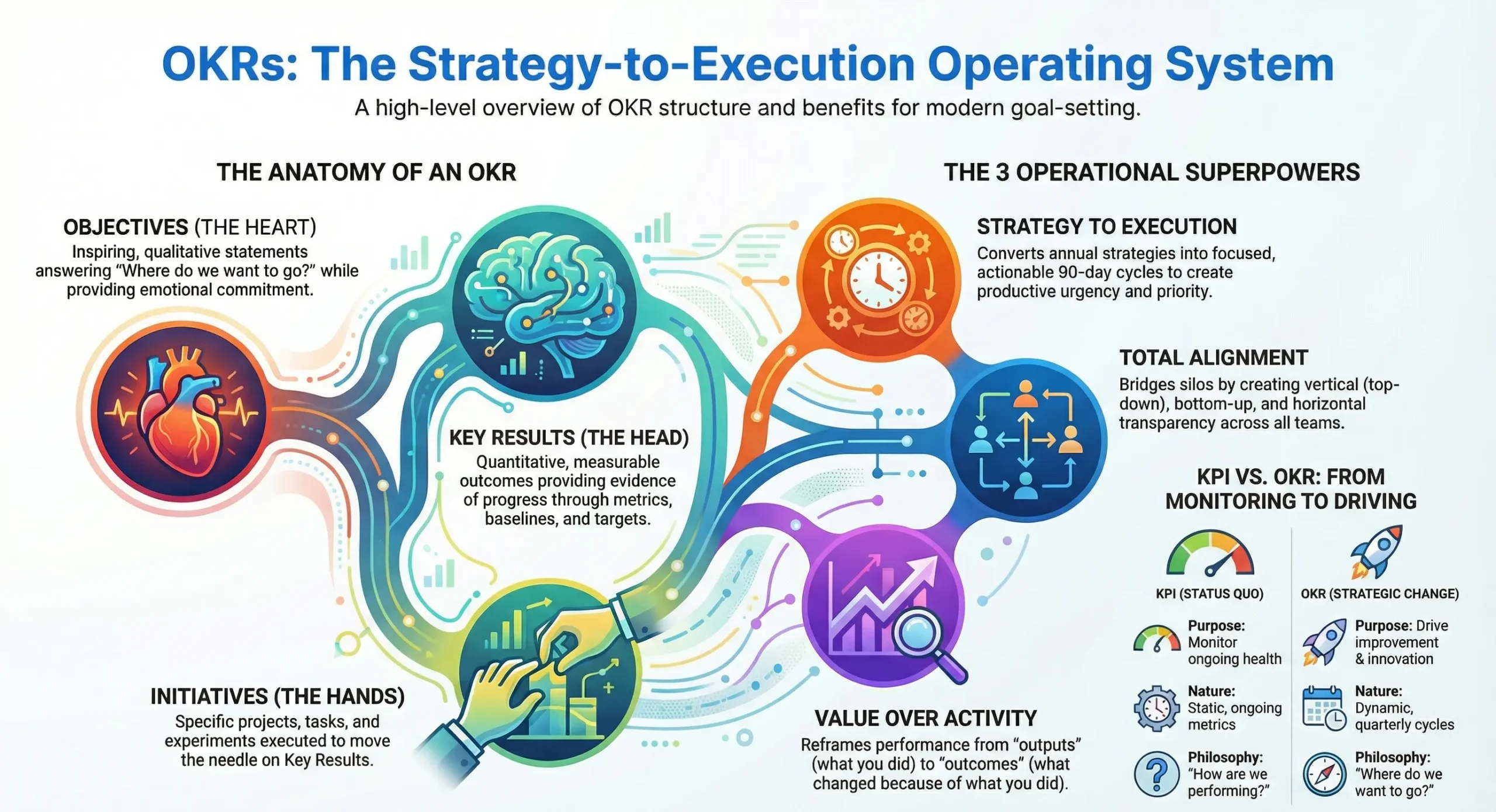
— Nikhil Maini, CEO, OKR InternationalThe framework is deceptively simple. An OKR has three interdependent components — Objectives, Key Results, and Initiatives — each serving a distinct function. At OKR International, we describe these as the DNA of every OKR, using a body metaphor that has helped thousands of practitioners internalise the framework:
The Heart
Objectives
Provide direction and inspiration. The qualitative goal that answers "where do we want to go?"
The Head
Key Results
Provide measurement and evidence of progress. The metrics that prove you're getting there.
The Hands
Initiatives
Get the actual work done. The projects and experiments that move the Key Results.
The Heart
Objectives
Objectives are qualitative, directional statements that define what you want to achieve. When well-crafted, they are ambitious enough to stretch the team, clear enough to be understood by anyone in the organisation, and inspiring enough to create emotional commitment. This is why we call them the heart of OKRs — they bring purpose and emotionality to what could otherwise be a dry planning exercise.
Characteristics of a well-written Objective
- Qualitative, not quantitative. An Objective describes a desired future state in words, not numbers. "Become the most customer-centric company in our sector" is an Objective. "Achieve 90% customer satisfaction" is a Key Result.
- Ambitious yet achievable. Objectives should push beyond business-as-usual without being delusional. Google distinguishes committed Objectives (roofshots — expected at 100%) from aspirational Objectives (moonshots — where 60–70% is a strong result). A healthy set mixes both.
- Action-oriented. Start with strong action verbs — build, launch, transform, establish, create, accelerate, deliver. Passive language produces passive execution.
- Time-bound. Set for a defined cycle — typically a quarter for tactical OKRs and a year for strategic OKRs. Annual Objectives break into quarterly ones, creating a natural rhythm.
- Derived from strategy. Every Objective traces back to the organisation's vision, mission, values, and strategy. An Objective that can't connect to a strategic priority is, by definition, not a priority.
Objective categories. Objectives typically revolve around core themes such as customer experience, revenue growth, operational performance, employee engagement, product innovation, or market expansion. At company level, 3–5 Objectives set strategic direction. At team level, Objectives should clearly contribute to one or more company-level Objectives.
The Head
Key Results
Key Results are quantitative, measurable outcomes that, when achieved, directly advance the Objective. They are the evidence of progress — the head of your OKR — bringing rigour and accountability to what would otherwise be an inspirational but unmeasurable aspiration.
Characteristics of well-written Key Results
- Measurable and verifiable. No grey area. As Andy Grove said: "Yes? No? Simple. No judgments in it."
- Every Key Result has a metric, a baseline, and a target. "Improve customer satisfaction" is not a Key Result. "Increase NPS from 32 to 55" is — you know what you're measuring, where you start, and where you need to be.
- Outcome-based, not activity-based. The single most important principle. "Conduct 20 customer interviews" is an activity (Initiative). "Reduce customer churn from 8% to 3%" is an outcome. The test: does this measure what changed, or what we did?
- Challenging but not delusional. For moonshots, 60–70% achievement is good. For roofshots, 100% is expected. If you always hit 100%, your targets aren't ambitious enough.
- Limited to 3–5 per Objective. This constraint forces prioritisation. Eight Key Results under one Objective means you haven't been rigorous about what truly matters.
The interactivity principle
A concept most OKR guides overlook, and it's critical. When you write 3–5 Key Results under an Objective, they are not independent checkboxes — they are interdependent and mutually reinforcing. Their cumulative, combined effect is what achieves the Objective. Think of them as a system, not a list.
Objective: Deliver an onboarding experience users love
- KR1: Increase Day-7 activation rate from 28% to 55%
- KR2: Reduce onboarding drop-off from 42% to 12%
- KR3: Achieve onboarding satisfaction score of 4.6/5
You can't sustainably raise activation (KR1) without reducing drop-off (KR2), and both ultimately drive satisfaction (KR3). These Key Results interact as a system. Achieving any one in isolation, while the others stagnate, is unlikely to realise the Objective.
The three patterns of Key Results
Increase
Grow revenue, raise NPS, improve activation rate
Decrease
Reduce churn, shorten cycle time, lower defect rate
Guardrail
Sustain quality while scaling; hold a threshold during change
The guardrail pattern is often overlooked but essential. It prevents teams from optimising one metric at the expense of another — for example, reducing time-to-hire without accidentally lowering candidate quality.
Scoring Key Results
- 0.0 to 1.0 scale (Google's method): 0.7 is the target for aspirational Key Results; 1.0 is expected for committed ones.
- Percentage completion: straightforward 0–100% progress tracking.
- Traffic light system: Red (no meaningful progress), Yellow (progress but short), Green (achieved or exceeded).
The scoring is not about judgement — it's about learning. A score of 0.6 on an aspirational OKR isn't failure; it's data that informs the next quarter's planning.
The Hands
Initiatives
Initiatives are the projects, tasks, experiments, and activities that drive execution. They are the hands of your OKR — they get things done. Without Initiatives, an OKR is a measurement system with no engine. Without Key Results, Initiatives are activities with no compass.
Characteristics of well-designed Initiatives
- Directly connected to a Key Result. Every Initiative needs a clear hypothesis: "We believe doing X will move Key Result Y." If you can't articulate this, it doesn't belong.
- At least one Initiative per Key Result. Often several, especially early in a quarter when you're testing multiple approaches.
- Within your circle of influence. If an Initiative depends entirely on another team and you can't influence it, it's a dependency to resolve, not a viable Initiative.
- Boolean or metric-driven. "Launch the redesigned onboarding flow — Yes/No" or "Publish 12 pillar articles this quarter." Both are valid.
The add-modify-delete approach
Add
An Initiative that's been missing — perhaps a new approach you hadn't considered.
Modify
An existing Initiative that's partially working but needs adjustment.
Delete
An Initiative that's proven a dead-end — don't keep investing simply because you committed to it.
The more frequently you review Initiatives — ideally in weekly or biweekly check-ins — the more opportunities you have for course correction. This cadence is the engine room of OKR execution, and the primary reason most traditional goals (and New Year's resolutions) go unachieved: they are set and forgotten, with no mechanism for ongoing adaptation.
The stability spectrum
- Most stableObjectives rarely change within a quarter unless there's a fundamental strategic shift.
- ModerateKey Results — metrics shouldn't change, though targets may occasionally be recalibrated mid-quarter if circumstances shift dramatically.
- Most dynamicInitiatives should be reviewed and adjusted frequently based on what's working.
How Objectives, Key Results & Initiatives work as a system
Objective
Build the healthiest, most engaged workforce in our industry.
KR1 — Increase employee engagement score from 62 to 82
- Launch monthly town halls with open Q&A and transparent updates
- Implement a peer recognition programme in the daily workflow
- Conduct pulse surveys every 3 weeks and share results transparently
KR2 — Reduce voluntary attrition from 22% to 10%
- Introduce stay interviews for top 20% performers
- Redesign compensation benchmarking using current market data
- Create internal mobility pathways before employees look outside
KR3 — Achieve 90% participation in development programmes (from 35%)
- Partner with 3 external learning platforms for on-demand skills
- Allocate 4 hours per month of dedicated learning time
- Tie development participation to manager OKRs for accountability
Notice how the Objective inspires, the Key Results measure three interdependent dimensions of workforce health, and the Initiatives are specific, actionable bets to move each Key Result. If the pulse surveys aren't improving engagement by mid-quarter, the team adds, modifies, or deletes — they don't wait until Q4. This is the OKR system in action: direction from the heart, measurement from the head, execution from the hands.
Contemporary practices: how OKR DNA has evolved
- Company and team OKRs over individual OKRsCurrent best practice (endorsed even by Google's Rick Klau, who reversed his original position) favours company- and team-level OKRs. Individual OKRs devolve into task lists and risk being conflated with performance evaluations. Teams own OKRs collectively; individuals contribute through their Initiatives.
- OKRs decoupled from compensationTying OKR achievement to bonuses incentivises conservative goal-setting and destroys the aspirational culture OKRs create. The standard is to inform performance conversations (alongside CFRs) but not to base rewards solely on OKR scores.
- Bidirectional alignment over top-down cascadingContemporary practice favours roughly 40% top-down and 60% bottom-up OKRs — ensuring strategic coherence while tapping front-line intelligence and fostering ownership.
- AI-assisted drafting and trackingAI tools suggest Key Results from historical data, predict whether trajectories will hit targets, recommend Initiative adjustments, and flag alignment conflicts — augmenting human judgment, not replacing it.
- Integration with Continuous Performance ManagementOKRs increasingly operate within a broader ecosystem of weekly check-ins, CFRs, quarterly retrospectives, and ongoing coaching — what Doerr calls Continuous Performance Management, replacing the annual review.
The four superpowers that make OKRs the gold standard
Every framework promises results. What makes OKRs fundamentally different — and why they've been adopted from Silicon Valley startups to manufacturing companies, governments, and non-profits — comes down to four structural advantages built into the DNA of the framework. John Doerr described OKR benefits with the acronym FACTS; after two decades across 500+ organisations, we've found these manifest as four operational superpowers leaders experience in practice.
Converting strategy to execution
Most organisations don't lack strategy — they lack execution. Per Harvard Business Review, roughly 67% of well-formulated strategies fail due to poor execution. The gap between a PowerPoint strategy and what happens on the ground is where most organisations lose.
OKRs act as a translation engine, converting annual strategy into quarterly, actionable goals. Limiting each team to 3–5 Objectives forces rigorous prioritisation. The quarterly cadence is critical: annual goals create a false sense of time abundance; 90 days creates productive urgency.
In practice
A mid-size Indian IT services company had a strategy to expand into Europe that sat on paper for three years. With OKRs, it became one Q1 Objective: "Establish a credible market presence in the UK" — with measurable KRs (two pilot clients, one partnership, a London microsite with 500+ qualified monthly visitors). Within 90 days they'd signed a pilot client and built two partnerships. The strategy hadn't changed; the execution mechanism had.
Creating higher levels of agility
Static annual plans are dangerously brittle. Economic shifts, disruption, and competitive moves can render a 12-month plan obsolete within weeks. Organisations that evaluate performance once a year drive with a rear-view mirror.
OKRs institutionalise agility through their quarterly cycle and a "fail-fast" philosophy — structured, time-boxed learning, not reckless experimentation. The mechanism is the add-modify-delete discipline applied to initiatives in weekly or biweekly reviews.
The critical distinction
Agility is not about changing objectives constantly. Objectives stay stable within a quarter — what changes are the initiatives, the bets you place. Be passionate about your objectives, be dispassionate about your initiatives. This is what prevents "agile" from becoming a euphemism for "directionless."
Achieving greater alignment of goals and efforts
One of the most pervasive organisational diseases is the "systemic disconnect" — teams working hard in silos, each optimising for their own goals, unaware of how their work connects to or conflicts with others. When a procurement team can't secure chips on time, the product team's Q2 launch becomes impossible — not from product failure, but because the goals were never connected.
Three mechanisms
Vertical alignment cascades company OKRs into team OKRs. Bottom-up alignment lets teams propose objectives, tapping the intelligence of people closest to customers. Horizontal (cross-functional) alignment — the most powerful and underused — lets teams see each other's OKRs transparently, identifying dependencies before it's too late.
OKR transparency is non-negotiable. When all OKRs are visible from CEO to front line, silos become structurally difficult to maintain, creating a healthy peer accountability no top-down reporting can replicate.
Focusing on value creation over activity
Most goal-setting systems reward busyness over impact. When people are measured on activities — calls made, reports written, meetings attended — the incentive is to maximise volume, not quality. The result is a workforce that's perpetually busy but not necessarily productive.
OKRs reframe measurement from outputs (what you did) to outcomes (what changed because of what you did). Compare Manager A ("Conduct 10 interviews per day" — transactional, no ownership of whether the right people are hired) with Manager B ("Build a high-performance talent pipeline" — KR1: reduce time-to-hire 90→45 days; KR2: 90-day retention 95%; KR3: offer acceptance 65%→85%). Manager B has autonomy over how, leading to greater engagement and better results.
Every time you write a key result, ask: "Does this measure what changed, or what we did?" If it measures what you did, it's an initiative, not a key result.
The multiplier effect
These superpowers don't operate in isolation — they compound. When strategy becomes focused quarterly goals, pursued with agility and rapid learning, aligned across every team, and measured by value rather than activity, the organisation becomes more effective than the sum of its parts. This is why OKRs are not just a goal-setting tool — they are a management operating system.
OKR examples across business functions
The best way to understand OKRs is to see them in action. Below are five examples across business functions — each written the way we coach clients at OKR International. Notice every example includes all three DNA components: an inspiring Objective, measurable Key Results with baselines and targets, and actionable Initiatives.
Sales
Become the undisputed leader in enterprise sales in our region.
Key Results
- Increase enterprise deal win rate from 18% to 35%
- Grow average deal size from ₹12L to ₹20L
- Reduce average sales cycle from 110 to 60 days
Initiatives
- Launch an enterprise solution-selling training programme
- Develop 5 industry-specific case studies for pitches
- Implement weekly pipeline inspection meetings
HR / People
Build a talent acquisition engine that consistently attracts best-fit candidates.
Key Results
- Reduce time-to-hire from 90 to 45 days
- Increase offer acceptance rate from 62% to 88%
- Achieve 90-day new-hire retention of 95% (from 78%)
Initiatives
- Redesign the candidate experience journey
- Partner with 3 niche recruitment platforms
- Introduce structured interviewing scorecards
Marketing
Establish our brand as the most trusted voice in our industry.
Key Results
- Increase organic traffic from 25,000 to 60,000 monthly sessions
- Grow MQLs from 200 to 500 per quarter
- Improve domain authority from 35 to 50
Initiatives
- Publish 12 high-value pillar articles
- Launch a monthly thought-leadership webinar
- Secure guest contributions on 8 publications
Product / Engineering
Deliver an onboarding experience that users genuinely love.
Key Results
- Increase Day-7 activation from 28% to 55%
- Reduce onboarding drop-off from 42% to 12%
- Achieve onboarding satisfaction of 4.6/5 (from 3.2)
Initiatives
- Conduct 20 user interviews to map friction points
- Build and A/B test a guided walkthrough
- Reduce onboarding steps from 11 to 5
Customer Success
Create customers so successful they become our most powerful growth engine.
Key Results
- Increase Net Promoter Score from 32 to 55
- Improve annual customer retention from 74% to 92%
- Generate 30% of new revenue from referrals and expansions (from 12%)
Initiatives
- Implement a structured quarterly business review (QBR) programme for top 20 accounts
- Launch a customer health scoring system to flag at-risk accounts 60 days before renewal
- Create a customer advocacy programme with referral incentives and co-marketing
What's the difference, and do you need both?
"We already track KPIs — why do we need OKRs too?" It's a fair question, and the answer isn't that one replaces the other. OKRs and KPIs serve fundamentally different purposes, and high-performing organisations need both.
What is a KPI?
A Key Performance Indicator is a quantifiable metric that monitors the ongoing health of your business — your organisation's vital signs. KPIs are stable, tracked continuously, and reflect business-as-usual: monthly revenue, churn rate, attrition, net margin, resolution time.
"How are we performing?"
What is an OKR?
An OKR is a goal-setting and execution framework that defines what you want to change, improve, or achieve — and how you'll measure whether you're getting there. OKRs are dynamic, set quarterly, and designed to push beyond the current state.
"Where do we want to go, and how will we know we've arrived?"
| Dimension | KPI | OKR |
|---|---|---|
| Purpose | Monitor ongoing performance | Drive strategic change |
| Nature | Static metric | Dynamic goal-setting framework |
| Time horizon | Ongoing, month over month | Time-bound, quarterly cycles |
| Direction | Backward-looking (lagging) | Forward-looking (leading) |
| Scope | Single metric | Objective + Key Results + Initiatives |
| Ambition | Attainable, realistic | Stretch goals (60–70% = success) |
| Flexibility | Rarely changes | Changes every quarter |
| Collaboration | Typically set by management | Top-down, bottom-up & cross-functional |
| Compensation | Frequently tied to bonuses | Best practice: decoupled |
| Transparency | Often team/manager only | Visible across the whole organisation |
How a KPI becomes an OKR: a real-world example
You're Head of Customer Success at a SaaS company. Your retention KPI has dropped to 72% for two consecutive quarters. The KPI has done its job — it surfaced the problem. But it can't fix it; it tells you what is underperforming, not why or how to change it. This is where OKRs step in.
Q3 OKR: Transform our customer success function into a retention and growth engine
Key Results
- Increase customer retention from 72% to 85%
- Improve NPS from 28 to 50
- Reduce average ticket resolution from 48 to 18 hours
- Generate 20% of new revenue from upsells and referrals (from 6%)
Initiatives
- Implement a customer health scoring model (flag risk 45 days before renewal)
- Launch QBRs for top 30 accounts
- Redesign support escalation with a dedicated tier-2 team
- Create a customer advocacy programme with referral incentives
The declining retention KPI triggered the OKR. The KPI metric (retention rate) became one of the Key Results. But the OKR added the ambition, the system of interdependent measures, and the initiatives that the KPI alone couldn't.
Five common mistakes when confusing OKRs with KPIs
- Treating OKRs as a KPI dashboard. If your OKRs look identical quarter after quarter, you've created KPIs and labelled them OKRs. OKRs should change as priorities evolve.
- Writing activity-based key results. "Conduct 15 customer calls per week" is a task. "Increase satisfaction from 3.8 to 4.5" is a key result. The calls are an initiative.
- Setting too many OKRs. When everything is a priority, nothing is. Twelve objectives is a scorecard, not an OKR set. Stick to 3–5.
- Linking OKRs directly to bonuses. This incentivises conservative goals and kills the aspirational nature. Keep KPIs in reviews and OKRs in strategic execution.
- Using OKRs without initiatives. An objective with key results but no initiatives is a wish list. Initiatives are the bets you place to move the key results.
OKR vs KPI vs MBO vs Balanced Scorecard
Leaders often ask how OKRs compare not just to KPIs, but to other goal-setting frameworks they may have used. Here is how the four most common frameworks stack up.
| Framework | Origin | Cycle | Goal-setting direction | Tied to comp? | Primary strength |
|---|---|---|---|---|---|
| KPI | Early 20th century | Ongoing | Top-down | Often yes | Monitoring business health |
| MBO | Drucker, 1954 | Annual | Top-down cascade | Yes | Individual accountability |
| Balanced Scorecard | Kaplan & Norton, 1992 | Annual | Top-down | Often yes | Multi-perspective strategy mapping |
| OKR | Grove / Intel, 1970s | Quarterly | Top-down + bottom-up + cross-functional | Best practice: No | Agility, alignment & ambitious execution |
Each framework has its strengths. KPIs are essential for monitoring. MBOs brought discipline to individual goal-setting. The Balanced Scorecard introduced measuring strategy across multiple perspectives (financial, customer, internal process, learning and growth). OKRs took the best of these predecessors and added quarterly agility, bidirectional alignment, transparency, and a culture of ambitious experimentation. In practice, most mature organisations use OKRs and KPIs together — KPIs providing the baseline, OKRs driving the strategic improvements that move those KPIs.
Do you need OKRs, KPIs, or both?
Frequently Asked Questions About OKRs
What is the difference between OKRs and KPIs?
OKRs and KPIs are complementary, not competing. KPIs are standalone metrics that monitor the ongoing health of your business — a dashboard showing where you are right now. OKRs are a goal-setting and execution system defining where you want to go and how you'll measure progress. KPIs track the status quo; OKRs drive change. A declining KPI often becomes the trigger for a new OKR — for example, if retention drops to 70%, you might set an Objective "Build a world-class customer success engine" with a Key Result "Increase retention from 70% to 85%." We often say: OKRs are KPIs with direction, purpose, and soul.
How many OKRs should a team or company have?
The recommended limit is 3 to 5 Objectives per quarter, with 3 to 5 Key Results per Objective. This constraint forces prioritisation — a core superpower of the framework. More than 5 objectives dilutes focus; fewer than 3 may underutilise capacity. At company level, 3–5 strategic OKRs cascade into team and individual OKRs, each maintaining the same discipline. The total across an organisation can reach the hundreds, but at any single level the 3-to-5 rule holds.
How often should OKRs be reviewed?
At multiple cadences. The standard is to set OKRs quarterly, but within each quarter teams should run weekly or biweekly check-ins to track progress and assess initiatives. A mid-quarter review allows course correction (add, modify, delete). At quarter-end, a formal retrospective evaluates what was achieved and learned. Annual strategic OKRs are reviewed at the start of each quarter. The discipline of frequent check-ins is where 80% of OKR success is determined.
What is the difference between committed and aspirational OKRs?
Committed OKRs ("roofshots") are goals the team is expected to fully achieve — critical business commitments targeting 100%. Aspirational OKRs ("moonshots" or stretch goals) are deliberately ambitious, where achieving 60–70% is a strong result. Aspirational OKRs drive innovation; committed OKRs ensure non-negotiable priorities are delivered. A healthy set mixes both — and clearly labels each so teams calibrate effort and expectations.
Should OKRs be tied to performance reviews or compensation?
The widely recommended practice is not to tie OKRs directly to compensation or performance ratings. When linked to bonuses, teams set conservative, easily achievable goals — defeating the purpose. OKRs thrive in psychological safety where teams can set ambitious stretch goals and learn from failure. Evaluate performance on quality of effort, learning velocity, and how intelligently teams adapted — not simply whether they hit 100%. OKRs inform performance conversations but shouldn't be the sole basis for rewards.
What are CFRs and how do they relate to OKRs?
CFRs — Conversations, Feedback, and Recognition — were introduced by John Doerr in Measure What Matters as the essential companion to OKRs. While OKRs provide the structure for goal-setting, CFRs provide the human element. Conversations are regular exchanges about progress and growth; Feedback is continuous, bi-directional input; Recognition acknowledges contributions. Together, OKRs and CFRs form Continuous Performance Management — replacing the annual review with an ongoing rhythm of dialogue and improvement.
Can OKRs be used for personal goals, not just business?
Yes. The framework is equally powerful for personal goal-setting — applying the same discipline of 3–5 meaningful objectives with measurable key results to health, relationships, finances, learning, and career. For example: Objective "Become the fittest version of myself," KR1 "Increase average deep sleep from 45 to 90 minutes," KR2 "Reduce waistline from 38 to 34 inches," KR3 "Complete 3 unassisted pull-ups by end of quarter." The difference from a typical New Year's resolution is the measurement discipline and regular review cadence.
How long does it take to implement OKRs in an organisation?
OKR implementation is a journey, not a one-time event. Most organisations see initial results within 2–3 quarters of disciplined practice, but full cultural adoption typically takes 4–6 quarters (1 to 1.5 years). The first quarter is often a learning cycle. Common approaches include starting with a pilot team, training OKR champions, and expanding gradually — rather than a company-wide rollout on day one. An experienced OKR coach can significantly accelerate this and help avoid the most common implementation mistakes.
About the Author
Nikhil Maini — CEO, OKR International
Nikhil Maini is the Founder and Managing Director of OKR International, based in Dubai, UAE — one of the world's leading consulting brands specialising in full-stack OKR implementation, certification, and coaching. He is also CEO of Synergogy and Chairman & Managing Director of Seven People Systems Pvt. Ltd.
With 29+ years of experience in organisational development, strategy execution, and leadership coaching, Nikhil has worked with 500+ organisations across 25+ industries — from Fortune 500 enterprises to high-growth startups — helping them translate strategy into measurable results.
He is the creator of the OKR-BOK™ (OKR Body of Knowledge), a globally recognised framework integrating behavioural science with strategic agility. A Forbes Business Council member and certified behavioural analyst, Nikhil is a recognised thought leader in OKR transformation, Agile Performance Management, and culture change. Connect on LinkedIn.
Ready to implement OKRs in your organisation?
Go from understanding OKRs to mastering them with the only certification endorsed by both ICF and HRCI.
OKR Foundation Course
Introductory e-learning on OKRs, available in Starter, Professional, and Expert plans.
Explore the course Get CertifiedOKR-BOK™ Certified Practitioner
Immersive e-learning certification covering 24 modules, available in English, Spanish, French and more.
Become a Practitioner Lead OthersOKR-BOK™ Certified Coach
16 hours of intensive, experiential learning based on the OKR-BOK™ credentials and standards.
Become a Coach