Skip to content
OKR International logo
  • Home
  • OKR Certifications
    • OKR-BOK™ Certified Coach
    • OKR-BOK™ Certified Practitioner
    • OKR Foundation Course
  • OKR Solutions
    • Implement OKRs
    • Agile PMS
    • OKR Coaching
    • OKR Advisory
    • OKRs for VCs
    • OKRs in UAE
    • OKRs in India
    • Keynote Speaker
  • OKR Insights
    • OKR-BOK™
    • Micro-OKRs™
    • Case Studies
    • What are OKRs?
    • OKR Examples by Function
    • OKR Examples by Industry
    • OKR Blog
    • OKR Glossary
    • OKR FAQs
  • Transformation Services
  • Contact Us
  • Home
  • OKR Certifications
    • OKR-BOK™ Certified Coach
    • OKR-BOK™ Certified Practitioner
    • OKR Foundation Course
  • OKR Solutions
    • Implement OKRs
    • Agile PMS
    • OKR Coaching
    • OKR Advisory
    • OKRs for VCs
    • OKRs in UAE
    • OKRs in India
    • Keynote Speaker
  • OKR Insights
    • OKR-BOK™
    • Micro-OKRs™
    • Case Studies
    • What are OKRs?
    • OKR Examples by Function
    • OKR Examples by Industry
    • OKR Blog
    • OKR Glossary
    • OKR FAQs
  • Transformation Services
  • Contact Us
OKR-BOK™ (Objectives and Key Results Body of Knowledge)
The Gold Standard for Objectives & Key Results

OKR-BOK™ — The OKR Body of Knowledge

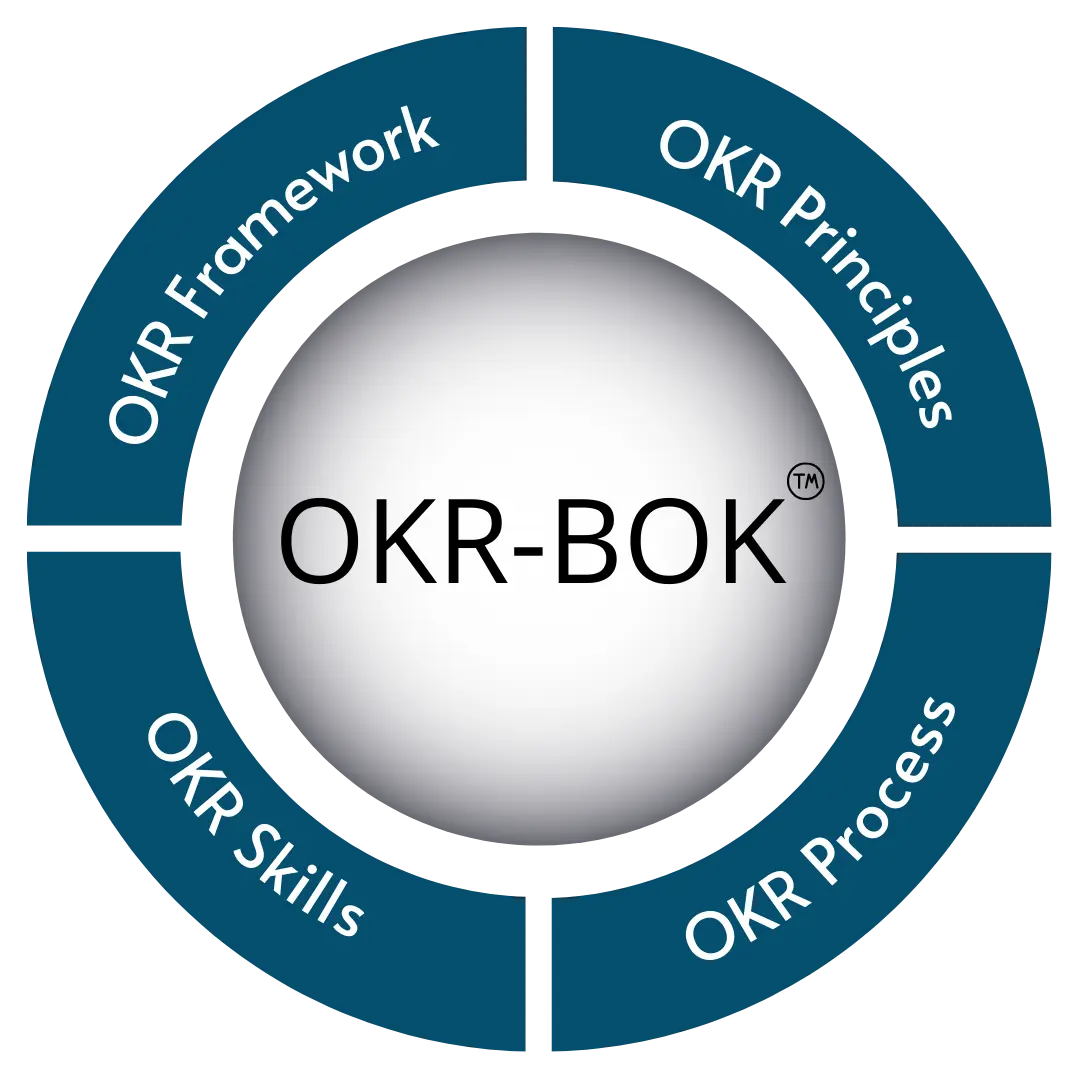
OKR-BOK™ is one of the world’s most comprehensive frameworks for mastering OKRs — defining the Framework, Principles, Process, Skills, and Ethical Guidelines that together set the gold standard of OKR practice.

  • 5Components
  • 3Certification levels
  • 2020Established
Explore the Framework Get OKR-BOK™ Certified
OKR-BOK™ — the OKR Body of Knowledge logo
The OKR Body of Knowledge

OKRs are open-source. Excellence in OKRs is not.

OKR-BOK™ (the OKR Body of Knowledge) is a structured framework, developed by OKR International in 2020, that defines the five components of effective OKR practice: the Framework, the Principles, the Process, the Skills, and the Ethical Guidelines. It is the authoritative reference against which OKR practitioners and coaches are certified, and against which organizations measure the maturity of their own OKR practice.

Created in response to a problem observed across hundreds of organizations — that OKRs had become one of the world’s most widely adopted goal-setting frameworks and one of the most widely misunderstood — the OKR-BOK™ codifies OKR practice into a single standard: 4 framework stages (Focus, Align, Track, Build), 9 principles, a 7-stage process, 12 skills, and 20 ethical standards. Refined across more than 30 industries, the OKR Body of Knowledge gives practitioners the clarity, credibility, and capability to drive strategic alignment and execution excellence.

✓ What OKR-BOK™ is

  • A structured synthesis refined across hundreds of organizations
  • A centralized OKR knowledge repository of best practices
  • A living body of knowledge, stewarded and evolving
  • Compatible with every OKR software platform

✕ What it is not

  • Not a software product — dependent on none
  • Not a rebranding of any single author’s method
  • Not a static reference frozen in time
  • Not a constraint on the open-source adaptability of OKRs
Why the OKR Body of Knowledge Matters

A popular discipline, imprecisely practised

OKRs travelled from Intel to Google to the global mainstream — but in that journey, the rigour that made them effective was often lost. The symptoms are consistent and recognisable, and they are exactly what the OKR-BOK™ was built to correct.

Most failed OKR initiatives did not fail because OKRs were tried and found wanting. They failed because OKRs were found difficult and never truly tried.

Key Results as task lists

Activity dressed as achievement — outputs written where outcomes belong.

Business-as-usual as ambition

Objectives that restate the everyday in aspirational language.

Cascade by decree

OKRs pushed down mechanically rather than aligned through dialogue.

Mature disciplines codify. The OKR-BOK™ codifies the practice of Objectives and Key Results not to end the adaptability that makes OKRs valuable, but to give that adaptability a stable foundation — the difference between OKRs as a craft, dependent on individual masters, and OKRs as a discipline.

The Five Components of OKR-BOK™

One architecture. Five components.

The OKR-BOK™ is built on five critical components. Each addresses a distinct question of practice; together they cover the complete intellectual territory of the OKR Body of Knowledge.

1 FRAMEWORK The structure Focus · Align · Track · Build 2 PRINCIPLES The standards 9 principles 3 PROCESS The lifecycle 7 stages 4 SKILLS The competencies 12 skills 5 ETHICS The conduct Guidelines STRUCTURE INTEGRITY

The five components of the OKR-BOK™ follow a deliberate order. The Framework establishes the structure; the Principles articulate the standards that fill it with well-formed OKRs; the Process describes the lifecycle; the Skills define the human competencies that make the Process work; and the Ethical Guidelines establish the moral floor of the discipline.

Component 1 of OKR-BOK™

The OKR Framework — Focus · Align · Track · Build

The first component of the OKR-BOK™ is the structural blueprint for setting and achieving organizational goals. It translates strategic vision into measurable Objectives and Key Results through four sequential stages that form the operating spine of OKR practice.
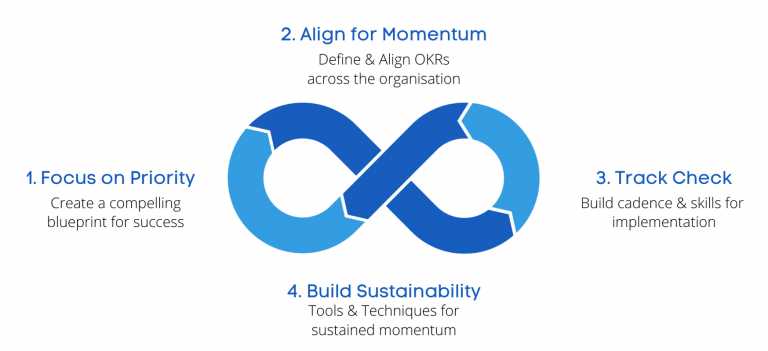
The OKR-BOK™ OKR Framework — Focus, Align, Track, Build
The OKR-BOK™ Framework — the four-stage operating spine of OKR practice.
1
Concentration

Focus on Priority

Identifying and defining the organization’s key priorities, aligned with vision, mission, and values. An organization which has not chosen what to deprioritize has not truly chosen its priorities.

2
Coherence

Align for Momentum

Establishing transparent systems that ensure vertical and horizontal alignment. When an organization is aligned, energy compounds rather than dissipates.

3
Accountability

Track Check

Reviewing progress and holding teams accountable through regular check-ins. The check-in — not the planning session — is where OKR practice succeeds or fails.

4
Sustainability

Build Sustainability

Establishing guides, templates, champion roles, and continuous support. Sustainability distinguishes an OKR initiative from an enduring OKR capability.

Component 2 of OKR-BOK™

The Nine OKR Principles

The second component of the OKR-BOK™ is the rules of engagement for crafting and managing OKRs — the standards, syntax, and best practices that prevent ambiguity and promote a common understanding across every team and department.

Principle 1

The DNA of OKRs

Objectives, Key Results, and Initiatives — the genetic foundation of all sound OKR practice.

Principle 2

OKR Standards

The quality bar: inspiring Objectives, and Key Results that are achievable, measurable, and outcome-oriented.

Principle 3

OKR Syntax

The grammar of the discipline — clear, consistent language so an OKR in one team is intelligible to every other.

Principle 4

Setting Guidelines

Best practices for crafting OKRs, balancing competing priorities, and ensuring alignment at every level.

Principle 5

Ambition & Stretch

Bold, aspirational Objectives that push beyond comfort zones while remaining grounded in reality.

Principle 6

Transparency & Alignment

Transparency is a structural requirement, not a courtesy. OKRs that are hidden cannot align.

Principle 7

Iterative Learning

Regular review and refinement — each cycle is an opportunity to learn, not merely to score.

Principle 8

Outcome Focus

The shift from output to outcome — the principle most often violated and most consequential to honour.

Principle 9

Cultural Fit

OKRs must align with the organization’s values and culture to be practical and sustainable in context.

The Critical Distinction

Outcomes, not outputs

No distinction is more important to the OKR-BOK™. An output is something an organization produces; an outcome is the change that production creates. The single most common failure in OKR practice is writing Key Results as outputs — activity dressed as achievement.

Output — activity
“Launch three marketing campaigns”
→
Outcome — change
“Increase qualified leads by forty percent”
Component 3 of OKR-BOK™

The Seven-Stage OKR Lifecycle

The third component of the OKR-BOK™ is a systematic approach to planning, implementing, and reviewing OKRs. The seven stages are not a one-time sequence but a recurring lifecycle — each turn sharper than the last.

1

Planning

Defining Objectives and setting Key Results aligned with strategic vision.

2

Implementation

Putting OKRs into action with proper communication and execution.

3

Review

Review cycles and feedback that measure progress and celebrate wins.

4

Communication & Cascade

Communicating OKRs from leadership to teams with line-of-sight preserved.

5

Monitoring & Measurement

Metrics, dashboards, and tracking systems that reinforce accountability.

6

Governance & Accountability

Clear roles and accountability frameworks supporting OKR ownership.

7

Continuous Learning

Feedback loops that feed the insights of one cycle into the next.

⚠️

Where the OKR Process most often breaks

Across hundreds of implementations, the OKR-BOK™ Process breaks most often at three points: at Planning, when Objectives are set without genuine prioritisation; at Review, when check-ins are skipped or reduced to status reporting; and at Continuous Learning, when the close of a cycle produces scores but no insight.

Component 4 of OKR-BOK™

Twelve OKR Skills — the bloodline of practice

The fourth component of the OKR-BOK™ is the set of competencies that form the crux of every OKR conversation. They empower practitioners to drive alignment and adapt the methodology to an organization’s unique needs — including the two signature OKR International competencies.

01Change Management
02Strategic Alignment & Facilitation
03Data-Driven Decision-Making
04Conflict Resolution & Negotiation
05Establishing Client Agreement
06Building Trust
07Growth Facilitator
08Appreciative Listening™Signature skill — listening beyond words to intent★
09Maintaining Presence
10Catalytic Questioning™Signature skill — questions that unlock insight★
11Being an OKR Coach
12Feedback & Feedforward
Component 5 of OKR-BOK™

The OKR-BOK™ Ethical Guidelines

The fifth component of the OKR-BOK™ sets the standard for behavior and professional conduct in all OKR-related activities. Every OKR-BOK™ certificant commits to these Guidelines as a condition of certification — building trust, ensuring transparency, and creating a respectful, safe environment for all stakeholders.

Ethical Conduct & Professional Integrity 20 standards

  • Ensure clients and sponsors are fully informed about the nature, use, benefits, and limitations of OKRs.
  • Create a formal agreement before starting services, outlining roles, responsibilities, rights, and expectations.
  • Maintain strict confidentiality in accordance with data protection laws and agreed terms.
  • Clarify how information will be exchanged, including scenarios where confidentiality cannot be maintained.
  • Securely manage, store, and dispose of all physical and digital data.
  • Stay informed about emerging technologies and ensure their ethical application.
  • Respect the right of any party to terminate the engagement at any time.
  • Recognise and manage power or status differences arising from contextual dynamics.
  • Provide consistent quality of service irrespective of compensation received.
  • Adhere to the OKR-BOK™ Ethical Guidelines, addressing breaches through respectful dialogue and escalation.
  • Ensure all support personnel adhere to the OKR-BOK™ Ethical Guidelines.
  • Commit to continuous personal, professional, and ethical development.
  • Acknowledge and act on personal limitations that may affect performance.
  • Resolve conflicts of interest by working transparently with all parties.
  • Accurately represent OKR qualifications, competency, experience, and credentials.
  • Make only truthful and accurate statements about services offered.
  • Communicate ethical standards clearly and raise awareness of responsibilities.
  • Maintain professional boundaries, avoiding any sexual or romantic relationships with clients.
  • Uphold fairness and equality, avoiding all forms of discrimination.
  • Honour the intellectual property of others, respecting copyright and licensing.

Professional Responsibilities 8 duties

  • Ensure all parties understand the nature and application of OKRs, including benefits, limitations, and terms.
  • Establish a formal agreement before commencement, defining roles, responsibilities, and rights.
  • Maintain the highest standards of confidentiality, in full compliance with applicable laws.
  • Clearly define how information will be shared, including where confidentiality may be limited.
  • Manage, store, and dispose of all data securely, ensuring ethical use of technological tools.
  • Respect the right of any party to terminate the relationship at any time.
  • Remain conscious of and actively manage power or status imbalances.
  • Deliver consistent quality regardless of the form or amount of compensation.
From the OKR Body of Knowledge to the Credential

The OKR-BOK™ Certification Ladder

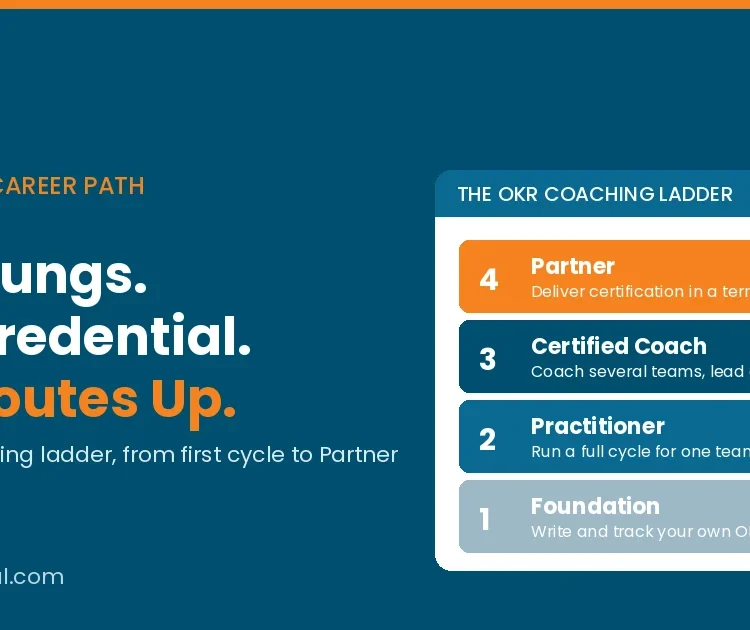
The OKR-BOK™ is delivered through a progressive certification ladder. Each level builds on the last — escalating from foundational fluency to coaching mastery.

Level 1 · Understand

OKR Foundation Course

For anyone beginning

Individual contributors, managers, and teams new to the framework. Builds foundational fluency in the OKR-BOK™ framework, principles, and vocabulary.

Learn more
Level 2 · Apply

OKR-BOK™ Certified Practitioner

For those implementing

Managers, team leads, and internal OKR champions. Builds applied capability to set, cascade, and run OKRs across teams and functions.

Learn more
Level 3 · Master

OKR-BOK™ Certified Coach

ICF & HRCI accredited
For those who coach others

Internal and external coaches, consultants, and senior leaders. Builds coaching mastery, including the signature skills of Appreciative Listening™ and Catalytic Questioning™.

Learn more

The OKR-BOK™ ladder mirrors the cognitive progression of any mature discipline: the Foundation Course builds understanding, the Certified Practitioner builds application, and the Certified Coach builds mastery — the capability to develop the OKR competence of others.

One Intellectual Estate

Two Bodies of Knowledge. One architecture.

The five-component architecture of the OKR-BOK™ is the structural foundation of the entire Performance Body of Knowledge™ family. KPI-BOK™, the sister discipline of performance measurement, adopts the identical architecture.

OKRs answer: what are we committing to achieve this cycle? KPIs answer: how is the organization performing on its enduring priorities? OKRs are the destination; KPIs are the dials. Mature organizations operate both.

If the question is…Use
What ambitious outcome are we committing to this quarter?OKR
How are we performing on this enduring priority?KPI
What stretch goal must we mobilise around now?OKR
What ongoing measure tells us we sustain excellence?KPI
Both — focused acceleration and sustained measurementBoth
Performance Body of Knowledge™ One family · one architecture OKR-BOK™ Ambitious, time-bound goals KPI-BOK™ Ongoing performance measurement Micro-OKRs™ Individual & team execution cadence Sister discipline
Nikhil Maini — creator of the OKR-BOK™, the OKR Body of Knowledge
Authored by the Creator of OKR-BOK™

Nikhil Maini

Founder & CEO of OKR International and creator of the OKR-BOK™ (2020), Micro-OKRs™, and KPI-BOK™.

He has worked with organizations across more than thirty industries — from Fortune 500 enterprises to high-growth startups, sovereign entities to family businesses — helping them translate strategy into measurable results. As creator and steward of the OKR Body of Knowledge, OKR International maintains the integrity of the OKR-BOK™, certifies practitioners and coaches against it, and evolves it in response to practitioner experience.

30+ industries · 45+ functions Based in Dubai, UAE

“OKRs are not a reporting tool. They are a discipline of focus, alignment, and honest conversation about what matters most.”
Build your OKR capability on the gold standard

Certify your people on the OKR-BOK™, license the OKR Body of Knowledge, or explore becoming a partner — talk to OKR International about bringing the gold standard of OKR practice to your organization.

Contact Us Licensing & Partnerships

OKR-BOK™, the OKR Body of Knowledge™, Micro-OKRs™, and KPI-BOK™ are trademarks of OKR International. Grounded in the OKR-BOK™ Constitutional Document v1.0.
© 2026 OKR International Management Consultancies Co. LLC. · okrinternational.com

Frequently Asked Questions

OKR-BOK™ — Common Questions

Answers to the questions most often asked about the OKR Body of Knowledge, its components, and certification.

What is the OKR Body of Knowledge (OKR-BOK™)?

The OKR-BOK™ (OKR Body of Knowledge) is a structured framework developed by OKR International in 2020 that defines the gold standard for the practice of Objectives and Key Results. It is organised around five components — the Framework, the Principles, the Process, the Skills, and the Ethical Guidelines — and serves as the authoritative reference against which OKR practitioners and coaches are certified, and against which organizations measure the maturity of their own OKR practice.

What are the five components of OKR-BOK™?

The OKR-BOK™ is built on five components, each answering a distinct question of practice: the OKR Framework (the structural blueprint — Focus, Align, Track, Build), the OKR Principles (nine rules of engagement for well-formed OKRs), the OKR Process (a seven-stage lifecycle from planning to continuous learning), the OKR Skills (twelve competencies at the crux of OKR conversations), and the Ethical Guidelines (twenty standards of professional conduct). Together they cover the complete intellectual territory of OKR work.

What is the difference between an outcome and an output in OKRs?

An output is something an organization produces; an outcome is the change that production creates. For example, “launch three marketing campaigns” is an output, while “increase qualified leads by forty percent” is an outcome. The OKR-BOK™ holds that the single most common failure in OKR practice is writing Key Results as outputs — activity dressed as achievement — rather than as measurable outcomes.

Who created OKR-BOK™ and who maintains it?

The OKR-BOK™ was created in 2020 by Nikhil Maini, Founder and CEO of OKR International and creator of Micro-OKRs™ and KPI-BOK™. OKR International is the steward of the OKR Body of Knowledge — maintaining its integrity, certifying practitioners and coaches against it, and evolving it in response to practitioner experience. It is formally codified in the OKR-BOK™ Constitutional Document (Version 1.0).

How do you get OKR-BOK™ certified?

OKR International offers a progressive, three-level certification ladder built on the OKR-BOK™: the OKR Foundation Course (foundational fluency for anyone beginning), the OKR-BOK™ Certified Practitioner (applied capability to set, cascade, and run OKRs), and the OKR-BOK™ Certified Coach (coaching mastery, accredited by the ICF and HRCI). Each level builds on the last, escalating from understanding to application to mastery.

How is OKR-BOK™ different from KPI-BOK™?

OKR-BOK™ and KPI-BOK™ share the same five-component architecture and together form the Performance Body of Knowledge™ family. They answer different questions: OKRs answer “what ambitious outcome are we committing to achieve this cycle?” while KPIs answer “how is the organization performing on its enduring priorities?” In short, OKRs are the destination and KPIs are the dials — mature organizations operate both.

Insights & Innovations

Learn From Our Blogs

Heirloom OKRs — how to spot, avoid and fix the never-retired OKR trap, by OKR International.
OKR - How To Series

Heirloom OKRs: How to Spot, Avoid and Fix the Never-Retired OKR Trap

Heirloom OKRs roll forward forever on sentiment. Learn to spot, avoid and fix stale, recycled

Read More »
Trojan OKRs — how to spot, avoid and fix the backlog-in-disguise OKR trap, by OKR International.
OKR - How To Series

Trojan OKRs: How to Spot, Avoid and Fix the Backlog-in-Disguise OKR Trap

Trojan OKRs hide last quarter’s backlog as strategy. Learn to spot, avoid and fix reverse-engineered

Read More »
Karaoke OKRs — how to spot, avoid and fix the no-ownership OKR trap, by OKR International.
OKR - How To Series

Karaoke OKRs: How to Spot, Avoid and Fix the No-Ownership OKR Trap

Karaoke OKRs are recited, not owned. Learn to spot, avoid and fix top-down, unowned OKRs

Read More »
Load More
OKR International Logo - 2026

We are driven by our purpose to help you become more agile, more collaborative and more successful.

Courses

  • OKR-BOK™ Certified Coach
  • OKR-BOK™ Certified Practitioner
  • OKR Foundation Course

OKR Services

  • Implement OKRs
  • OKR Coaching
  • OKR Advisory
  • OKRs for VCs
  • Keynote Speaker
  • Transformation Services
  • Agile Performance Management

Resources

  • What are OKRs?
  • OKR Blog
  • OKR-BOK™
  • OKR Examples
  • OKR FAQs
  • OKR Glossary
  • OKR Software
  • OKRs Library

Useful Links

  • Terms and Conditions
  • Privacy Policy
  • Cookies Policy
  • Become a Partner
Copyright 2026 © All Rights Reserved | OKR International Management Consultancies Co. LLC.
Sign In
The password must have a minimum of 8 characters of numbers and letters, contain at least 1 capital letter
I want to sign up as instructor
Remember me
Sign In Sign Up
Restore password
Send reset link
Password reset link sent to your email Close
Your application is sent We'll send you an email as soon as your application is approved. Go to Profile
No account? Sign Up Sign In
Lost Password?
OKR International Logo - 2026OKR International
Sign inSign up

Sign in

Don’t have an account? Sign up
Lost your password?

Sign up

Already have an account? Sign in