Key takeaways: the OKR coach career path
- Fewer than 15 percent of teams say OKRs deliver noticeable performance gains (Mind the Product and NEO Culture survey). The gap between adopting OKRs and benefiting from them is where coaches earn their living.
- Coaching has passed 100,000 practitioners worldwide, up 54 percent since 2019 (ICF, 2023). The title is common; the credential is rare.
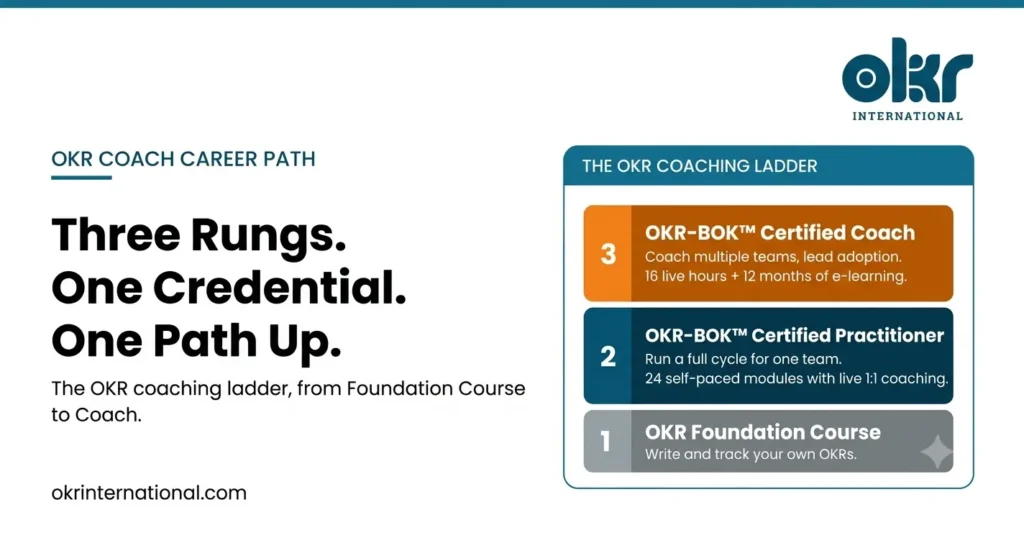
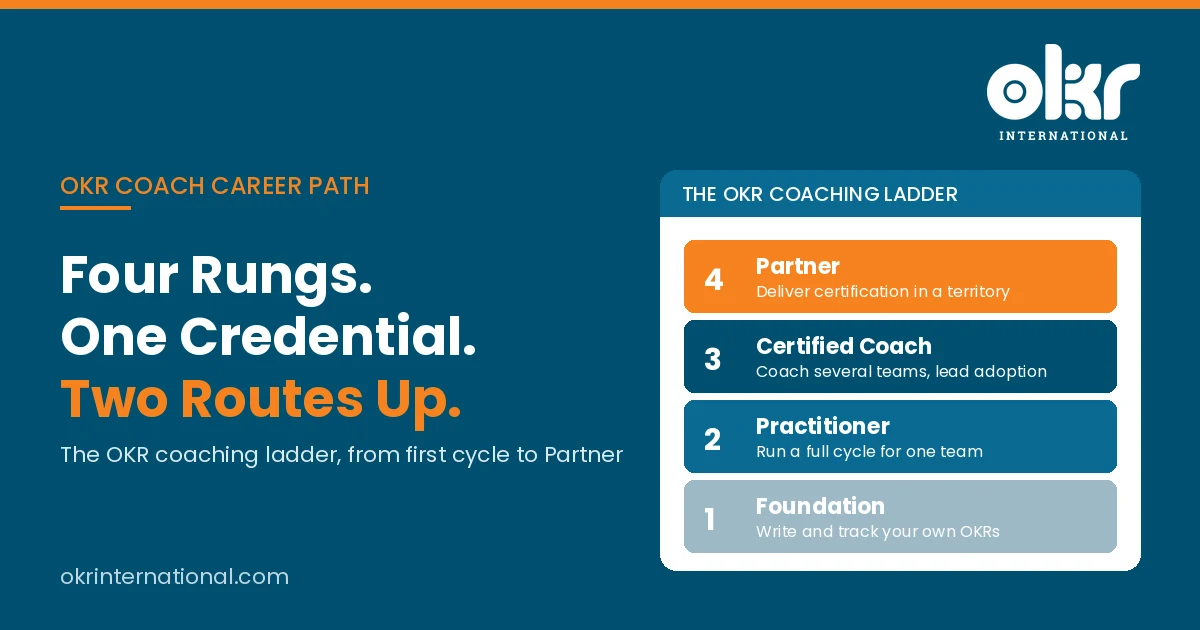
- The OKR coaching ladder has four rungs: Foundation, Certified Practitioner, Certified Coach, Partner. Each rung unlocks a different kind of work.
- Competencies, not years, decide OKR coach progression. The OKR-BOK™ sets them out in four domains.
- The path forks at rung three: build an internal coaching function, or build an OKR coaching business. Both start with the same credential.
The OKR coach career path is new. Nobody hands you a map. Ten years ago the role did not exist outside a handful of technology firms. Today HR leaders, consultants and transformation heads ask us the same questions. What are the OKR coach levels, and which one am I at? Which OKR coach competencies matter at each level? Can I build an OKR coaching business on this, or is it an internal role? And what does OKR coach progression look like over three to five years? This guide answers all four. It draws on the OKR-BOK™, the OKR Body of Knowledge we have taught since 2017. It also draws on 500+ implementations across 30+ countries. We wrote it for people who have decided to coach OKRs and want to know what comes next.
Why an OKR coach career path exists now
Two numbers explain the demand. The first is the adoption gap. Mind the Product and NEO Culture surveyed product teams using OKRs. Fewer than 15 percent said OKRs delivered noticeable performance improvements. They had the framework. They did not have anyone who could make it work past the first cycle.
The second number is supply. The 2023 ICF Global Coaching Study counted more than 100,000 coach practitioners worldwide, up 54 percent since 2019. Asia grew by 86 percent and the Middle East and Africa by 74 percent. Coaching as a profession is booming. OKR coaching as a specialism inside it is still small, and that is the opportunity.
Put the two together and you get the shape of the OKR coach career path. Organisations have adopted a method that fails without coaching. Coaches are plentiful, but coaches who understand the method are rare. The gap closes one credentialed person at a time, through an internal function or an OKR coaching business.
The OKR coaching ladder: four OKR coach levels
We call the progression the OKR coaching ladder. It has four rungs, and each one unlocks a different kind of work. The OKR coach levels below map to the OKR-BOK™ programmes. You can see where you stand today.
| Rung | Programme | Who it is for | What it lets you do | Format |
|---|---|---|---|---|
| 1. Foundation | OKR Foundation Course | Anyone new to OKRs | Write and track OKRs for yourself; speak the language | 11 self-paced modules |
| 2. Practitioner | OKR-BOK™ Certified Practitioner | Managers and team members applying OKRs in their own work | Run a full cycle for one team; act as an OKR champion | 24 self-paced modules, from $499 |
| 3. Certified Coach | OKR-BOK™ Certified Coach | People who will coach leaders and teams, inside or outside an organisation | Coach several teams; diagnose stalled programmes; lead adoption | 16 hours live over two days, plus 12 months e-learning |
| 4. Partner | OKR International Partner Program | Certified Coaches and firms delivering certification in a territory | Deliver OKR-BOK™ programmes, build a practice, sub-license | Associate, Certified or Master Partner tiers |
Two things stand out. First, the OKR coach levels are cumulative. Every Partner is a Certified Coach, and every effective Certified Coach has run a cycle as a Practitioner. Second, rung three is the pivot. Below it you apply OKRs. From it onwards you coach others, and the OKR coach career path forks. OKR coach progression is cumulative: nobody skips a rung for long.
The OKR coach competencies at each rung
Years of experience do not move you up the OKR coaching ladder. OKR coach competencies do. The OKR-BOK™ groups them into four domains, and each rung adds depth in all four:
- Framework. Objectives that matter, the six types of key result, the link to strategy and KPIs. A Practitioner can write them. A Certified Coach can tell in one conversation why a key result will not survive the quarter.
- Principles. Focus, alignment, transparency and stretch, and the separation of OKRs from appraisal and pay. A coach holds these principles when a leadership team wants to bend them.
- Processes. Cycle planning, check-ins, reviews, scoring and retrospectives, plus S.A.F.E.™ diagnostics for programmes in trouble. Rung two runs the process; rung three repairs it.
- Skills. Catalytic Questioning™, Appreciative Listening™, feedback, psychological safety and workshop facilitation. These OKR coach competencies separate a coach from a project manager with a template.
The full breakdown of the Skills domain is in our article on how to become an OKR coach, which covers the five OKR coaching skills in detail. This article focuses on what happens once you have them.
A five-stage OKR coach career path
Here is the sequence we see most often among the coaches we certify, stage by OKR coach level. The stages hold across India, the UAE, Europe and North America. The timelines vary.
- Apply OKRs to your own work (months 0–6). Take the Foundation Course or go straight to the Certified Practitioner. Run one full quarterly cycle for a team you lead or belong to. You cannot coach the check-in you have never sat through.
- Become the champion for one team (months 3–12). Own the cadence for a team that is not your own. Keep the calendar, run the scoring, write the retrospective. This is where you discover that process competency is necessary and not sufficient.
- Earn the Certified Coach credential (one cohort, two days). The OKR coach certification is the licence to coach other people’s OKRs. It tests the competencies above in live role-plays. It is the only one endorsed by both the ICF and HRCI, and the credential is for life. The next live cohort runs on 27–28 November 2026.
- Scale beyond one team (year one as a coach). Inside an organisation, that means coaching several business units and training a second champion in each. Outside, it means a first paying client beyond your own employer. The OKR coach career path forks here and we cover both routes below.
- Multiply through others (years two to five). Internal coaches build a coaching function and certify their champions as Practitioners. External coaches join the Partner Program and deliver certification in their territory. At this rung your output is other coaches, not just coached teams.
Internal function or OKR coaching business: the fork at rung three
The OKR coach career path splits once you hold the Certified Coach credential. They reward different things.
The internal route. You stay inside one organisation and build OKR coaching into a function. It usually sits in HR, OD, strategy or a transformation office. The measure of success is independence: the organisation no longer needs external consultants to keep OKRs alive. Internal coaches typically certify five to ten Practitioners in year one and use the OKR-BOK™ as the shared competency standard. The ceiling is scope. The OKR coach progression inside a firm runs from one business unit to the group, then to the board’s planning cycle.
The OKR coaching business route. You coach several organisations as an independent or as part of a consultancy. The measure of success is a repeatable offer: a diagnostic, an implementation sprint and a coaching retainer. Our OKR coaching services page shows how we structure that offer at OKR International. The ceiling is capacity. The Partner Program is how an OKR coaching business breaks through it: you deliver certification, not only coaching hours.
A practical note for the OKR coaching business route. Do not position yourself on “AI writes your OKRs”. Tools can draft OKRs in seconds; they cannot run the retrospective. Position on the human standard and the coaching, which is where organisations still pay.
A worked example: three years on the ladder
Take a simplified example drawn from several coaches we have certified. Priya is an HR business partner in Bengaluru. Her firm adopts OKRs in January; she takes the Certified Practitioner and runs the cycle for her own HR team. In the second quarter she becomes the champion for the sales team. There she learns that a cancelled check-in predicts a missed key result better than any dashboard.
In November she joins the Certified Coach cohort. By the following March she is the internal OKR coach for four business units and has certified six Practitioners. Her firm stops using an external consultant. Eighteen months after her first OKR, the CEO asks her to coach the leadership team’s annual planning.
In year three she chooses the second branch. She leaves to start an OKR coaching business with two clients already signed. She joins the Partner Program as an Associate Partner and delivers Foundation and Practitioner programmes in Karnataka. That is one OKR coach career path, and her OKR coach progression took three years. Others stay inside and run the function for a decade. Both began with a single quarterly cycle.
How long OKR coach progression takes
People want a number, so here is the range we see. Competencies set the pace, not the calendar. Foundation to Practitioner takes one quarter, because you need a full cycle to learn anything. Practitioner to Certified Coach takes six to twelve months, mostly waiting for a second cycle and a cohort date. Certified Coach to internal function lead or first external client takes a year. Certified Coach to Partner takes a further year of delivery.
So the realistic OKR coach progression from first OKR to running a practice or a function is two to three years. Slower is common for people who skip stage two and try to coach a cycle they have never run.
Two shortcuts work. Certify a cohort of colleagues together, so the internal function exists on day one. And use Micro-OKRs™ to practise the cadence weekly rather than quarterly; four short cycles teach more than one long one.
Five mistakes that stall OKR coach progression
We see the same five competency gaps in coaches whose OKR coach progression stalls.
- Collecting courses instead of cycles. Three certificates and no retrospectives is not a career path. Every OKR coach level needs a cycle behind it.
- Staying the champion forever. Champions keep the calendar. Coaches keep the quality. If you never move from admin to conversations, you stay at rung two.
- Coaching without a diagnostic. Every stalled programme gets the same fix. Use S.A.F.E.™ before you prescribe. Our article on why OKRs fail shows how often the cause is not the one leaders name.
- Choosing a credential you cannot verify. Our evidence-based comparison of OKR certifications shows which carry external accreditation. Pick the one a CFO can check.
- Building an OKR coaching business on templates. Templates are free. Clients pay for the conversations OKRs force and for a coach who can hold them.
Frequently asked questions
It is the progression from applying OKRs in your own work to coaching others and, eventually, multiplying through other coaches. On the OKR coaching ladder it runs Foundation, Certified Practitioner, Certified Coach, then Partner. Most people reach a practice or an internal function within two to three years.
Four. Foundation (write and track your own OKRs), Certified Practitioner (run a full cycle for one team), Certified Coach (coach several teams and lead adoption) and Partner (deliver OKR-BOK™ certification in a territory). Each level is cumulative and maps to an OKR International programme.
The OKR-BOK™ groups them into four domains: Framework (writing objectives and key results), Principles (focus, alignment, stretch, separation from pay), Processes (the cadence and S.A.F.E.™ diagnostics) and Skills (Catalytic Questioning™, Appreciative Listening™, feedback and facilitation).
Yes. The usual route is Certified Coach, then a repeatable offer of diagnostic, implementation sprint and coaching retainer, then the OKR International Partner Program to deliver certification in your territory. Partners keep 100 percent of their consulting and coaching revenue.
Foundation to Practitioner takes about one quarter. Practitioner to Certified Coach takes six to twelve months. Certified Coach to leading an internal function or landing a first external client takes about a year. Two to three years from first OKR to running a practice is typical.
Start where you are on the ladder
The OKR coach career path has one rule. OKR coach progression starts from where you stand, not from where you wish you were. New to OKRs? Start with the Foundation Course. Running OKRs for your own team? The Certified Practitioner is self-paced and starts today. Ready to coach others? The next Certified Coach cohort runs live online on 27–28 November 2026, with another on 17–18 December. All dates are on our certification dates page. Already certified and ready to build an OKR coaching business? Request the Partner prospectus, or write to info@okrinternational.com.
One question to settle before you choose a rung: in the last twelve months, how many full OKR cycles have you actually run?