Key takeaways: how to become an OKR coach
- Most strategies deliver only 63 percent of the financial value they promise (Mankins and Steele, Harvard Business Review). OKRs exist to close that gap, and someone has to keep them honest.
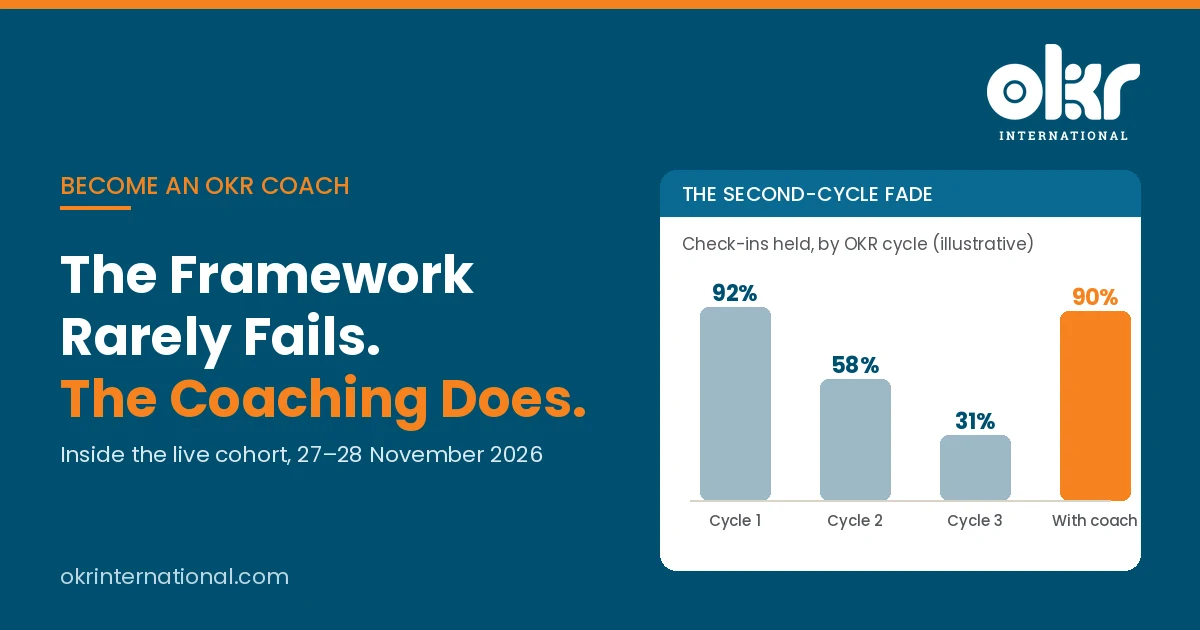
- OKR programmes rarely fail at launch. They fade in cycle two or three. We call this the second-cycle fade.
- Coaching has passed 100,000 practitioners worldwide (ICF, 2023). Organisations now expect a verifiable standard behind the title.
- To become an OKR coach you need five things: a body of knowledge, practice, a diagnostic method, a cadence and a verifiable credential.
- The next Certified Coach cohort runs live online on 27–28 November 2026. It is the only OKR certification endorsed by both the ICF and HRCI.
People who want to become an OKR coach usually ask the same first question: what does an OKR coach do that a manager with a template cannot? The short answer: they keep the system alive after the launch excitement fades. The longer answer involves three things. A specific set of OKR coaching skills. A clear view of the OKR coach vs OKR consultant question. And a decision about whether you will work as an internal OKR coach inside one organisation or across many. This guide covers all of them. It draws on 500+ implementations across 30+ countries and on the two live days of the Certified Coach programme. The next cohort runs on 27–28 November 2026. If you plan to join it, read this first.
Why organisations want an internal OKR coach, not another template
OKR templates are free. What organisations lack is someone who can hold the conversations OKRs force, cycle after cycle.
Michael Mankins and Richard Steele found that most companies realise only 63 percent of the financial value their strategies promise. Their 2005 Harvard Business Review research still shapes how boards think. OKRs exist to close that 37 percent gap. They only do so when someone keeps the system honest.
The market has noticed. The 2023 ICF Global Coaching Study counted more than 100,000 coach practitioners worldwide, up 54 percent since 2019. Asia grew by 86 percent and the Middle East and Africa by 74 percent. More people become an OKR coach every year, so organisations ask harder questions about the standard behind the title. A credential people can verify answers those questions before anyone asks them.
This is why leadership teams increasingly certify their own OKR champions rather than rent help indefinitely. An internal OKR coach makes the organisation independent of consultants, including us.
The second-cycle fade: where OKR programmes really lose
Few OKR rollouts fail in the first quarter. The launch has energy, a sponsor and a deadline. The trouble starts in cycle two or three. Check-ins slip. Key results turn into task lists. Scores become a formality. We call this pattern the second-cycle fade, and it explains most of the cases in our article on why OKRs fail.
The fade has one root cause. Nobody inside can lead the three conversations OKRs force: what we will stop doing, what good looks like, and what we learned when we missed. A manager can run a meeting. A coach runs those conversations. That difference is the whole OKR coach role. It is why OKR coaching skills matter more than OKR writing skills.
The OKR coach role, then, is a prevention role. It is also where the OKR coach vs OKR consultant difference shows: the consultant was gone by cycle two. The coach spots the fade in week six, not in the retrospective. Anyone who wants to become an OKR coach needs to see the early signs. A check-in cancelled twice. A key result nobody can score. An objective that quietly reverts to a department name.
What does an OKR coach do? OKR coach vs OKR consultant vs OKR champion
People mix up the three titles constantly. What does an OKR coach do that the others do not? The table sets out the OKR coach role beside the other two.
| Question | OKR consultant | OKR coach | OKR champion |
|---|---|---|---|
| Main job | Design the system and the rollout | Build ownership through conversations | Run the admin of the cycle |
| Where they sit | Outside the organisation | Inside or outside; internal OKR coaches are the growing group | Inside, usually part-time |
| Typical tenure | One rollout | Every cycle, for years | Every cycle |
| Core skill | Diagnosis and design | OKR coaching skills: questioning, listening, feedback | Tooling and scheduling |
| Measure of success | Launched on time | Teams score honestly and reset ambition each cycle | Everything updated |
| Recognised credential | Varies | Certification endorsed by ICF and HRCI | Often none |
The OKR coach vs OKR consultant question has a simple answer. The consultant leaves; the coach stays. Many Certified Coaches do both; our coaching services page shows how that mix works. Comparing programmes rather than roles? Our evidence-based comparison of the best OKR certification options sets out verifiable facts for each provider.
The coaching skills that separate a coach from a facilitator
Five OKR coaching skills define the role of an OKR coach. Each maps to a module in the OKR-BOK™ and a practice session in the live cohort.
- Catalytic Questioning™. Questions that make a team confront the gap between activity and outcome. “Which of these three key results would the customer notice?”
- Appreciative Listening™. Hearing what the team already does well, so the stretch feels earned rather than imposed.
- Feedback and acknowledgement. Scoring a 0.4 without blame and a 1.0 without suspicion. Psychological safety becomes a skill, not a poster.
- Diagnosis. Using the S.A.F.E.™ Model to decide what to fix first when a programme is in trouble.
- Facilitation. Running the planning workshop, the mid-cycle review and the retrospective. The leadership team makes the decisions, not the coach.
Notice what is missing: writing OKRs for people. Anyone who wants to coach well must unlearn that habit. It creates a dependency, not a capability. The OKR-BOK™ treats these skills as a component in its own right, separate from Framework, Principles and Processes.
How to become an OKR coach in five steps
Here is the sequence we recommend to anyone who wants to become an OKR coach, as an OKR consultant or as an internal OKR coach.
- Learn the body of knowledge, not one book. OKRs have a framework, principles, processes and skills. New to OKRs? Start with the OKR Foundation Course. Already running them? Take the OKR-BOK™ Certified Practitioner first.
- Run at least one full cycle yourself. You cannot coach the second-cycle fade if you have never felt it.
- Build the coaching skills deliberately. Practise the questions, the listening and the feedback on real teams, with a more experienced coach watching. This is what the two live days of the Certified Coach are for: coaching skills, rehearsed.
- Adopt a diagnostic method. Every coach needs a way to tell whether a struggling programme has a Strategy, Alignment, Focus or Execution problem.
- Earn a credential people can verify. The OKR coach certification we run is pre-approved for continuing education by both the ICF and HRCI. No other OKR certification holds both. Whether you work as an OKR coach or OKR consultant, a lifetime credential also removes the renewal fees that tax other programmes.
Inside the two live days: 27–28 November 2026
The next Certified Coach cohort runs live online on Friday 27 and Saturday 28 November 2026. Sessions run 08:00–16:00 CET, which is 12:30–20:30 in India and 11:00–19:00 in the UAE. Here is a simplified outline of the 16 hours.
Day one covers the Framework and Principles components. The morning works through objectives that matter and the six types of key result. The afternoon turns to focus, alignment, transparency and stretch. Cohort practice starts on day one: you write, score and rewrite OKRs for a real case.
Day two covers Processes and Skills. The morning runs the full cycle: planning, check-ins, reviews, scoring and retrospectives, plus S.A.F.E.™ diagnostics for programmes in trouble. The afternoon is the coaching lab. You rehearse the three conversations in live role-plays with feedback from a senior coach.
After the two days you get 12 months of access to 24 e-learning modules, a workbook, templates and checklists. You also join the Global OKR Forum and the coach community. The credential is for life. The fee is USD 1,999. A second cohort runs on 17–18 December 2026; both dates are on our certification dates page.
A worked example: the internal OKR coach who caught the fade
Take a simplified example drawn from several engagements. A 400-person logistics firm in Dubai launched OKRs in January with an external OKR consultant. Quarter one went well. By quarter two the consultant had left. The head of HR, newly certified, became the internal OKR coach.
In week five she saw two signs of the second-cycle fade. The operations team had cancelled its check-in twice. Nobody could score its key result, “Implement the new routing software”. She did not rewrite it. She asked one catalytic question at the next check-in. “If the software works perfectly, what number changes for the customer?” The team rewrote the key result as “Reduce late deliveries from 8 percent to 3 percent”. The check-in went back into the diary.
That is what an OKR coach does. One question from someone inside the business turned an output into an outcome and restarted the cadence. A good OKR implementation leaves exactly this capability behind.
Who owns what: sponsor, coach and champion
OKR coach responsibilities only work inside a clear division of roles. Three roles keep the system honest:
- The executive sponsor owns the objectives and the stop list. Only the sponsor can say that a favourite project is ending. Our guide to OKRs and budgeting shows why that stop list matters for funding.
- The coach owns the conversations. The coach coaches planning, check-ins, reviews and retrospectives rather than chairing them.
- The OKR champion owns the rhythm. The champion keeps the calendar; the coach keeps the quality.
When one person holds all three roles, the coaching skills go first. That is why organisations send a second person to become an OKR coach rather than overloading the champion.
Five mistakes new coaches make
Most people who become an OKR coach make at least one of these in their first year.
- Writing the OKRs for the team. It feels helpful. It removes ownership. What an OKR coach does instead is ask.
- Coaching the document, not the conversation. A perfectly formatted OKR that nobody believes in is still a failed OKR.
- Treating a 0.7 as a problem. A coach who punishes honest scores gets dishonest ones next quarter. See our piece on sandbagging OKRs.
- Skipping diagnosis. Every programme in trouble gets the same fix. Use a method such as S.A.F.E.™ before prescribing anything.
- Confusing the OKR coach vs OKR consultant roles. Designing the system and coaching the people are different jobs. Know which one you are doing today.
Each mistake comes from the same place. The knowledge is there; the OKR coaching skills are not yet. The two live days close that gap before it costs a client.
Frequently asked questions
Join the 27–28 November cohort
Most 2027 planning calendars lock within the next eight weeks. Organisations that want an internal OKR coach in place before the January cycle need to certify that person now. The Certified Coach programme gives them a shared standard and the OKR coaching skills to apply it. Both the ICF and HRCI endorse the credential.
The 27–28 November 2026 cohort runs live online, for coaches and OKR consultants alike. Ready to become an OKR coach? Enrol through the Certified Coach page, or write to info@okrinternational.com about a private cohort for your team. Prefer to apply OKRs in your own work first? The Certified Practitioner is self-paced and starts whenever you do.
One question for your next planning meeting. When your OKRs start to fade in cycle two, who inside the organisation will notice first?