
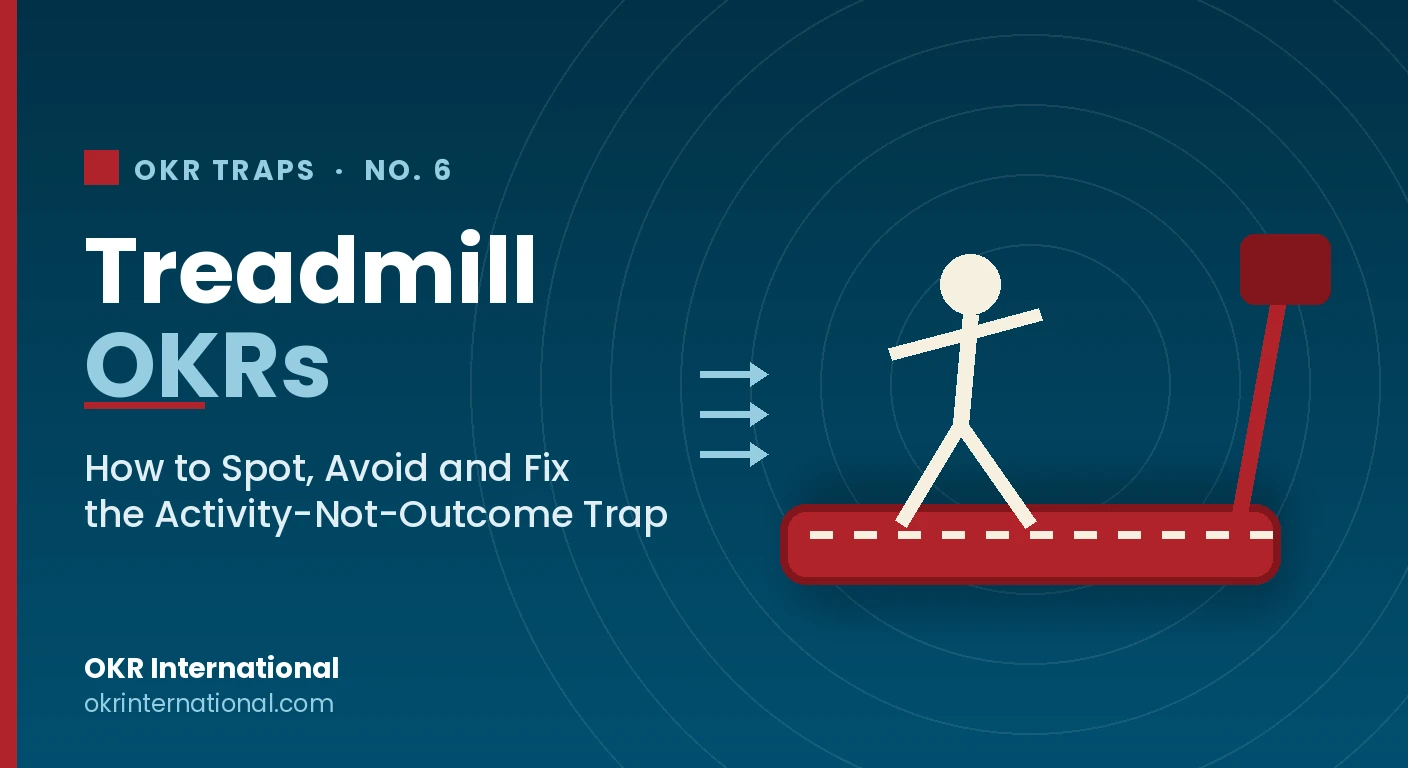
Treadmill OKRs: How to Spot, Avoid and Fix the Activity-Not-Outcome OKR Trap
Treadmill OKRs are the most exhausting of all the OKR traps: maximum effort, zero distance. The team runs hard all quarter, ticks off everything, and the business is exactly where it started. They are the classic case of activity vs outcomes confusion, where the output vs outcome distinction has collapsed and Key Results measure what the team did rather than what changed. The board fills with input-based key results — sessions run, decks shipped, meetings held — while the real OKR outcomes never move. Crucially, the qualitative Objective is usually right; the failure is Key Results that count effort instead of effect. Drawing on two decades of OKR training, coaching, and implementation work by OKR International, this guide shows you how to recognise Treadmill OKRs, the real cost they impose, how to avoid them at the writing stage, and how to recover if your team is already running on the spot.
What are Treadmill OKRs?
Treadmill OKRs are Objective and Key Result sets whose Key Results measure activity rather than results. “Deliver 20 training sessions” feels productive, but it says nothing about whether anyone learned, changed, or performed better.
The defining feature is activity vs outcomes inversion: the team is rewarded for motion, not movement. When input-based key results dominate, a full checklist masks a flat metric, and the output vs outcome line disappears entirely. For the wider catalogue of failure modes, see the 10 OKR Traps diagnostic atlas, and the closely related overload described in our guide to Pomegranate OKRs.
The OKR-BOK™ principle: outcomes over outputs
Fixing Treadmill OKRs rests on the central shift in the OKR-BOK™ framework: a Key Result names a change in the world, not a task the team performs. Outputs (things you produce) and activities (things you do) are Initiatives; only OKR outcomes — a moved metric — belong on the Key Result line.
The cure is not to stop doing the work; the work stays as Initiatives. The cure is to ask, for every input-based key result, “so that what changes?” and put that change on the board instead. Getting the output vs outcome boundary right, with the six types of Key Results as a filter, is what turns the treadmill into forward motion.
Why Treadmill OKRs form in the first place
The first cause is effort feels safer than results. You control your own activity but only influence an outcome, so teams retreat to input-based key results.
The second is busyness as a proxy for value. In cultures that prize visible work, activity vs outcomes tips toward activity because it is easier to show.
The third is confusing the plan with the goal. Teams list what they intend to do and call it a Key Result, losing the output vs outcome distinction and burying the real OKR outcomes under a to-do list.
Treadmill OKRs examples: before and after (OKR-BOK™ structure)
See input-based key results beside their outcome versions. The Objective is unchanged; the activity moves to Initiatives, and the Key Result now names the change.
Example 1 — L&D. Objective (unchanged): Build a workforce that sells better. Treadmill KR: “run 20 training sessions.” Outcome KR: lift average deal size from £40k to £55k (Growth). Initiative: the 20 sessions.
Example 2 — Marketing. Objective (unchanged): Make content a growth engine. Treadmill KR: “publish 30 articles.” Outcome KR: grow organic sign-ups from 300 to 700 per month (Growth). Initiative: the 30 articles.
Example 3 — Engineering. Objective (unchanged): Make the platform dependable. Treadmill KR: “close 200 tickets.” Outcome KR: cut Sev-1 incidents from 8 to 2 per quarter (Reduction). Initiative: the ticket work.
Notice the pattern. The Objective stays qualitative; each input-based key result becomes an Initiative; and a genuine OKR outcome takes its place, resolving the activity vs outcomes confusion.
The real impact of Treadmill OKRs
Motion without progress. The defining cost of activity vs outcomes inversion is a busy quarter that changes nothing measurable.
False confidence. A board of completed input-based key results looks like success, hiding the flat metric underneath until results arrive.
Misallocated effort. Without an output vs outcome test, teams keep doing activities that never move the needle, because completion is mistaken for impact.
Demoralised teams. People sense when hard work yields nothing. Chasing input-based key results quarter after quarter drains meaning from the work.
Compounding into other traps. Activity boards are easy to abandon, drifting into Snowglobe and Heirloom. Fixing Treadmill OKRs at the writing stage prevents several failures at once.
How to spot a Treadmill OKR: the 60-second test
Apply each question to the Key Results. If you answer “yes” to two or more, you are on a treadmill. First, does the Key Result start with a verb like run, build, deliver, or publish — the signature of an input-based key result? Second, could you complete it fully and still not move any business metric? Third, does it measure your own activity rather than a customer or business change? Fourth, is it really an Initiative wearing a Key Result label — the output vs outcome error? Fifth, if you asked “so that what changes?” is there no answer on the board? Real OKR outcomes pass this test; activity vs outcomes confusion fails it.
How to avoid Treadmill OKRs at the writing stage
Ask “so that what changes?” For every candidate Key Result, push until you reach a metric. That question is the fastest cure for activity vs outcomes confusion.
Move activities to Initiatives. Every task belongs beneath the Key Results, not on them. This preserves the work while restoring the output vs outcome distinction.
Ban input verbs on the KR line. Run, deliver, publish, and complete signal an input-based key result; reserve them for Initiatives.
Name the metric that moves. Every Objective needs at least one real OKR outcome attached. Ground the practice in what OKRs are and a disciplined OKR implementation.
How to recover if you are already in the Treadmill OKR trap
Step one — keep the Objective, convert the Key Results. The qualitative Objective is fine. Replace each input-based key result with the outcome it was meant to produce.
Step two — relocate the activity. Move the tasks to the Initiatives layer so the work continues without owning the board, ending the activity vs outcomes confusion.
Step three — set a baseline for the new outcome. Capture where the metric stands now so the new OKR outcome is trackable for the rest of the quarter.
Step four — re-contract with stakeholders. Explain that the board now shows change, not effort, restoring the output vs outcome discipline. A short engagement with an OKR coach keeps the conversion honest.
Step five — run an outcome retrospective. At quarter-end, review where activity crept back onto the board and agree the “so that what changes?” test as standard.
How OKR International eliminates Treadmill OKRs
Eliminating Treadmill OKRs is core to the OKR-BOK™ framework developed by OKR International, and it runs through every service we offer. The methodology forces every Key Result to name a change in the world, with activities pushed to Initiatives, which makes input-based key results easy to catch.
On the training side, the OKR Foundation Course, the OKR-BOK™ Certified Practitioner programme, and the OKR-BOK™ Certified Coach programme teach teams to master this and to spot input-based key results in a draft — with regional cohorts for OKR training in the UAE and OKR training and consulting in India.
Through coaching, our OKR coaching and OKR advisory services put a certified coach in the room to resolve activity vs outcomes before the board is locked.
For implementation, our OKR implementation, agile performance management, and broader transformation services embed the discipline organisation-wide, while Micro-OKRs™ break each Objective into weekly measured rhythms. Organisations across India, the UAE, the Gulf, and Asia-Pacific use this approach to convert Treadmill OKRs into disciplined, reliable commitments.
Stop your team running hard and going nowhere.
Talk to OKR International about certification, hands-on coaching, or a full OKR implementation that turns activity into measurable outcomes.
Practitioner note. The single habit that prevents relapse is naming the OKR outcomes first. When OKR outcomes lead and activities follow as Initiatives, the board stays honest. Teams that anchor on OKR outcomes — not effort — consistently avoid the treadmill, because every review starts from the OKR outcomes that actually moved, which keeps the team honest about real OKR outcomes versus mere motion.
Frequently Asked Questions
What is a Treadmill OKR?
A Treadmill OKR is an Objective and Key Result set whose Key Results measure activity — sessions run, decks shipped, tickets closed — rather than results. The team works hard and completes everything, yet no business metric moves, because activity vs outcomes has been inverted.
What is the difference between output and outcome?
An output is something you produce; an outcome is a change that results from it. The output vs outcome distinction is the heart of good OKRs: outputs and activities are Initiatives, while only OKR outcomes — a moved metric — belong on the Key Result line.
Are input-based key results ever acceptable?
Rarely, and only as a temporary leading indicator when the outcome genuinely cannot be measured yet. Even then, an input-based key result should sit beside a real outcome, not replace it, or the board slides back into activity vs outcomes confusion.
How do I turn an activity into an outcome?
Ask “so that what changes?” until you reach a metric. “Run 20 sessions” becomes “lift deal size from £40k to £55k.” The activity stays as an Initiative; the OKR outcome goes on the board.
How do I fix a Treadmill OKR mid-quarter?
Keep the qualitative Objective, convert each input-based key result into the outcome it was meant to produce, move the activity to Initiatives, and set a baseline for the new metric. This restores the output vs outcome discipline without losing the work.
Turn effort into measurable distance
Treadmill OKRs are the most tiring and most demoralising of the traps, because activity vs outcomes confusion turns a hard-working quarter into a standstill. Spot them with the 60-second test, prevent them by asking “so that what changes?”, and recover from them by converting inputs to outcomes mid-quarter. If your team keeps writing input-based key results and confusing output vs outcome, losing sight of real OKR outcomes, write to us at info@okrinternational.com to discuss OKR training, hands-on coaching, or a full OKR implementation — or explore the OKR-BOK™ Certified Coach programme to build outcome discipline into every OKR your organisation sets.