If you want to learn OKRs online, you have arrived at the right place. This guide walks you through the OKR goal-setting framework from the ground up, explains what to look for in OKR beginner training, and shows you exactly how an objectives and key results course can transform the way your organisation sets and achieves goals.
Objectives and Key Results (OKRs) have become one of the most widely adopted management frameworks in the world. Google used OKRs to scale from 40 employees to over 100,000. Intel relied on OKRs to navigate one of the most competitive industry pivots in technology history. Today, organisations across healthcare, finance, education, and manufacturing adopt OKRs to drive alignment and deliver results that matter.
However, learning OKRs without a structured programme often leads to costly mistakes — poorly written Key Results, misaligned teams, and OKR cycles that produce no real change. That is precisely why structured OKR beginner training exists. It gives you the right foundation before you roll out OKRs across your organisation.
What Is the OKR Goal-Setting Framework?
Before you begin any objectives and key results course, you need a clear answer to one foundational question: what exactly is the OKR goal-setting framework?
Andy Grove developed OKRs at Intel during the 1970s. John Doerr later introduced them to Google in 1999, and the rest is management history. At its core, the OKR framework consists of two elements:
- Objective — an inspiring, qualitative statement that describes what you want to achieve. Objectives answer the question: “Where do we want to go?”
- Key Results — specific, measurable outcomes that show whether you reached your Objective. Key Results answer the question: “How will we know when we get there?”
Consequently, the OKR goal-setting framework removes the ambiguity that plagues most strategic planning exercises. Instead of setting vague annual targets, teams write OKRs that everyone can see, track, and act on.
Why OKRs Outperform Traditional Goal-Setting Methods
Traditional goal-setting methods — KPIs, MBOs, and annual performance targets — share one critical weakness: they often disconnect individual effort from organisational strategy. By contrast, the OKR goal-setting framework creates a direct line of sight between each team member’s daily priorities and the company’s biggest goals.
Moreover, OKRs run in short cycles — typically quarterly — which means teams review progress regularly, adapt quickly, and course-correct before small problems become large ones. As a result, organisations that adopt OKRs report faster decision-making, stronger cross-team alignment, and measurable improvement in employee engagement.
Why Should You Learn OKRs Online?
Online learning has fundamentally changed how professionals develop new skills. Specifically, it removes three of the biggest barriers to professional development: time, geography, and cost. When you choose to learn OKRs online, you gain the flexibility to study at your own pace, revisit complex concepts as many times as you need, and apply what you learn in real time within your organisation.
Furthermore, online OKR beginner training gives you access to practitioner-grade content that was previously available only in expensive in-person workshops. Today, a structured objectives and key results course delivers the same depth of knowledge — plus interactive quizzes, downloadable templates, and community forums — at a fraction of the cost.
Who Benefits Most from OKR Beginner Training?
OKR beginner training suits a wider audience than most people expect. Therefore, whether you lead a 10-person startup or a 10,000-person enterprise, learning OKRs online equips you with a skill set that drives immediate organisational value.
| Role | How OKR Beginner Training Helps |
|---|---|
| CEO / CXO | Translate long-term strategy into measurable quarterly priorities across all functions |
| HR & OD Professional | Integrate the OKR goal-setting framework into performance management and engagement programmes |
| Project Manager | Align project deliverables with organisational objectives and track outcomes — not just outputs |
| Team Leader | Write team-level OKRs that cascade from company goals and motivate team members |
| Startup Founder | Build a culture of focus and accountability from day one using a proven goal-setting system |
| Business / Agile Coach | Add OKR facilitation skills to your coaching toolkit and guide clients through OKR cycles |
What a Quality Objectives and Key Results Course Covers
Not every objectives and key results course delivers the same value. When you evaluate any OKR training programme, look for these six content pillars. Together, they form a complete learning journey — from first principles to confident, real-world application.
- Introduction to OKRs — history, purpose, and how the OKR goal-setting framework differs from KPIs and other performance systems
- Types of Objectives — aspirational vs. committed Objectives, and how to write each type correctly so your OKRs inspire rather than intimidate
- Types of Key Results — input, output, and outcome KRs, plus leading and lagging indicators, so you measure the right things at the right time
- OKR Cycles and Rituals — how to set, check in on, score, and review OKRs across a quarterly cycle without creating administrative burden
- OKR Alignment — how to cascade OKRs from company level to department and team level so every person sees their contribution to the bigger picture
- OKR Pitfalls to Avoid — the most common mistakes organisations make when they first adopt OKRs, and practical strategies to sidestep each one
Additionally, the best objectives and key results courses include live OKR examples from multiple industries, downloadable OKR templates, and assessments that test your understanding at the end of each module. Without these practical elements, theory alone rarely transfers into confident day-to-day OKR practice.
Advanced Topics Worth Exploring After Your Beginner Training
Once you complete your OKR beginner training, you open the door to advanced topics that significantly deepen your capability. Specifically, these include OKR prioritisation frameworks, balancing OKRs across multiple business functions, and advanced Key Result typologies such as the Micro-OKRs™ methodology. As a result, you move from understanding OKRs intellectually to driving OKR culture organisationally.
Choose the Right Plan to Learn OKRs Online
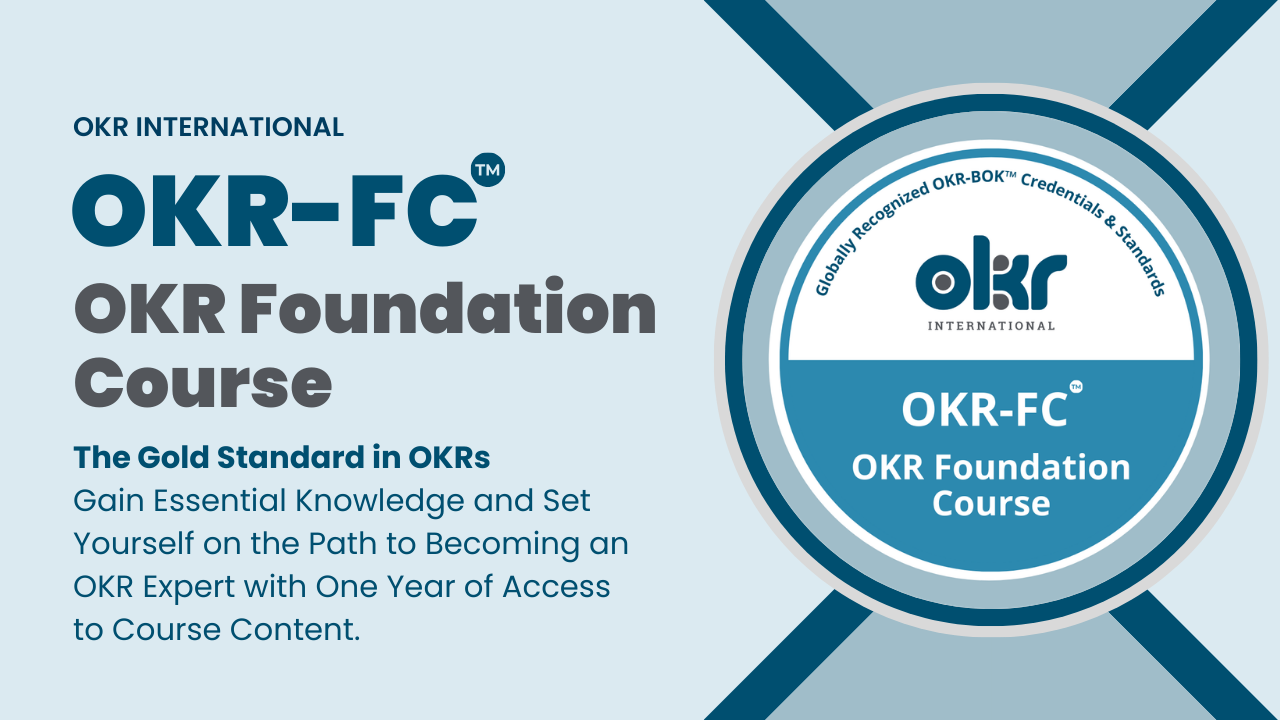
OKR International designed the OKR Foundation Course to meet learners wherever they are — whether they explore OKRs for the first time or deepen an existing practice. Accordingly, the course offers three plans so you can start immediately and upgrade as your confidence grows.
Free Plan
30 days · No commitment
- Introduction to OKRs
- OKR Examples
- Types of Objectives
- Types of Key Results
- OKR Cycles & Rituals
- OKR Pitfalls to Avoid
Full Course
Everything in Starter, plus:
- Module-end quizzes
- Downloadable handouts
- Digital badge
- Digital certificate
- 365-day access
Advanced Modules
Everything in Professional, plus:
- Mastering OKR Prioritisation
- Input, Output & Outcome KRs
- Leading and Lagging KRs
- Balancing OKRs
- How to Use OKR Templates
Notably, every plan builds on the same OKR-BOK™ (Body of Knowledge) — the gold standard framework that OKR International developed over two decades of global OKR practice. This means that regardless of the plan you choose, you learn OKRs online through rigorous, practitioner-tested content.
How to Start Your OKR Beginner Training in Four Steps
Starting your OKR beginner training takes less time than you might expect. In fact, you can enrol in the free Starter plan and begin your first module within minutes. Here is the recommended path for new learners:
- Enrol in the free Starter plan. Begin with the core modules — Introduction to OKRs, Types of Objectives, Types of Key Results, and OKR Pitfalls to Avoid. Complete these at your own pace before committing to a paid plan.
- Write your first OKR draft. After completing the introduction module, apply the OKR goal-setting framework directly to a real challenge your organisation faces right now. This step turns theory into muscle memory.
- Upgrade to the Professional or Expert plan. Once you grasp the basics, unlock quizzes, handouts, and — in the Expert plan — advanced modules that cover leading indicators, OKR templates, and prioritisation techniques.
- Earn your digital certificate. Completing the Professional or Expert plan earns you a digital badge and certificate from OKR International. Share this credential on LinkedIn to demonstrate your OKR knowledge to employers and clients.
💡 Pro tip from Nikhil Maini: The most common mistake new learners make is treating OKRs as a documentation exercise. Therefore, from day one of your beginner training, focus on outcomes — not activities. A Key Result must describe a change in the world, not a task you plan to complete.
What Professionals Say After They Learn OKRs Online
Thousands of professionals across 20+ industries have completed OKR beginner training through OKR International. Here is what some of them share about the experience:
“OKR International has played an instrumental part in enabling MetLife Gulf to implement OKRs. Their team guided us to set our organisational and departmental goals in a very structured and efficient manner.”
— Dimitris Mazarakis, CEO, MetLife Gulf
“Nik is a genius in OKR with his real-life experiences, providing an immersive and confident learning environment. His eLearning courses are top-notch, complemented by detailed handouts that fully equip you for every stage of OKR application.”
— Swapnil Thakare, Founder, ORENDDAH (Canada)
“OKR International gave me a solid foundation in understanding the OKR framework. The pedagogy built great skills and instilled in me the confidence to embark on my path as an OKR Coach.”
— Vijay Sinha, Executive Vice President – HR, JSW
OKR Foundation Course vs. OKR Certification: What Is the Difference?
Learners who want to learn OKRs online often ask one important question: what is the difference between the OKR Foundation Course and a full OKR certification? The answer shapes how you plan your learning journey, so it is worth addressing clearly.
| Feature | OKR Foundation Course | OKR-BOK™ Certification |
|---|---|---|
| Format | Fully self-paced e-learning | Live cohort + e-learning platform |
| Duration | 2–3 hours (core modules) | 16 hours of intensive training |
| Assessment | Module-end quizzes | Rigorous practitioner assessment |
| Credential | Certificate of completion + digital badge | Globally recognised OKR credential |
| Best for | OKR beginners and team members | OKR coaches, consultants, senior leaders |
| First step | Free Starter plan available immediately | Foundation Course recommended first |
In short, the OKR Foundation Course is the ideal starting point. Once you complete it, you build the knowledge base that makes the OKR-BOK™ Certified Practitioner and OKR-BOK™ Certified Coach programmes far more accessible and impactful.
Why Learn OKRs Online with OKR International?
Many platforms offer generic goal-setting content. OKR International, however, builds every objectives and key results course on the OKR-BOK™ — a proprietary Body of Knowledge that represents 20+ years of OKR practice across 500+ organisations in 20+ industries. This means you learn OKRs the way they actually work in the real world, not the way they look in a textbook.
- OKR-BOK™ foundation — every module aligns with the gold standard Body of Knowledge for OKR practice, developed by Nikhil Maini and the OKR International team
- Practitioner-authored content — written by OKR coaches and consultants with hands-on client experience across 20+ industries, not by content marketers
- Global community access — connect with OKR practitioners from around the world through forums and peer discussion boards
- Flexible plans for every budget — start free and upgrade only when you are ready, with no hidden fees
- Pathway to advanced credentials — your OKR beginner training feeds directly into the Certified Practitioner and Certified Coach programmes
- In-house and virtual options — if your organisation prefers live delivery, OKR International also offers in-person and virtual instructor-led formats
📚 Continue your OKR learning journey:
Frequently Asked Questions About Learning OKRs Online
What is the best way to learn OKRs online?
The most effective way to learn OKRs online is through a structured objectives and key results course that combines video lessons, real-world examples, and practice exercises. OKR International’s OKR Foundation Course offers a free Starter plan and paid plans that take you from beginner to confident OKR practitioner at your own pace.
Is OKR beginner training suitable for someone with no prior experience?
Yes. OKR beginner training requires no prior experience. The OKR Foundation Course starts with core concepts — what OKRs are, how to write them, and how to run OKR cycles — before progressing to advanced topics. Therefore, complete beginners can enrol with full confidence.
How long does it take to complete an objectives and key results course?
Most learners complete the core modules of an objectives and key results course in 2 to 3 hours. Because OKR International provides 365-day access, you can revisit content at any time and progress entirely at your own pace.
What is the OKR goal-setting framework?
The OKR goal-setting framework is a structured method for defining Objectives — inspiring qualitative goals — and Key Results — measurable outcomes that signal whether you achieved those goals. Organisations such as Google, Intel, and LinkedIn use the OKR framework to align teams, drive focus, and measure what truly matters.
Can I earn a certificate when I learn OKRs online?
Yes. Completing the Professional or Expert plan of the OKR Foundation Course earns you a digital certificate and a shareable digital badge from OKR International. You can add this credential directly to your LinkedIn profile.
What is the difference between the OKR Foundation Course and OKR certification?
The OKR Foundation Course is a self-paced e-learning programme that awards a certificate of completion. Full OKR certification programmes — such as the OKR-BOK™ Certified Practitioner and OKR-BOK™ Certified Coach — involve deeper assessment, live cohort training, and globally recognised credentials. The Foundation Course is the ideal first step before you pursue full certification.
Ready to Learn OKRs Online?
Join thousands of professionals who use the OKR goal-setting framework to align their teams, drive focus, and achieve results that actually matter. Start your OKR beginner training today — for free.