
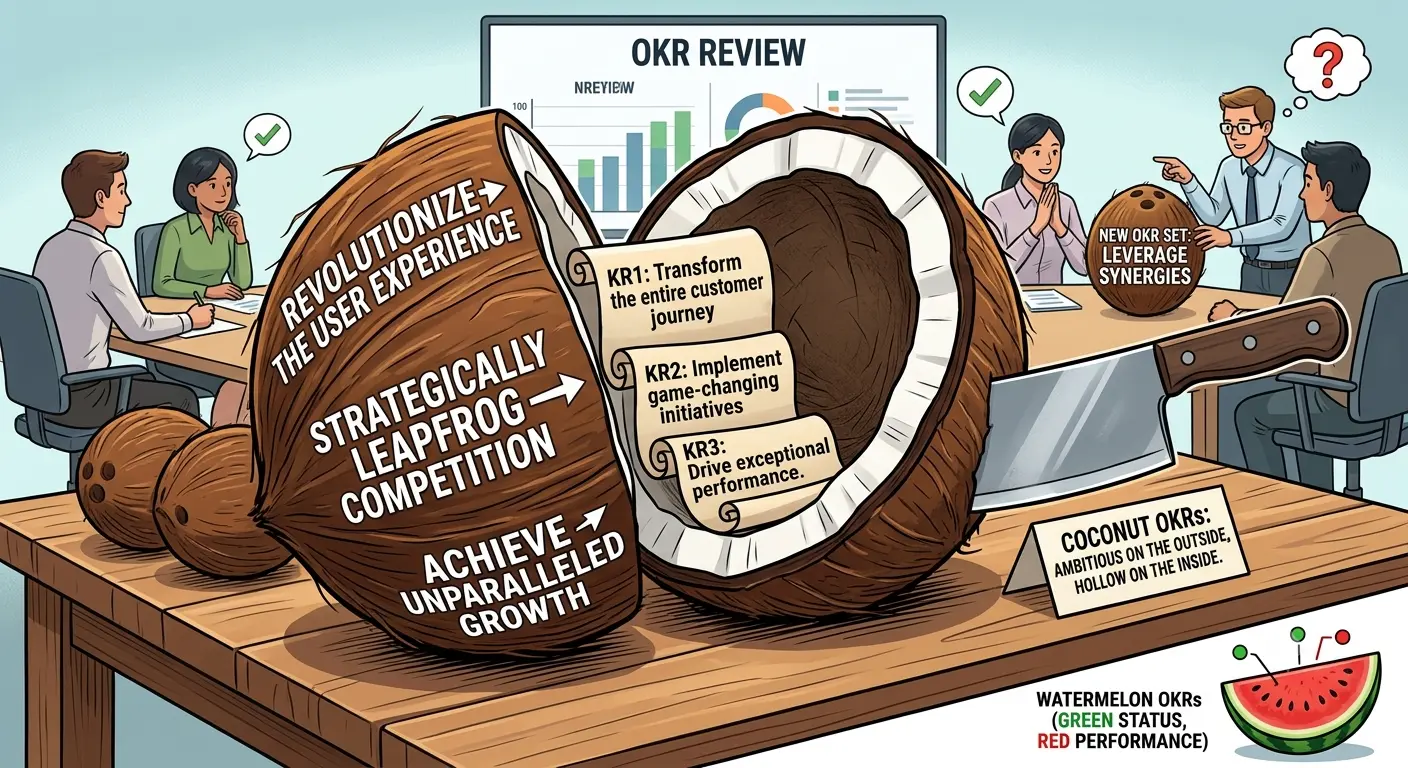
Coconut OKRs: How to Spot, Avoid and Fix the Hollow OKR Trap
Coconut OKRs are the most common and most misdiagnosed of all the OKR traps: bold, inspiring Objectives sitting above Key Results that measure nothing. Like a coconut, they present a tough, impressive shell around a hollow centre. They begin life as vague OKRs, harden into hollow OKRs, and survive as non-measurable OKRs that no quarterly review can meaningfully challenge — usually because a team paired a fine Objective with empty Key Results, or wrote weak OKR objectives that give no real direction in the first place. Crucially, the inspiring Objective is not the problem; an Objective is meant to be qualitative. The problem lives in the Key Results. Drawing on two decades of OKR training, coaching, and implementation work by OKR International, this guide shows you how to recognise Coconut OKRs, the real cost they impose, how to avoid them at the writing stage, and how to recover if your team already holds one.
What are Coconut OKRs?
Coconut OKRs are Objective and Key Result sets that sound ambitious on the surface but carry no measurable substance once you cut them open. The Objective uses bold, directional language; the Key Results simply restate that language in slightly different words. Nothing in the set tells you what would visibly change by the end of the quarter, or how anyone would know success had been reached.
The term belongs to the same family as Watermelon OKRs but describes a different failure. A Watermelon hides red performance behind a green status; a Coconut never had a measurable Key Result to turn red or green in the first place. Vague OKRs of this kind survive because the language feels strategic, and challenging it in a leadership meeting can look like a lack of ambition. That social pressure is precisely why hollow OKRs persist quarter after quarter. For the wider catalogue of failure modes, see the 10 OKR Traps diagnostic atlas.
The OKR-BOK™ principle: where numbers belong
Before fixing a single Coconut OKR, one principle from the OKR-BOK™ framework must be clear, because almost every botched repair gets it wrong. The DNA of OKRs has three parts: the Objective, the Key Results, and the Initiatives.
The Objective is always qualitative and never contains a number. It is the inspiring, directional statement of intent — the “what” and the “why.” The Key Results are always measurable; they carry every metric, baseline, and target. The Initiatives are the actions, projects, and tasks a team runs to move those Key Results. So the cure for a Coconut OKR is never to push numbers up into the Objective. The Objective stays qualitative. The cure is to write measurable Key Results beneath it, and to type each one against the six Key Result types in the OKR-BOK™ — Growth, Reduction, Guardrail, Efficiency, Quality, and Milestone. Teams that confuse these layers produce non-measurable OKRs by trying to make the Objective do the measuring; teams that respect the layers fix the trap at source. The full taxonomy lives in our guide to the six types of Key Results.
Why Coconut OKRs form in the first place
Three forces manufacture Coconut OKRs, and recognising them helps you intercept the trap early.
The first is inspiration mistaken for measurement. Leaders are told Objectives should be aspirational, so they stop at the inspiring sentence and never add measurable Key Results beneath it. The Objective is fine; the empty space below it is the failure.
The second is fear of commitment. A precise Key Result invites accountability; a vague phrase does not. Teams under pressure quietly prefer non-measurable OKRs because no one can be held to a number that was never set. The vagueness is protective, not accidental.
The third is copy-paste strategy language. Corporate vision decks overflow with phrases like “operational excellence” and “customer obsession.” Those phrases make perfectly good Objectives — but when no measurable Key Results follow, vague OKRs are the inevitable output, and weak OKR objectives that lack even directional clarity make it worse.
Coconut OKRs examples: before and after (OKR-BOK™ structure)
The fastest way to internalise the trap is to see hollow OKRs beside their repaired versions. Note the pattern in every example: the Objective does not change and never carries a number. Only the Key Results change — from empty restatements into measurable outcomes, each tagged with its OKR-BOK™ type. Initiatives sit below as the actions that move them.
Example 1 — Sales
Objective (qualitative, unchanged): Become the undisputed market leader in our region.
Coconut Key Results (hollow): “Be recognised as the best,” “Win more deals,” “Grow our presence.”
Repaired Key Results (measurable): Grow regional market share from 12% to 18% (Growth); lift competitive win rate from 26% to 40% (Quality); increase average deal size from £48k to £60k (Growth).
Initiatives: launch competitive battlecards; recruit two enterprise account executives; run a win/loss review programme.
Example 2 — Product
Objective (qualitative, unchanged): Deliver a user experience customers love from day one.
Coconut Key Results (hollow): “Make the product world-class,” “Improve usability,” “Delight users.”
Repaired Key Results (measurable): Raise activation rate from 41% to 60% (Growth); cut time-to-first-value from 9 days to 3 (Efficiency); improve 30-day retention from 55% to 70% (Quality).
Initiatives: redesign onboarding; ship in-app guidance; remove three steps from sign-up.
Example 3 — Human Resources
Objective (qualitative, unchanged): Build a culture where people do their best work and stay.
Coconut Key Results (hollow): “Foster belonging,” “Be a great place to work,” “Strengthen culture.”
Repaired Key Results (measurable): Raise employee net promoter score from +18 to +35 (Growth); reduce regretted attrition from 14% to 8% (Reduction); lift internal-fill rate for senior roles from 30% to 50% (Growth).
Initiatives: launch a manager-coaching programme; redesign the exit-interview loop; build an internal mobility marketplace.
Example 4 — Marketing
Objective (qualitative, unchanged): Own the conversation in our category.
Coconut Key Results (hollow): “Dominate digital,” “Build the brand,” “Drive engagement.”
Repaired Key Results (measurable): Increase marketing-qualified pipeline from £2.0m to £3.5m (Growth); grow organic sessions from 40k to 70k per month (Growth); hold cost-per-lead at or below £35 (Guardrail).
Initiatives: publish a weekly thought-leadership series; rebuild the three highest-intent landing pages; launch an SEO content cluster.
Notice what stays constant. In every pair the Objective remains qualitative and number-free, exactly as the OKR-BOK™ requires. The non-measurable OKRs were never broken at the Objective line; they were broken at the Key Result line. Repair always happens there.
The real impact of Coconut OKRs
Leaders often treat Coconut OKRs as a harmless cosmetic issue. In practice the cost compounds across the whole quarter, and the damage is rarely visible until it is too late to recover.
Strategic drift. When the Key Results cannot be measured, teams quietly substitute their own interpretation of what the Objective means. Five teams pursue five versions of “world-class,” and alignment — the entire reason OKRs exist — evaporates. Vague OKRs do not merely fail to help; they actively fragment effort.
Wasted quarters. A hollow OKR cannot be scored honestly, so the quarter ends with a confident green that means nothing. The organisation learns nothing, repeats the same approach, and loses the compounding advantage that disciplined OKR cycles deliver.
Eroded trust in the system. After two or three quarters of non-measurable OKRs, managers conclude that “OKRs do not work here.” The framework takes the blame for what was really a Key Result writing failure. This is how weak OKR objectives and empty Key Results quietly kill an entire OKR programme.
False confidence at the top. Executives reading a dashboard of green Coconuts believe the strategy is on track. The gap between the reported picture and the real one only surfaces in the results — missed revenue, slipped launches, rising attrition — long after the quarter could have been corrected.
Compounding into other traps. A Coconut rarely stays a Coconut. Left unmeasured, it becomes a Snowglobe (ignored after week three), then a Heirloom (carried forward forever). Fixing the Coconut OKRs at the Key Result stage prevents three downstream failures at once.
How to spot a Coconut OKR: the 60-second test
Run this quick diagnostic on any draft. Apply each question to the Key Results, not the Objective. If you answer “no” to two or more, you are holding a Coconut.
First, can you state the number that would prove the Key Result was met? Second, is there an agreed baseline you are moving from? Third, is there a target and a direction of travel? Fourth, could two reasonable people disagree about whether it was achieved — that disagreement is the signature of a non-measurable OKR. Fifth, do the Key Results merely echo the Objective in new words rather than measuring it? Echoing is the tell-tale of a hollow OKR. Separately, sense-check the Objective itself: it should be qualitative, but it must still give direction — an Objective so generic it could belong to any team is one of the weak OKR objectives that breed Coconuts. Run every draft through this test and most vague OKRs reveal themselves in under a minute.
How to avoid Coconut OKRs at the writing stage
Prevention is faster than repair. Four OKR-BOK™ disciplines, applied during drafting, stop Coconut OKRs before they reach a dashboard.
Keep the Objective qualitative, then demand measurable Key Results. Let the Objective inspire and point the direction — no numbers required there. Then refuse to accept any Key Result that is not quantified. This single separation prevents most hollow OKRs.
Type every Key Result. Tag each Key Result against the six OKR-BOK™ types — Growth, Reduction, Guardrail, Efficiency, Quality, or Milestone. A Key Result that fits no type is usually not a measure at all, which exposes the non-measurable OKRs immediately.
Apply the five-test gate to each Key Result. Every Key Result must carry a baseline, a target, a deadline, an owner, and an evidence source. A blank in any column means the draft is still a set of vague OKRs and is not ready to commit.
Audit your verbs and move tasks to Initiatives. Words like improve, enhance, drive, and optimise belong in the Objective or as Initiatives — never as standalone Key Results. Anything that is an action rather than an outcome is an Initiative, and mislabelling Initiatives as Key Results is a frequent source of weak OKR objectives dressed up as complete OKRs. Ground the whole practice in what OKRs are and a disciplined OKR implementation.
How to recover if you are already in the Coconut OKR trap
Discovering a Coconut OKR mid-quarter is not a reason to scrap it. A disciplined rescue salvages both the quarter and the team’s confidence. Follow this sequence.
Step one — keep the Objective, rebuild the Key Results. The qualitative Objective is usually sound and stays exactly as written. Do not add numbers to it. Instead, write the measurable Key Results that were missing, so the hollow OKR gains a measurable spine.
Step two — set a retroactive baseline. Pull whatever data exists from the start of the quarter. Even an approximate baseline converts a non-measurable OKR into something trackable for the weeks that remain.
Step three — add leading indicators. When the lagging outcome cannot move in the time left, define one or two leading Key Results you can still influence. This keeps the team honest without pretending the original vague OKRs can be fully recovered.
Step four — re-contract with stakeholders. Tell whoever depends on the OKR that the Key Results have changed and why. Transparency here rebuilds the trust that Coconut OKRs erode, and it models the behaviour you want next quarter. A short engagement with an OKR coach often accelerates this conversation and keeps it constructive.
Step five — run a write-better retrospective. At quarter-end, review which Objectives produced Coconuts and why. Capturing the lesson is what stops weak OKR objectives and empty Key Results from reappearing — the single most valuable output of the rescue.
How OKR International eliminates Coconut OKRs
Eliminating Coconut OKRs is core to the OKR-BOK™ framework developed by OKR International, and it runs through every service we offer. The methodology keeps Objectives qualitative while giving every Key Result a defined type, a baseline, and an evidence source, which makes non-measurable OKRs structurally difficult to write.
On the training side, the OKR Foundation Course, the OKR-BOK™ Certified Practitioner programme, and the OKR-BOK™ Certified Coach programme teach teams to keep Objectives qualitative, write measurable Key Results, and spot vague OKRs in a draft — with regional cohorts for OKR training in the UAE and OKR training and consulting in India.
Through coaching, our OKR coaching and OKR advisory services put a certified coach in the room to repair the Key Results behind a hollow OKR before it ever reaches a dashboard.
For implementation, our OKR implementation, agile performance management, and broader transformation services embed the discipline organisation-wide, while Micro-OKRs™ break each quarterly Objective into weekly measured rhythms so a Coconut cannot hide until review. Organisations across India, the UAE, the Gulf, and Asia-Pacific use this approach to convert weak OKR objectives and empty Key Results into measurable, defensible commitments.
Stop your team writing Coconut OKRs this quarter.
Talk to OKR International about certification, hands-on coaching, or a full OKR implementation tailored to your organisation.
Frequently Asked Questions
What is a Coconut OKR?
A Coconut OKR is an Objective and Key Result set that sounds bold and transformational on the outside but has no measurable substance inside. The Key Results restate the Objective in different words rather than defining what will change and how it will be measured, which makes the OKR impossible to score honestly.
Should the Objective contain numbers to fix a Coconut OKR?
No. In the OKR-BOK™ framework the Objective is always qualitative and never carries a number — it states intent and direction. Numbers live exclusively in the Key Results. You fix a Coconut OKR by keeping the qualitative Objective and writing measurable Key Results beneath it, not by quantifying the Objective itself.
How are Coconut OKRs different from Watermelon OKRs?
Watermelon OKRs hide poor performance behind a green status — they have a real metric that is quietly failing. Coconut OKRs never had a measurable Key Result at all; they are non-measurable OKRs from the moment they are written. One conceals red; the other was never measurable enough to turn red or green.
Are vague OKRs always a problem?
A qualitative Objective is correct and desirable — inspiration and direction are its job. Vague OKRs become a problem only when the Key Results are also vague. The cure is not to remove ambition from the Objective but to attach measurable, typed Key Results beneath it.
How do I fix a hollow OKR mid-quarter?
Keep the qualitative Objective, write the measurable Key Results that were missing, set a retroactive baseline, add leading indicators you can still influence, re-contract with stakeholders, and run a retrospective at quarter-end. This converts a hollow OKR into something trackable without scrapping the work already done.
Turn hollow ambition into measurable progress
Coconut OKRs are the most common and most underestimated of all the OKR traps, and they are also the most fixable — because the Objective is usually fine and only the Key Results need rebuilding. Spot them with the 60-second test, prevent them with the five-test gate, and recover from them with a disciplined mid-quarter rescue. If your team keeps writing vague OKRs, hollow OKRs, or non-measurable OKRs built on weak OKR objectives, write to us at info@okrinternational.com to discuss OKR training, hands-on coaching, or a full OKR implementation — or explore the OKR-BOK™ Certified Coach programme to build measurement discipline into every OKR your organisation sets.