
Bonsai OKRs: How to Spot, Avoid and Fix the Sandbagging OKR Trap
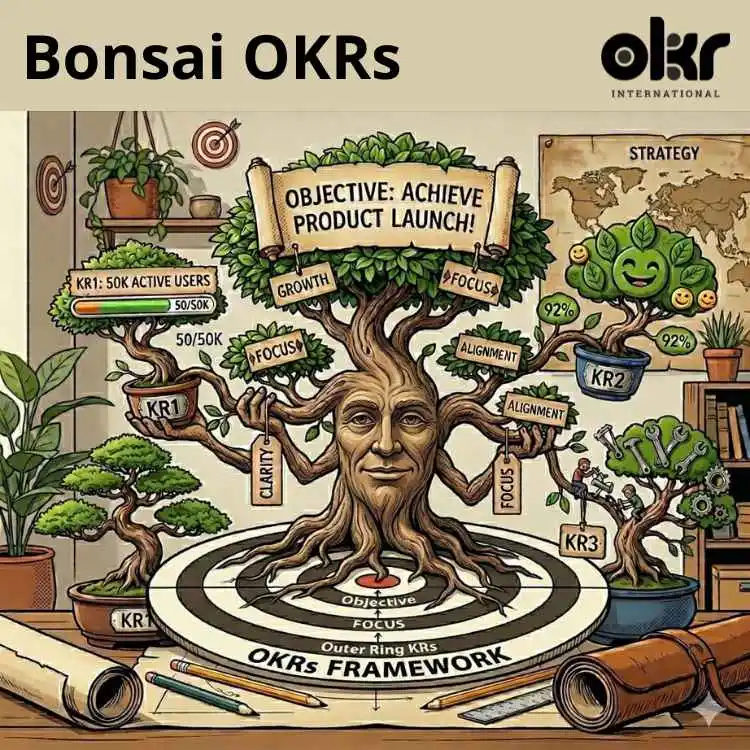
Bonsai OKRs are the quietest and most respectable of all the OKR traps: targets deliberately pruned so small that a perfect score is guaranteed before the quarter even begins. Like a bonsai tree, they are healthy, tidy, and admired — and deliberately kept tiny. They are the product of sandbagging OKRs, where teams set low-ambition OKRs to protect a flawless record, quietly abandoning the OKR stretch goals that give the framework its power. The result is a board full of easy OKR targets that everyone hits and nobody is energised by. Crucially, the problem is not the qualitative Objective — it is how the Key Result targets are calibrated. Drawing on two decades of OKR training, coaching, and implementation work by OKR International, this guide shows you how to recognise Bonsai OKRs, the real cost they impose, how to avoid them at the writing stage, and how to recover if your team is already pruning for the easy win.
What are Bonsai OKRs?
Bonsai OKRs are Objective and Key Result sets whose targets have been deliberately miniaturised to make success certain. The Objective may be perfectly sound; the Key Results carry real metrics. The failure is that those metrics are set at a level the team already knows it will reach — sandbagging OKRs in their purest form. Everything looks disciplined: clean numbers, clear baselines, predictable greens. Yet the aspiration that should stretch the team has been pruned away.
The trap is seductive because it is rewarded. A flawless 1.0 looks like execution excellence to anyone glancing at a dashboard. But low-ambition OKRs hide the most expensive question in goal-setting: what could this team have achieved if the target had been bold? When every quarter ends in a tidy 100%, the organisation has stopped asking that question. For the wider catalogue of failure modes, see the 10 OKR Traps diagnostic atlas, and the closely related opposite failure in our guide to Coconut OKRs.
The OKR-BOK™ principle: committed versus aspirational
Diagnosing Bonsai OKRs correctly requires one distinction from the OKR-BOK™ framework: not every Key Result is meant to be a stretch. The framework separates committed Key Results — the ones a team must deliver, where a score near 1.0 is the expectation — from aspirational or stretch Key Results, where a score around 0.7 represents genuine success and a 1.0 quietly signals the target was too small.
A Bonsai problem appears when a team dresses easy OKR targets as if they were aspirational, then celebrates the inevitable 1.0 as a triumph. The cure is not to make every Objective harder, nor to abandon committed Key Results that genuinely should land at 1.0. The cure is honest calibration: label which Key Results are committed and which are OKR stretch goals, set stretch targets at a level where 0.7 would be a real win, and judge the quarter accordingly. The OKR-BOK™ principle of Ambition & Stretch exists precisely to stop sandbagging OKRs from passing as discipline. Pair this with a clear understanding of the six types of Key Results, since Growth and Efficiency Key Results are where Bonsai pruning hides most often.
Why Bonsai OKRs form in the first place
Three forces manufacture Bonsai OKRs, and recognising them helps you intercept the trap early.
The first is scoring tied to pay or performance reviews. The moment an OKR score influences a bonus or a rating, the rational move is to set easy OKR targets. People are not being dishonest; they are responding to the incentive the organisation built. This single mistake produces more sandbagging OKRs than any other.
The second is punishing the miss. When a team that aimed high and scored 0.6 is treated worse than a team that aimed low and scored 1.0, everyone learns the lesson within one cycle. Ambition gets punished, caution gets rewarded, and low-ambition OKRs spread across the organisation.
The third is fear of looking incompetent. A public dashboard turns every red cell into a perceived failure. Teams protect their reputation by setting targets they cannot miss, abandoning OKR stretch goals in favour of certainty. The dashboard meant to drive ambition ends up suppressing it.
Bonsai OKRs examples: before and after (OKR-BOK™ structure)
The fastest way to internalise the trap is to see sandbagging OKRs beside their re-calibrated versions. Note the pattern in every example: the Objective does not change and never carries a number. Only the Key Result targets change — from guaranteed wins into genuine stretch — each tagged with its OKR-BOK™ type. The baseline is shown so you can see exactly how small the original ambition was.
Example 1 — Sales
Objective (qualitative, unchanged): Build a faster, stronger regional sales engine.
Bonsai Key Results (sandbagged): Grow revenue from £10.0m to £10.3m (Growth); lift win rate from 38% to 39% (Quality) — both within normal drift, certain to land at 1.0.
Re-calibrated Key Results (stretch): Grow revenue from £10.0m to £13.0m (Growth, aspirational); lift win rate from 38% to 50% (Quality, aspirational); hold discount rate at or below 12% (Guardrail, committed).
Example 2 — Product
Objective (qualitative, unchanged): Make onboarding something new users love.
Bonsai Key Results (sandbagged): Raise activation from 58% to 60% (Growth); keep crash-free sessions at 99% (Quality) — already today’s reality.
Re-calibrated Key Results (stretch): Raise activation from 58% to 75% (Growth, aspirational); cut time-to-first-value from 7 days to 2 (Efficiency, aspirational); maintain crash-free sessions at or above 99.5% (Guardrail, committed).
Example 3 — Human Resources
Objective (qualitative, unchanged): Become a place people choose and stay.
Bonsai Key Results (sandbagged): Improve eNPS from +30 to +31 (Growth); run four engagement events (Milestone) — activity, not outcome.
Re-calibrated Key Results (stretch): Improve eNPS from +30 to +45 (Growth, aspirational); reduce regretted attrition from 12% to 7% (Reduction, aspirational); keep time-to-hire at or below 35 days (Guardrail, committed).
Example 4 — Marketing
Objective (qualitative, unchanged): Turn marketing into a real pipeline engine.
Bonsai Key Results (sandbagged): Grow MQLs from 1,000 to 1,030 per month (Growth); publish 12 blog posts (Milestone) — comfortably guaranteed.
Re-calibrated Key Results (stretch): Grow marketing-qualified pipeline from £2.0m to £3.5m (Growth, aspirational); lift landing-page conversion from 2.1% to 3.5% (Quality, aspirational); hold cost-per-lead at or below £35 (Guardrail, committed).
Notice the pattern. The Objective stays qualitative and unchanged; the baselines reveal how little the easy OKR targets were really asking; and the re-calibrated sets mix honest OKR stretch goals with one committed Guardrail, so ambition rises without recklessness. That balance is what separates a healthy stretch from a Bonsai.
The real impact of Bonsai OKRs
Leaders often see Bonsai OKRs as the safe, sensible option. In practice the cost is enormous precisely because it is invisible — you cannot see the growth you never attempted.
Forgone performance. The single largest cost of low-ambition OKRs is the gap between what was achieved and what was possible. A team that grows revenue 3% to guarantee a 1.0 may have left 20% on the table. That gap never appears on any dashboard, which is what makes it so dangerous.
A culture of caution. When sandbagging OKRs are rewarded, the whole organisation learns that ambition is risky and safety pays. The best people notice fastest, and the appetite for bold work quietly drains away across every team.
Meaningless scoring. A board of guaranteed greens tells leadership nothing. When every easy OKR target lands at 1.0, scores lose all diagnostic value, and the organisation can no longer tell a genuinely high-performing team from a cautious one.
Demotivated talent. Ambitious people are energised by meaningful OKR stretch goals, not by colouring in foregone conclusions. Quarter after quarter of trivial targets is one of the most reliable ways to bore your strongest performers into leaving.
Compounding into other traps. A Bonsai rarely stays alone. Sandbagged targets are easy to ignore, so they drift into Snowglobe (forgotten after week three) and Heirloom (rolled forward untouched). Fixing the Bonsai OKRs at the calibration stage prevents several downstream failures at once.
How to spot a Bonsai OKR: the 60-second test
Run this quick diagnostic on any draft. If you answer “yes” to two or more, you are growing a Bonsai.
First, are you already confident you will hit this target before the quarter starts? Second, does the target sit within normal month-to-month drift of the baseline? Third, would missing it be almost impossible? Fourth, is this Key Result labelled as a stretch yet priced like a certainty — the signature of sandbagging OKRs? Fifth, has the team scored a clean 1.0 on similar Key Results for several quarters running? A consistent flawless record is the clearest tell-tale of low-ambition OKRs. Run every draft through this test and most easy OKR targets reveal themselves in under a minute — especially once you compare the target against its own baseline.
How to avoid Bonsai OKRs at the writing stage
Prevention is faster than repair. Four OKR-BOK™ disciplines, applied during drafting, stop Bonsai OKRs before they reach a dashboard.
Decouple scoring from compensation. This is the single most powerful move. Once an OKR score no longer drives pay or ratings, the incentive to set easy OKR targets disappears almost overnight, and teams can risk real OKR stretch goals without fear.
Label committed and aspirational Key Results explicitly. Mark each Key Result as committed (expect ~1.0) or aspirational (expect ~0.7). This single act of honesty makes sandbagging OKRs visible, because a stretch priced as a certainty stands out immediately.
Use the baseline-and-stretch test. For every Key Result, write the baseline beside the target and ask whether the gap would genuinely stretch the team. If the target sits within normal drift, it is a low-ambition OKR and needs raising before commitment.
Reward the honest miss. Celebrate a team that aimed high and scored 0.7 more loudly than one that aimed low and scored 1.0. When ambition is visibly rewarded, Bonsai OKRs stop being the rational choice. Ground the whole practice in what OKRs are and a disciplined OKR implementation.
How to recover if you are already in the Bonsai OKR trap
Discovering Bonsai OKRs mid-quarter is not a reason to tear up the board. A disciplined re-calibration restores ambition without destroying trust. Follow this sequence.
Step one — raise the target, keep the Objective. The qualitative Objective is usually fine. Lift the sandbagged Key Result to a genuine stretch and label it aspirational, so the low-ambition OKR regains a real ceiling.
Step two — separate the committed floor from the stretch. Where a real commitment exists, keep it as a committed Key Result at 1.0, and add a separate aspirational target above it. This protects delivery while restoring the OKR stretch goals the team had pruned away.
Step three — reset expectations on scoring. Tell the team that a 0.7 on the raised target is now a success, not a failure. Removing the penalty is what makes it safe to abandon sandbagging OKRs mid-flight.
Step four — re-contract with leadership. Explain that scores will look lower and why that is a good sign. Transparency here protects the team from being judged on the old easy OKR targets logic. A short engagement with an OKR coach often makes this conversation easier and more credible.
Step five — fix the incentive at quarter-end. The lasting cure is structural: review where scoring still touches pay or status, and remove it. Otherwise Bonsai OKRs will regrow next quarter no matter how well you prune them this one.
How OKR International eliminates Bonsai OKRs
Eliminating Bonsai OKRs is core to the OKR-BOK™ framework developed by OKR International, and it runs through every service we offer. The methodology builds the Ambition & Stretch principle and the committed-versus-aspirational distinction into how every Key Result is set, which makes sandbagging OKRs far harder to disguise.
On the training side, the OKR Foundation Course, the OKR-BOK™ Certified Practitioner programme, and the OKR-BOK™ Certified Coach programme teach teams to calibrate OKR stretch goals honestly and to spot low-ambition OKRs in a draft — with regional cohorts for OKR training in the UAE and OKR training and consulting in India.
Through coaching, our OKR coaching and OKR advisory services put a certified coach in the room to challenge easy OKR targets and re-calibrate them before they are locked for the quarter.
For implementation, our OKR implementation, agile performance management, and broader transformation services redesign the incentives that breed sandbagging OKRs in the first place, while Micro-OKRs™ break each Objective into weekly measured rhythms that keep ambition visible. Organisations across India, the UAE, the Gulf, and Asia-Pacific use this approach to convert Bonsai OKRs into bold, honestly scored commitments.
Stop your team sandbagging its OKRs this quarter.
Talk to OKR International about certification, hands-on coaching, or a full OKR implementation that builds real stretch into every Objective.
Frequently Asked Questions
What is a Bonsai OKR?
A Bonsai OKR is an Objective and Key Result set whose targets have been deliberately set low enough to guarantee a perfect score. The metrics are real, but the ambition has been pruned away, so the team hits 1.0 without being stretched. It is sandbagging dressed up as disciplined execution.
How is sandbagging different from a committed Key Result?
A committed Key Result is one a team genuinely must deliver, where a score near 1.0 is the honest expectation. Sandbagging OKRs disguise a safe, certain target as if it were an aspirational stretch, then celebrate the inevitable 1.0. The difference is honesty about which Key Results are committed and which are OKR stretch goals.
Is a 1.0 score always a Bonsai problem?
No. A 1.0 on a committed Key Result is exactly right. The problem is a 1.0 on a Key Result that was labelled, or should have been, an aspirational stretch. Consistent 1.0 scores across every Key Result, quarter after quarter, are the reliable signal of low-ambition OKRs.
What is the single best way to stop Bonsai OKRs?
Decouple OKR scoring from compensation and performance ratings. The moment scores stop driving pay, the incentive to set easy OKR targets disappears, and teams can pursue real stretch without fear of being penalised for an honest miss.
How are Bonsai OKRs different from Coconut OKRs?
Coconut OKRs have no measurable Key Results at all. Bonsai OKRs have perfectly measurable Key Results — the targets are simply set too low. One fails on measurability; the other fails on ambition. Both undermine the OKR programme, but they need opposite fixes.
Turn safe targets into bold, honest progress
Bonsai OKRs are the most respectable and most expensive of all the OKR traps, because the cost is the growth you never attempted. Spot them with the 60-second test, prevent them by decoupling scores from pay, and recover from them by re-calibrating targets mid-quarter. If your team keeps setting sandbagging OKRs, low-ambition OKRs, or easy OKR targets in place of real OKR stretch goals, write to us at info@okrinternational.com to discuss OKR training, hands-on coaching, or a full OKR implementation — or explore the OKR-BOK™ Certified Coach programme to build genuine ambition into every OKR your organisation sets.