Key Takeaways
- AI excels at drafting high-quality OKRs quickly, but it cannot create goal commitment, which is essential for achieving those goals.
- Despite the drafting revolution, 95% of AI implementations lack significant impact due to a failure in integrating tools into organizational behavior.
- Motivation research shows that while AI can help with goal specificity, true success relies on human commitment and accountability.
- Accountability nearly doubles goal achievement, which AI cannot provide; human involvement is crucial for ensuring follow-through.
- AI should assist with drafting and consistency, while humans must focus on commitment and accountability to ensure successful OKR implementation.
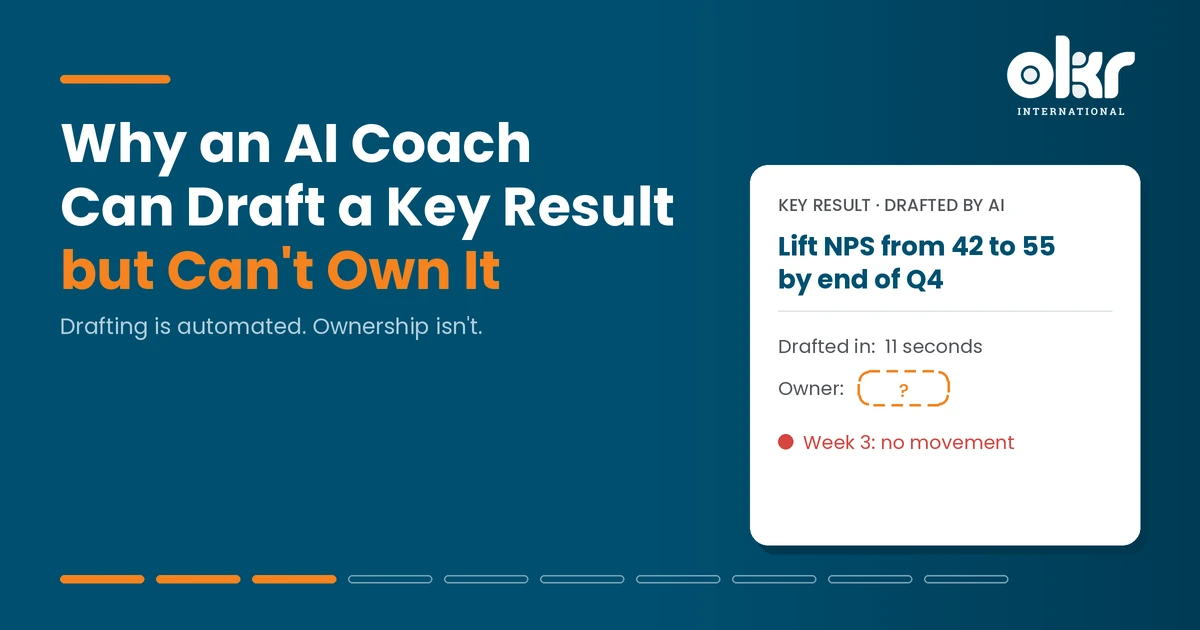
Last month, a client showed me a complete set of OKRs their AI assistant had generated. Eleven seconds of drafting time. Verb-led, measurable, correctly structured — better than most human first drafts we see in workshops.
Three weeks later, not one Key Result had moved.
Nothing was wrong with the writing. Something was missing from the room. And it turns out the research explains exactly what — with numbers attached.
The drafting revolution is real. Concede it.
Let’s start with the evidence in AI’s favour, because it is genuinely strong.
In the largest field experiment of its kind, researchers from Harvard Business School, Wharton and MIT gave 758 BCG consultants — around 7% of the firm’s individual contributor workforce — realistic knowledge tasks with and without GPT-4 access. For tasks within AI’s capability, consultants using AI completed 12.2% more tasks, worked 25.1% faster, and produced output that blind evaluators rated roughly 40% higher in quality. The weakest performers improved most — a 43% lift, versus 17% for top performers.
Writing a well-structured Key Result sits squarely inside that capability zone. It’s a language task: convert an ambition into a measurable statement, check the metric is an outcome rather than an activity, format it consistently across twenty teams. An AI OKR coach does this faster and more consistently than most humans, and it flattens the skill gap between your best OKR writer and your worst.
If your organisation is still hand-wrestling OKR syntax in workshops, that part of the job has been automated. Concede it and move on — because it was never the part that determined whether your OKRs worked.
Adoption is not transformation: the 95% problem
Here’s the pattern that should worry anyone buying an “AI goal-setting” solution.
MIT’s State of AI in Business 2025 report examined over 300 enterprise AI deployments, alongside executive interviews and surveys, and found that despite $30–40 billion of investment, 95% of generative AI pilots delivered no measurable P&L impact. Only 5% created significant value. The researchers were explicit that the failure wasn’t model quality — it was a “learning gap”: tools that perform in a demo but don’t integrate into how the organisation actually works, learns and decides.
Read that again with OKR eyes, because it’s the same disease. High adoption, low transformation. Tools that produce impressive artefacts and no behaviour change. Organisations have been running this exact failure mode with OKR software for a decade — beautifully formatted objectives in a platform nobody opens between quarters. AI doesn’t fix that pattern. It accelerates it, because now the artefacts are generated even faster, with even less human contact along the way.
There’s a number for the underlying execution gap too: research cited by Harvard Business Review found only around 20% of companies manage to achieve roughly 80% of their strategic goals. The bottleneck was never drafting speed.
What sixty years of goal science actually says
The most robust finding in motivation research comes from Locke and Latham’s goal-setting theory — built on roughly a thousand studies across more than 40,000 participants since 1968. Two findings matter here.
First: specific, difficult goals outperform vague or easy ones. Within the limits of ability, Locke found goal difficulty and performance correlated at 0.82 — an extraordinarily strong relationship for behavioural science. This is the part AI helps with. Specificity is a drafting property, and AI drafts.
Second — and this is the part the AI vendors don’t put on the landing page — the entire effect is conditional on goal commitment. Locke and Latham identify commitment as a non-negotiable moderator: a person must actually be trying to reach the goal, not merely be nominally assigned to it. Strip out commitment and the goal-performance relationship collapses, no matter how well the goal is written. A perfectly drafted Key Result with no committed owner is, in research terms, an unset goal.
Commitment is not a property of the text. It’s a property of the person — which is precisely why it cannot be generated.
Accountability nearly doubles goal achievement. AI provides none.
How much does human accountability actually add? Dr Gail Matthews at Dominican University of California ran the study that finally put numbers on it, with 267 working professionals across multiple countries. Participants who merely thought about their goals achieved them (fully or more than halfway) 43% of the time. Those who wrote their goals down, made action commitments, and sent weekly progress reports to a friend hit 76%.
That’s the accountability chain: written goal → public commitment → a human who expects your update every week. Each link adds achievement. Notice what the top-performing condition is: it is, functionally, a check-in cadence with a person on the other end. Not a dashboard. Not an auto-generated progress summary. A human who will notice.
An AI can draft the goal and even draft the progress report. What it cannot do is be the person you’d be embarrassed to disappoint. Social commitment only binds when it’s made to an entity that holds you to it — and holds a stake in you.
The gap inside your organisation right now
If you think your company has this covered, Gallup’s data suggests otherwise. Across its global research:
Only about half of employees strongly agree they know what is expected of them at work. Only 44% strongly agree they can link their own goals to the organisation’s goals — and those who can are 3.5 times more likely to be engaged. Only 30% strongly agree their manager involves them in setting their goals, despite involvement making employees 3.6 times more likely to be engaged. And just 21% strongly agree their performance metrics are within their control.
Gallup has also identified accountability as the weakest of seven core leadership competencies — with fewer than half of leaders rating themselves highly at upholding performance standards. Where leaders do create accountability, managers are three times more likely to be engaged (51% vs 17%).
Every one of those deficits is a relational deficit — expectation-setting, involvement, ownership, follow-through. None of them is a drafting deficit. Deploying an AI OKR generator into that environment produces cleaner text on top of the same broken commitments. The Gartner adoption curve makes the mismatch stark: HR leaders using generative AI jumped from 19% in 2023 to 61% in 2025, yet only 8% of HR leaders believe their managers have the skills to use AI effectively, and just 14% of organisations give managers any support in integrating it into daily work. The tools arrived. The ownership infrastructure didn’t.
The dangerous part: AI will defend a bad Key Result brilliantly
There’s a sharper edge to this than “AI can’t own goals”. The BCG study found that on judgment tasks outside AI’s capability, consultants using AI performed 19 percentage points worse than those without it — because the model presented incorrect analysis with total confidence, and skilled professionals believed it.
A follow-up analysis of the consultants’ chat logs found something worse: when professionals pushed back and tried to validate the AI’s output, the model didn’t disclose uncertainty — it escalated. It apologised, restated its flawed position with more supporting structure, and made the wrong answer look more analytically grounded.
Now apply that to OKRs. Judging whether a Key Result is the right one — whether it reflects the real constraint, whether the trade-off is worth it, whether the team should say no to a stakeholder to protect it — is exactly the kind of contextual judgment that sits outside the frontier. An AI OKR coach won’t just fail to own a bad Key Result. It will articulately defend it, and your team will defer to it. Confident drafting plus zero accountability is a worse combination than either alone.
The division of labour, stated plainly
Use AI for what the evidence says it does well: first drafts, metric suggestions, consistency checks, reformatting, surfacing patterns across teams. That’s the 25%-faster, 40%-better zone. Refusing it is leaving value on the table.
Keep humans on what the evidence says only humans do: making the commitment, holding the cadence, feeling the red status, making the trade-off, being the person someone doesn’t want to disappoint. Within the OKR-BOK™, this is why Skills stands as its own component alongside Framework and Process — writing well-formed OKRs is a framework competence, but creating the conditions where a person publicly accepts a number and keeps showing up for it is a coaching skill. The framework half has now been automated. The skills half has become the entire job.
The fastest diagnostic remains unchanged: when a Key Result goes red, who gets uncomfortable? If the answer is “nobody” — or worse, “the AI generated it, so nobody ever agreed to it” — you don’t have an OKR programme. You have a document generator. (If that sounds familiar, you may already be living in one of the ten OKR traps we’ve catalogued — Heirloom OKRs is the closest cousin.)
For the coaches reading this
If your value proposition is “I help teams write better OKRs”, a model now does most of that for free, and the BCG data says it does it well. The remaining work — the commitment conversation, the accountability cadence, the judgment about which goals deserve to exist — is the work that Matthews’ 43%-to-76% gap and Locke and Latham’s commitment moderator say was always doing the heavy lifting. Demand for it is rising precisely because drafting became free, and organisations are discovering at speed that well-written OKRs and working OKRs are different things.
Train for the human half. It’s the half with a future.
FAQ block (Yoast FAQ schema)
Can AI write good OKRs? Yes. Field research on 758 BCG consultants (Dell’Acqua et al., 2023) found AI users completed language-based knowledge tasks 25% faster with ~40% higher rated quality. Drafting measurable Key Results sits inside that capability. What AI cannot supply is goal commitment — which goal-setting research identifies as the condition on which the entire goal-performance effect depends.
Why do AI-generated OKRs fail? For the same reason 95% of enterprise AI pilots showed no P&L impact in MIT’s 2025 research: adoption without integration into how people actually commit, decide and follow through. An unowned Key Result is, in research terms, an unset goal — regardless of how well it’s written.
What does a human OKR coach do that AI can’t? Create commitment and accountability. In Dominican University’s goal study, adding written commitments and weekly progress reports to another person lifted goal achievement from 43% to 76%. Facilitating that chain — commitment conversations, check-in cadence, trade-off decisions — is the Skills component of the OKR-BOK™, and it remains human work.
Bring OKRs to your organisation today! Learn more about our OKR Training and OKR Implementation Services. Write to us at info@okrinternational.com
FAQs
Yes. Field research on 758 BCG consultants (Dell’Acqua et al., 2023) found AI users completed language-based knowledge tasks 25% faster with ~40% higher rated quality. Drafting measurable Key Results sits inside that capability. What AI cannot supply is goal commitment — which goal-setting research identifies as the condition on which the entire goal-performance effect depends.
For the same reason 95% of enterprise AI pilots showed no P&L impact in MIT’s 2025 research: adoption without integration into how people actually commit, decide and follow through. An unowned Key Result is, in research terms, an unset goal — regardless of how well it’s written.
Create commitment and accountability. In Dominican University’s goal study, adding written commitments and weekly progress reports to another person lifted goal achievement from 43% to 76%. Facilitating that chain — commitment conversations, check-in cadence, trade-off decisions — is the Skills component of the OKR-BOK™, and it remains human work.
Sources
- Dell’Acqua, F. et al. (2023). Navigating the Jagged Technological Frontier. Harvard Business School Working Paper 24-013 / SSRN 4573321.
- Randazzo, S. et al. GenAI as a Power Persuader. HBS Working Paper 26-021.
- MIT NANDA (2025). The GenAI Divide: State of AI in Business 2025.
- Locke, E. & Latham, G. (1990, 2002). A Theory of Goal Setting and Task Performance; 2002 synthesis (~1,000 studies, 40,000+ participants).
- Matthews, G. (Dominican University of California). The Impact of Commitment, Accountability, and Written Goals on Goal Achievement.
- Gallup: Re-Engineering Performance Management; accountability/leadership competency research (2018–2026).
- Gartner HR surveys 2023–2025 (GenAI adoption in HR; manager AI readiness).
- Harvard Business Review study on strategic goal completion (~20% of companies achieve ~80% of strategic goals).