Key takeaways
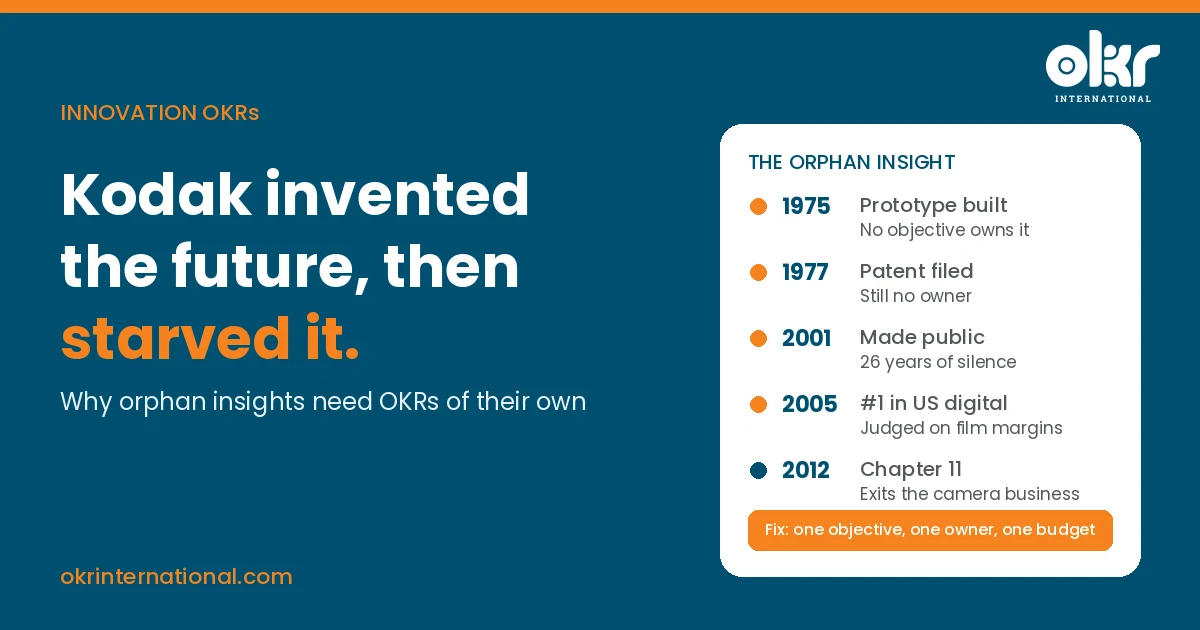
- In December 1975, Kodak engineer Steve Sasson built the first hand-held digital camera. It weighed 3.6 kg and stored a 0.01-megapixel image on cassette tape in 23 seconds.
- Kodak patented the idea in 1977, kept it quiet until 2001, and filed for Chapter 11 in January 2012 with $5.1 billion in assets against $6.8 billion in debt.
- McKinsey reports that over 80% of executives rank innovation as a top-three priority, yet fewer than 10% are satisfied with their innovation performance.
- The Kodak digital camera story is not a story about missing the future. It is a story about a breakthrough with no owner. We call that an orphan insight.
- Innovation OKRs fix this by giving the new business its own objective, its own innovation key results, and its own budget line.
The Kodak digital camera story is the most quoted innovation lesson in business, and most people draw the wrong moral from it. Kodak did not miss digital photography. It invented it, patented it and then starved it, because every key result in the company measured film. That is the innovator’s dilemma in one sentence: the metrics that protect today’s business quietly kill tomorrow’s. Innovation OKRs exist to break that pattern. They give a new idea its own objective, its own innovation key results and its own owner, so the breakthrough has somewhere to live. This article uses the Kodak case to show why OKRs for disruptive innovation need a different design from the OKRs that run the core business, and how to write them so your next 1975 moment does not end in your own 2012.
Why the Kodak digital camera story still matters
Steve Sasson was 24 when his supervisor at Eastman Kodak handed him a new charge-coupled device and told him to see what he could do with it. A year later, in December 1975, he had a working prototype. Rensselaer Polytechnic Institute records the specification: 3.6 kg, 0.01 megapixels, black and white, 23 seconds to write one image to cassette tape. NBC News adds that it took another 23 seconds to read the picture back onto a television.
Kodak filed a patent on the design in 1977, according to Wikipedia’s biography of Sasson. Then the company said nothing in public about the camera until 2001. Sasson told anyone who asked that the technology would become commercial in 15 to 20 years. He was right. By 2003, digital camera shipments in the United States had overtaken film cameras.
Kodak did eventually compete. In 2005 its EasyShare range made it the top-selling digital camera brand in the United States, with sales up 40% to $5.7 billion. The same year, its film business fell 18%. The company that held about 90% of the US film market in 1976 was now the leader in a category it had helped create, and that category carried a fraction of film’s margin.
On 19 January 2012, Bloomberg reported Kodak’s Chapter 11 filing: $5.1 billion in assets, $6.8 billion in debt. Three weeks later, CNN Money reported that Kodak was leaving the digital camera business altogether. The firm that invented the product exited it in bankruptcy.
The orphan insight: why breakthroughs die inside healthy companies
The lazy reading of the Kodak digital camera story is that executives were short-sighted. The evidence points somewhere more uncomfortable. Kodak’s leaders made rational choices against the measures in front of them. Film carried enormous margins. Digital cameras carried thin ones. Every quarter, the numbers said: protect film.
We call this an orphan insight: a breakthrough that no objective owns. The insight exists. People know about it. But no leader carries a key result that moves only if the insight succeeds, so the idea drifts through budget cycles until a competitor adopts it. Sasson’s camera lived as an orphan insight for 26 years.
This pattern is far from rare. In its explainer on innovation, McKinsey reports that over 80% of executives call innovation a top-three priority, while fewer than 10% say they are satisfied with their organisation’s innovation performance. The gap is not ambition. It is ownership and measurement. Established companies, McKinsey notes, are usually better operators than innovators; they succeed by optimising the core.
Clayton Christensen named the mechanism the innovator’s dilemma in 1997, and Kodak remains the textbook case of the innovator’s dilemma in action. Good management, listening to the best customers and funding the highest-margin products, leads well-run firms to ignore disruptive technologies until it is too late. The innovator’s dilemma is not a failure of intelligence. It is a failure of the scorecard. And a scorecard is exactly what OKRs are.
Core OKRs versus innovation OKRs: a comparison
Most OKR programmes we see at OKR International serve the core business. That is right for 80% of the work. It is fatal for the other 20%, because the innovator’s dilemma lives in that gap. The table below shows why innovation OKRs need a different design.
| Dimension | Core business OKRs | Innovation OKRs |
|---|---|---|
| Objective | Grow or defend an existing line | Prove or kill a new line |
| Key result type | Lagging: revenue, margin, share | Leading: learning, validation, adoption |
| Time horizon | Quarterly | Quarterly checkpoints inside a 2–3 year bet |
| Ambition | 70% achievement is strong | A “no” learned fast counts as success |
| Owner | Line leader | A named leader with protected budget |
| Funding | From this year’s P&L | Ring-fenced, not pooled with the core |
| Review question | Did we hit the number? | Did we reduce the biggest uncertainty? |
Kodak ran every digital initiative through the left-hand column. It measured its 2005 digital success against film margins, so a market-leading business looked like a failure. That is the innovator’s dilemma at work: the right column never existed, so the new business never had a fair test.
Six steps to write OKRs for disruptive innovation
OKRs for disruptive innovation follow the same grammar as any OKR, but the content changes. Here is the sequence we use in OKR implementation engagements where a client has a genuine new bet.
- Name the orphan. List the ideas, prototypes and pilots that exist today but sit in no leader’s objectives. Most companies find three to five.
- Give it an objective of its own. Do not fold it into “grow revenue”. Write a separate objective such as “Prove that a subscription model works for mid-market clients”.
- Write innovation key results that measure learning, not sales. Early innovation key results should sound like “Complete 30 customer interviews and validate three of five assumptions” or “Run a 90-day pilot with two paying clients”.
- Assign one owner with budget authority. The innovator’s dilemma survives on shared ownership, and innovation OKRs without a named owner are decoration. One name, one ring-fenced budget line, one review slot.
- Set a kill criterion in advance. OKRs for disruptive innovation must say what evidence would stop the bet. This protects the team from the sunk-cost trap and protects the firm from endless pilots.
- Review the uncertainty, not the number. At each check-in, the only question is: which assumption did we test, and what did we learn?
Teams trained through our OKR certification programmes practise this sequence on live cases before they run it on their own business.
A worked example: a simplified illustration
Consider a mid-sized printing company, which we will call Meridian Print. (This is a simplified example, not a client case.) Meridian makes money from commercial print. An engineer has built a prototype for on-demand packaging design using AI. It is Meridian’s own 1975 camera.
A core-business OKR would read: “Objective: Grow packaging revenue. KR1: Reach $4 million in packaging sales.” The prototype disappears inside that number, because the number is dominated by the existing business.
An innovation OKR reads differently:
- Objective: Prove that AI-designed packaging can win mid-market customers.
- KR1: Sign five paying pilot customers by the end of Q2.
- KR2: Reduce design turnaround from ten days to two in at least three pilots.
- KR3: Validate or reject the pricing assumption with 25 structured interviews.
- Kill criterion: If fewer than two pilots renew, close the bet and document the learning.
Now the orphan has a home. The owner reports on learning, not on revenue that cannot exist yet. The innovator’s dilemma loses its grip the moment the new bet gets a scorecard of its own. The board sees progress against uncertainty rather than silence. This is the practical heart of innovation OKRs, and it is the step Kodak never took.
Who owns innovation OKRs?
Ownership is where OKRs for disruptive innovation most often fail. Three roles matter.
The sponsor. A C-level leader who holds the innovation objective in their own OKR set and who treats the innovator’s dilemma as a personal risk. If the CEO’s scorecard contains only core metrics, the innovator’s dilemma wins by default.
The owner. A single leader, often below the executive team, with authority over the ring-fenced budget and the pilot team. This person writes and reports the innovation key results.
The finance partner. Someone who agrees to judge innovation spend on learning milestones, not on this year’s return. Without this agreement, the first budget review reabsorbs the money into the core.
Our transformation services work maps these three roles before anyone writes a single OKR. The Kodak digital camera story shows what happens when the roles are missing: a patent, a prototype and 26 years of silence.
Common mistakes with innovation OKRs
- Measuring the new business with core metrics. Revenue and margin key results make an early-stage bet look like a failure every quarter.
- Sharing ownership across a committee. Committees create orphan insights. One owner, or no OKR.
- No kill criterion. Without one, pilots run for years and the firm learns nothing. Innovation OKRs should make the exit as explicit as the entry.
- Folding innovation into agile delivery. Our agile performance management work shows that sprint velocity measures output, not whether the idea is worth building.
- Hiding the bet. Kodak kept its camera confidential until 2001. Innovation key results should be visible across the company so that talent, ideas and customers can find them.
- Treating one win as proof. Kodak led US digital camera sales in 2005 and still lost money on the category. Innovation key results must track unit economics as the bet scales.
If you want a wider list of the patterns that derail OKR programmes, our frequently asked questions on OKRs and the OKR blog cover the most common ones.
Frequently asked questions
Innovation OKRs are objectives and key results written for a new product, service or business model rather than the core business. They measure learning and validation, such as pilots signed and assumptions tested, instead of revenue and margin, and they carry a named owner, a ring-fenced budget and a pre-agreed kill criterion.
Kodak built the first hand-held digital camera in 1975 and patented it in 1977, but every objective in the company measured film, which carried far higher margins. The camera became an orphan insight with no owner or budget. Kodak filed for Chapter 11 in January 2012 and exited the digital camera business a month later.
An orphan insight is a breakthrough that no objective owns. The idea exists and people know about it, but no leader holds a key result that moves only if the idea succeeds, so it drifts through budget cycles until a competitor adopts it. Innovation OKRs give the orphan an objective, an owner and a budget line.
OKRs for disruptive innovation use leading key results such as customer interviews completed, pilots signed and assumptions validated, run inside a two to three year bet with quarterly checkpoints, and treat a fast, evidence-based “no” as a success. Core OKRs use lagging key results such as revenue and share and treat 70% achievement as strong.
The innovator’s dilemma, named by Clayton Christensen in 1997, describes how well-run companies ignore disruptive technologies because their best customers and highest-margin products point them elsewhere. It is a measurement problem: the scorecard that protects today’s business starves tomorrow’s. Innovation OKRs redesign that scorecard.
Build the capability to write innovation OKRs
The Kodak digital camera story is a warning, but it is also a design brief. A company does not need more ideas. It needs an objective for the ideas it already has, innovation key results that measure learning, and an owner with the budget to act. The innovator’s dilemma is a measurement problem, and measurement is something you can redesign. Innovation OKRs are that redesign.
The OKR-BOK™ Certified Practitioner programme teaches leaders to write OKRs for disruptive innovation alongside OKRs for the core, including the kill criteria and review cadence described here. If you would rather we work the method through with your leadership team, our OKR implementation and OKR-centric delivery model pages describe how an engagement runs. Write to info@okrinternational.com and tell us which orphan insight you are trying to rescue.
Here is the question to take to your next leadership meeting: which breakthrough in your company today has a prototype, a believer and no objective?