Key takeaways on annual vs quarterly OKRs
- Google OKRs ran on a quarterly cycle until 2011. Larry Page then added annual OKRs, so every Googler held two sets of goals.
- After Sundar Pichai became CEO, Google dropped the quarterly goal track. It kept annual OKRs plus mandatory quarterly progress reports.
- In 2022, Pichai said Google would cut its company-wide OKRs by a third from 2023.
- Quarterly is still the most popular OKR cadence. The right choice depends on how fast your strategy changes.
- The Cadence Fit Test uses five questions to choose annual, quarterly or hybrid OKRs. It keeps your OKR check-ins frequent either way.
John Doerr built his OKR advice around the quarter. Then Google, his most famous adopter, stopped setting quarterly goals. Under Sundar Pichai, Google OKRs moved to an annual cycle with quarterly progress reports. Many leaders read that as permission to drop the quarter. It is not. The annual vs quarterly OKRs debate is really a question of fit. Your OKR cadence should match how fast your strategy changes and how mature your teams are. It should also reflect how much planning time you can afford. Stretch the OKR planning cycle without strengthening your OKR check-ins, and goals drift for months before anyone notices. This article explains what Google changed and why it worked. It then introduces the Cadence Fit Test and gives you five steps to choose your own rhythm.
What Google actually changed
Google adopted OKRs in 1999. For its first decade, Google OKRs ran on a quarterly cycle. Felipe Castro notes in an interview with Perdoo that quarterly OKRs were Google’s model until 2011. That year Larry Page returned as CEO and added annual OKRs. Every Googler then worked to two sets of goals: one for the year and one for the quarter.
Sundar Pichai became Google’s CEO in 2015, and he simplified the system. Business Insider reported in 2018 that he removed the quarterly goal track. Each department filed mandatory quarterly progress reports instead. So Google kept a quarterly rhythm. It simply stopped rewriting goals every 90 days.
Pichai later went further. In 2022 he told staff that Google would cut its company-wide OKRs by a third from 2023. It was part of a push to simplify the company. Fewer goals, set less often, reviewed regularly. That is the real story of Google’s OKRs, and it is subtler than “Google abandoned quarterly OKRs”.
Why the rule-break worked for Google
Nick Sonnenberg, writing in Inc., argues that Pichai made the right call. He gives three reasons. Fewer goals mean fewer decisions and less planning time. Employees track one set of goals, which sharpens focus. And a longer horizon suits longer, higher-impact bets.
Sonnenberg also notes that Google’s workforce doubled and Alphabet’s value tripled under Pichai. Read that with care. Many forces drove that growth, and the change in OKR cadence was one factor at most. Correlation is not proof. Google’s OKRs under Pichai worked because they fitted the company he ran, not because annual cycles are always better.
The deeper reason is stage. Under Page, Google behaved like a start-up, and people wore many hats. Pichai inherited one of the most diverse business portfolios in the world. Its core priorities no longer shifted every quarter. A quarterly OKR planning cycle there added overhead without adding much learning. Doerr himself has argued, as Business Insider reported, that the best execution cycle depends on each company’s context and culture. Castro puts the rule of thumb simply: adapt OKRs to your context as you evolve.
Two clocks: goal-setting and review
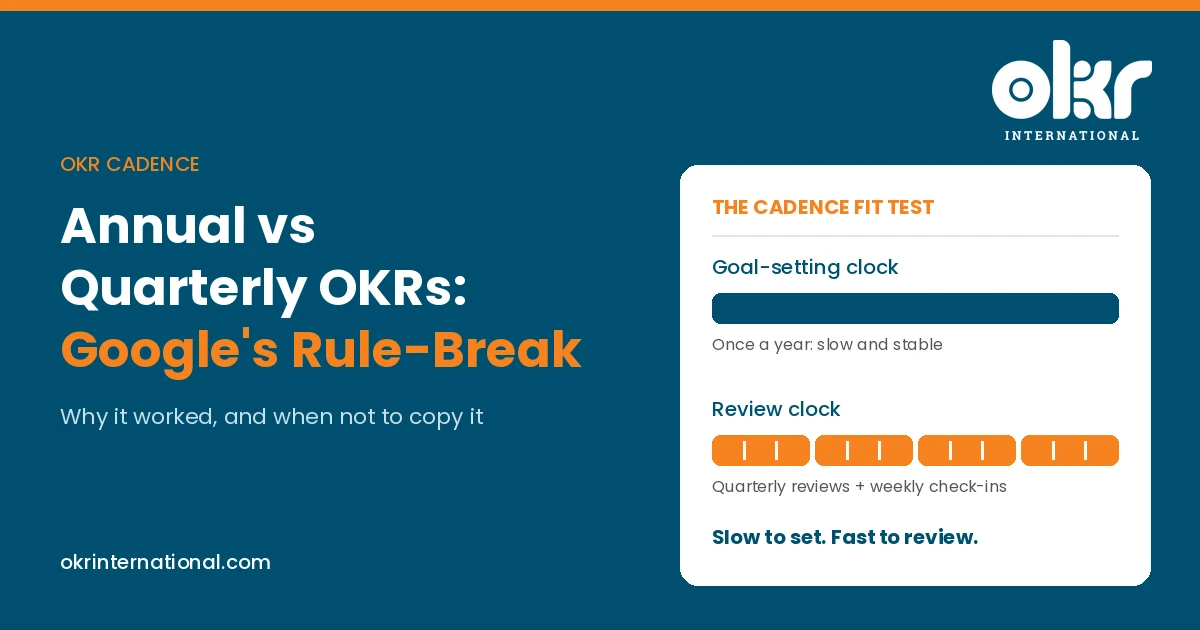
Most debates on annual vs quarterly OKRs blur two different clocks. The first is the goal-setting clock: how often you write new objectives. The second is the review clock: how often you check progress and make decisions. Google slowed the first clock. It kept the second running every quarter. Separate them and the choice between annual or quarterly OKRs gets easier. You can slow your goal-setting cadence and still learn every week.
Confuse the two and you risk the worst combination: annual goals with an annual review. That is not an OKR cadence. It is a yearly wish list. Our analysis of why OKRs fail shows how fast unreviewed goals decay.
We call the decision the Cadence Fit Test. It is a short diagnostic that matches your goal-setting clock to how fast your world changes. It also keeps your review clock fast, whichever planning cycle you choose. In practice, that means weekly or fortnightly OKR check-ins and a real quarterly review. That holds even when the objectives themselves run for a year.
What the Google OKRs story means for smaller firms
Most organisations are not Google, and that matters. A start-up of 40 people may pivot twice in a year. For that team, an annual OKR planning cycle would lock in last spring’s assumptions. Quarterly OKRs, or even six-week cycles, fit far better.
Mid-size firms sit in between. Their core strategy may hold for a year while their markets move every quarter. For them, the question is rarely annual vs quarterly OKRs. It is which layer runs on which clock. Company objectives can run for a year, while team key results reset each quarter. The OKR cadence then mirrors the business: slow at the top, fast at the edge.
Large enterprises can learn the most from Google OKRs. Their planning cost is highest, and their strategies change slowest. Even so, they need the review discipline Google kept. Without it, annual OKR planning becomes a ritual and nothing more.
Annual, quarterly or hybrid: how the models compare
Quarterly remains the default. What Matters calls it the most popular OKR cadence. It notes that some organisations run six-month cycles with more ambitious goals. Castro says the most common model he sees is annual company OKRs with quarterly team OKRs. The table compares annual vs quarterly OKRs and the hybrid model that sits between them.
| Question | Annual OKRs, quarterly reviews | Quarterly OKRs | Hybrid model |
|---|---|---|---|
| Best fit | Stable, mature organisations with long bets | Start-ups, fast markets, new OKR users | Most mid-size and large organisations |
| Goal-setting clock | Once a year | Every 90 days | Company yearly, teams quarterly |
| Planning overhead | Low | High | Medium |
| Speed of learning | Slow unless reviews bite | Fast | Fast at team level |
| Main risk | Set-and-forget goals | Planning fatigue | Misaligned calendars |
| Check-in rhythm | Weekly or fortnightly | Weekly | Weekly |
The Cadence Fit Test: five questions
Answer these five questions honestly before you change your OKR planning cycle. Each one tests a different reason to choose annual or quarterly OKRs.
- How often does your strategy really change? If priorities shift within a quarter, keep quarterly OKRs. If they have held for a year, an annual objective may serve you better.
- How mature is your OKR practice? Castro advises beginners to start with a quarterly cadence and a mid-quarter review. Early cycles teach the method, and four cycles a year teach it faster than one.
- How long are your biggest bets? A multi-year platform build suits an annual objective. A campaign or a product launch suits a quarter.
- What does each cycle cost you? Count the leadership hours each OKR planning cycle consumes. Then ask how many objectives actually changed.
- Will your review clock hold? If you cannot commit to regular OKR check-ins, do not lengthen the cycle. A longer cycle needs stronger reviews, not weaker ones.
Mostly fast, new and short answers point to quarterly OKRs. Mostly stable, mature and long answers point to annual OKRs with quarterly reviews. A mix points to the hybrid model. Run the test once a year, during annual OKR planning. Your answers will change as the organisation grows, and your OKR cadence should change with them.
Five steps to change your OKR cadence safely
A switch between annual and quarterly OKRs is a change programme, not a calendar edit. Use this sequence.
- Separate the two clocks on paper. Write down your goal-setting clock and your review clock as two distinct decisions.
- Pilot with one business unit. Test the new OKR planning cycle for two quarters before you roll it out. Our OKR implementation service follows the same pilot-first logic.
- Cut the number of OKRs as you lengthen the cycle. Company-level Google OKRs shrank by a third. A longer cycle with the same goal count simply spreads attention thinner.
- Make every quarterly review decide something. End each review with three verdicts per objective: continue, change or stop.
- Synchronise the calendars. Castro warns that mismatched cycles destroy alignment. A team on four-month cycles and a company on quarters will sync only once a year.
Steps one and four protect the review clock. Steps two, three and five protect the organisation from a messy transition.
A worked example: the logistics firm
Take a simplified example, not a client case. A 600-person logistics firm in Dubai runs quarterly OKRs. Its leaders spend three days each quarter in quarterly OKR planning workshops. Most objectives roll over unchanged. The strategy, a five-year network expansion, rarely shifts.
The Cadence Fit Test gives a clear reading on annual vs quarterly OKRs. Strategy is stable. The OKR practice is three years old. The biggest bet runs for five years. Planning costs twelve leadership days a year, yet most objectives change little.
The firm moves to the hybrid model. The executive team sets three annual company objectives. Teams set quarterly OKRs beneath them, so sales and operations keep their speed. Each quarter, leaders run a half-day review and give every objective a verdict. Teams hold 15-minute weekly OKR check-ins. Leadership planning time falls from twelve days a year to roughly five. Our OKR examples show how to word the annual and quarterly layers.
Who owns the OKR cadence
Three roles keep the two clocks honest:
- The CEO owns the goal-setting clock. Only the CEO can decide that company objectives will run for a year.
- The OKR champion owns the review clock. The champion schedules quarterly reviews and makes sure each one ends in decisions.
- Team leads own the weekly OKR check-ins. Good OKR coaching turns these from status reports into problem-solving conversations.
At OKR International, we treat cadence as a design decision, not a fixed rule. Practitioners trained in the OKR-BOK™ learn to fit the system to the organisation, which is exactly what Google did.
Five mistakes when copying Google’s OKRs
Google OKRs are the most copied model in the field, and the most misread. These five mistakes come up again and again.
- Copying the cadence without the context. Google was a mature giant when it went annual. A 40-person start-up is not.
- Dropping quarterly reviews along with quarterly goals. Google kept its quarterly progress reports. Without them, annual OKRs become set-and-forget targets.
- Keeping the same number of OKRs on a longer cycle. Fewer goals are part of the deal.
- Setting safe annual goals. What Matters notes that longer cycles call for more ambitious goals. Twelve months of easy targets is sandbagging on a grand scale.
- Giving every team its own clock. Different OKR planning cycles across teams break alignment at the handovers.
Each mistake copies Google’s goal-setting clock and forgets its review clock. Our guide to the 10 OKR traps maps related failures.
Frequently asked questions
Build the capability before your next OKR planning cycle
Most leadership teams inherit their OKR cadence. Few choose between annual and quarterly OKRs deliberately. The OKR-BOK™ gives them a shared standard for that choice.
The OKR Foundation Course builds fluency across the leadership team. The OKR-BOK™ Certified Practitioner builds the applied skill to design annual and quarterly layers that fit together. The OKR-BOK™ Certified Coach programme, endorsed by the ICF and HRCI, builds the capability to guide others through it. The next Coach cohort runs on 27–28 November 2026. You can see every date on our certification dates page.
One question to take into your next planning meeting: if your strategy has held for three quarters, why rewrite your OKRs every 90 days?