
Key takeaways
- 90% of software professionals now use AI at work, up 14% in a year (DORA, 2025).
- In 2024, DORA found delivery stability fell 7.2% for every 25% rise in AI adoption.
- Most engineering OKRs fail because they count features shipped, not value delivered.
- Value-linked engineering OKRs pair a delivery metric with a customer or business outcome.
- Below: 10 software development OKR examples you can adapt this quarter.
Your engineers ship every sprint, but does the business feel it? Good software development OKR examples answer that question in one line each. Yet many engineering OKRs still read like a release plan: launch the new dashboard, migrate the database, close 200 tickets. OKRs for software engineers often stop at story points. DevOps OKRs often stop at tool rollouts. Software QA OKRs, if they exist, count test cases rather than escaped defects. This guide fixes that. First, it explains why output-heavy goals keep failing. Next, it introduces value-linked engineering OKRs, a simple way to join speed, stability and customer value. Then it gives you ten software development OKR examples, each with three measurable key results. Finally, it covers how to write your own, who owns what, and the mistakes to avoid.
Why software development OKRs often miss the point
Engineering has never moved faster. Google’s 2025 DORA report found that 90% of software professionals use AI at work, up 14% on the year before. Moreover, 65% rely on it heavily, and more than 80% say it has lifted their productivity.
Speed, however, is not the same as value. As TechTarget reported, DORA’s 2024 research linked every 25% rise in AI adoption to a 7.2% drop in delivery stability. In 2025, throughput no longer slowed, yet instability still rose. In addition, 30% of developers said they trust AI output only a little or not at all.
So the risk is clear. Teams can now produce more code than ever. If their engineering OKRs reward output, they will get output, plus the outages that come with it.
The root cause: feature-factory goals versus value-linked engineering OKRs
Most teams write feature-factory goals. They list what they will build, then count it: features shipped, tickets closed, story points burned. Those numbers are easy to move. However, they say nothing about whether customers benefit.
Value-linked engineering OKRs flip the order. Each objective pairs a delivery metric, such as lead time or change failure rate, with an outcome a customer or the business would notice. Speed still matters, but only when it reaches users safely.
This is the engineering version of a trap we call Treadmill OKRs: lots of motion, little distance. Another common one is the Trojan OKR, where last quarter’s backlog returns dressed as strategy. For the basics, see what OKRs are and how OKRs differ from KPIs.
Feature-factory vs value-linked key results
| Area | Feature-factory key result | Value-linked key result |
|---|---|---|
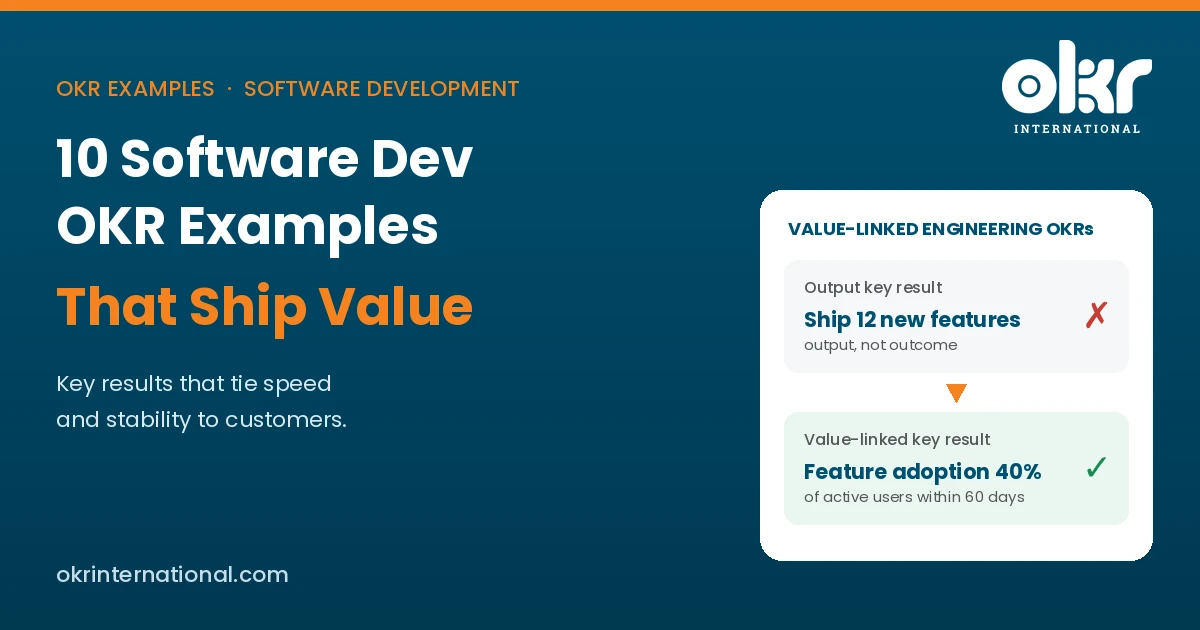
| Product delivery | Ship 12 new features | Reach 40% adoption of new features within 60 days |
| Speed | Complete 300 story points | Cut lead time for changes from five days to one |
| Reliability | Migrate to the new cloud platform | Hold 99.95% availability on customer-facing services |
| Quality | Write 500 new test cases | Halve escaped defects per release |
| Developer experience | Roll out a new IDE plugin | Cut time to first merged change for new hires from 15 days to 5 |
Which engineering OKRs does each team need?
Not every team should copy the same goals. Instead, match the software development OKR examples below to the work each team actually controls.
Product engineering teams. Their engineering OKRs should join delivery to adoption, retention or revenue. Good engineering OKRs also protect quality, so speed never hides rework.
Platform and operations teams. DevOps OKRs should centre on the four DORA measures: lead time, deployment frequency, change failure rate and recovery time. Strong DevOps OKRs treat other engineers as customers. SRE OKRs add service-level objectives on top.
Quality teams. Software QA OKRs should measure what escapes, not what gets tested. Good software QA OKRs also cut flaky tests, because nobody trusts a noisy pipeline. In practice, testing OKRs should sit inside each team’s delivery goals, not in a separate silo.
Individual engineers. OKRs for software engineers work best when they are few and linked to a team objective. Developer OKRs should reflect skills and outcomes, such as faster reviews or fewer pages, never lines of code. For instance, a senior engineer’s OKRs for software engineers might target a 30% cut in a service’s response time. A newer engineer’s OKRs for developers might focus on shipping a first feature end to end.
10 software development OKR examples you can adapt this quarter
Each of these software development OKR examples follows the same pattern: one qualitative objective and three measurable key results. Treat the numbers as placeholders. Set your own baseline first, then adjust.
1. Delivery speed
Objective: Get valuable changes into customers’ hands faster.
- Cut median lead time for changes from five days to one.
- Increase deployment frequency from weekly to daily on core services.
- Keep change failure rate below 10% while speed rises.
Why it works: speed and stability sit in the same objective, so neither can be gamed alone. That is why so many DevOps OKRs start here.
2. Reliability and DevOps OKRs
Objective: Make our platform something customers never have to think about.
- Hold 99.95% availability on all customer-facing services.
- Restore service within 60 minutes for 95% of incidents.
- Reduce pages outside working hours by 50%.
Why it works: these DevOps OKRs measure what users and on-call engineers actually feel.
3. Software QA OKRs
Objective: Catch problems before our customers do.
- Halve escaped defects per release, from 12 to 6.
- Automate tests for 90% of critical user journeys.
- Cut the flaky-test rate in the main pipeline from 8% to below 2%.
Why it works: software QA OKRs built on escaped defects reward prevention, not paperwork. They also keep QA OKRs honest about what users experience.
For manufacturing-style quality goals, see our quality control OKR examples.
4. Developer experience
Objective: Make this the easiest codebase our engineers have ever worked in.
- Cut median code review wait time from 30 hours to 8.
- Reduce local build time from 12 minutes to under 4.
- Raise the developer satisfaction score from 6.1 to 7.5 out of 10.
Why it works: friction slows every other goal, so removing it pays back across all engineering OKRs. It also makes OKRs for software engineers far easier to hit.
5. Product value
Objective: Build features customers actually use.
- Reach 40% adoption of new features among active users within 60 days.
- Retire three features used by fewer than 2% of customers.
- Lift 90-day retention for new accounts from 70% to 78%.
Why it works: it links engineering effort directly to customer behaviour.
Pair this with our product management OKR examples.
6. Technical debt
Objective: Pay down the debt that slows us most.
- Remove the legacy payments module from all live traffic.
- Cut the time to add a new payment method from six weeks to one.
- Reduce incidents linked to legacy code by 60%.
Why it works: debt work earns a place only when it unlocks speed or stability you can measure.
7. Secure by default
Objective: Ship secure code without slowing down.
- Fix 100% of critical vulnerabilities within seven days.
- Run automated security scanning on every pull request.
- Cut open high-severity findings from 140 to 20.
Why it works: security becomes part of the flow, not a gate at the end.
Our security OKR examples cover the wider programme.
8. Platform engineering
Objective: Give every team a paved road to production.
- Cut new-service setup time from three days to two hours.
- Move 80% of services onto the shared deployment pipeline.
- Raise internal platform satisfaction from 55% to 80%.
Why it works: platform team OKRs that treat engineers as customers get adopted, not ignored.
9. AI-assisted development
Objective: Use AI to go faster without breaking things.
- Agree review standards for AI-generated code across all teams.
- Keep change failure rate flat or lower as AI use grows.
- Cut time spent on routine test writing by 40%.
Why it works: it captures the speed gain while guarding against the stability risk DORA keeps finding.
For model-building teams, see our AI and machine learning OKR examples.
10. Engineering onboarding
Objective: Turn new engineers into confident contributors fast.
- Cut time to first merged change from 15 days to 5.
- Give every new hire a named mentor and a 30-day plan.
- Raise new-hire confidence scores at day 60 from 60% to 85%.
Why it works: developer OKRs that start on day one compound for years. Good software engineer OKRs begin with a fast, confident start.
How to write engineering OKRs in five steps
Use these steps to turn the software development OKR examples above into goals that fit your team.
- Start with the business goal. Ask what the company needs this quarter, such as lower churn or a new market.
- Find engineering’s lever. Decide which outcome your team can move most, such as reliability for DevOps OKRs or escaped defects for software QA OKRs.
- Write one objective. Keep it qualitative, short and memorable.
- Add three key results. Pair at least one delivery metric with one customer or business outcome.
- Review weekly. Check progress in a 15-minute stand-up using live dashboards, not slides.
A worked example: from feature factory to value-linked
Here is a simplified example. A mid-sized SaaS team set this goal: “Deliver the Q3 roadmap.” Its key results were 12 features shipped, 300 story points completed and a cloud migration finished. The team hit all three. Even so, churn rose and two outages hit major accounts.
Next quarter, the team rewrote its engineering OKRs as value-linked engineering OKRs. The objective became “Make our product faster and more dependable for our biggest customers.” The key results became 99.95% availability, lead time cut from five days to one, and 40% adoption of new features within 60 days. The roadmap shrank by a third. Moreover, churn fell, and the board finally understood what engineering was buying. Engineers said the goals felt fairer too, because each one described a result they could influence.
Who owns software development OKRs
The CTO or VP Engineering owns the company-level engineering objective and agrees it with product and the business. Engineering managers own key results for their teams. Platform leads own DevOps OKRs, and quality leads own software QA OKRs. Product managers co-own any key result about adoption. QA engineers should shape testing OKRs alongside developers, not after them. Individual engineers may set one or two OKRs for software engineers, linked to their team’s goal. For capability on the wider IT estate, see our information technology OKR examples.
Common mistakes with engineering OKRs
- Counting output. Features, tickets and story points are tasks, not key results.
- Speed without stability. Always pair a speed metric with change failure rate or recovery time.
- Roadmap as OKRs. A list of projects is a plan. OKRs describe the change the plan should create.
- Individual metrics as targets. Lines of code and commit counts damage trust and quality. Keep developer OKRs focused on outcomes.
- Too many objectives. Keep to two or three per team each quarter.
- Set and forget. OKRs that nobody reviews weekly quietly die.
Frequently asked questions
Good software development OKR examples pair one clear objective with three outcome-based key results. For example: make releases boring, measured by deployment frequency, change failure rate and time to restore service. Each key result tracks speed, stability or customer value, never the number of tickets closed.
Yes, DORA metrics make strong key results for engineering OKRs because they measure delivery speed and stability together. Use lead time, deployment frequency, change failure rate and recovery time. Pair them with at least one customer outcome so faster delivery is linked to value, not just volume.
Write OKRs for software engineers around outcomes they can influence: faster code reviews, fewer escaped defects, quicker onboarding or better on-call health. Keep personal OKRs to one or two objectives. Link each one to a team objective, and never turn story points or lines of code into key results.
Typical DevOps OKRs aim to make delivery fast and safe. Example key results: cut lead time for changes from five days to one, keep change failure rate below 10%, restore service within one hour and automate 90% of environment setup. Each key result describes a result, not a tool rollout.
Measure software QA OKRs by quality outcomes, not testing activity. Useful key results include escaped defects per release, automated test coverage on critical paths, flaky-test rate and time to detect regressions. Treat the number of test cases written as a task, not a key result.
Build engineering OKRs your customers feel
These software development OKR examples are a starting point. The best ones are adapted to your own baseline and architecture. For hundreds more across every function, browse our OKR examples library. To check how mature your wider OKR practice is, take the free Pulse Scan™ in our OKR Maturity Model.
Put these OKR examples to work
Learn to write and run OKRs like these with the OKR-BOK™ Certified Practitioner — the self-paced OKR certification endorsed by both ICF and HRCI, built from 500+ implementations across 30+ countries.
Explore the OKR-BOK™ Practitioner Certification →So, look at your current engineering OKRs: would your customers notice if you hit every one?