
Key takeaways
- Most budgets copy last year. McKinsey found that a third of businesses received almost exactly the same capital as the year before.
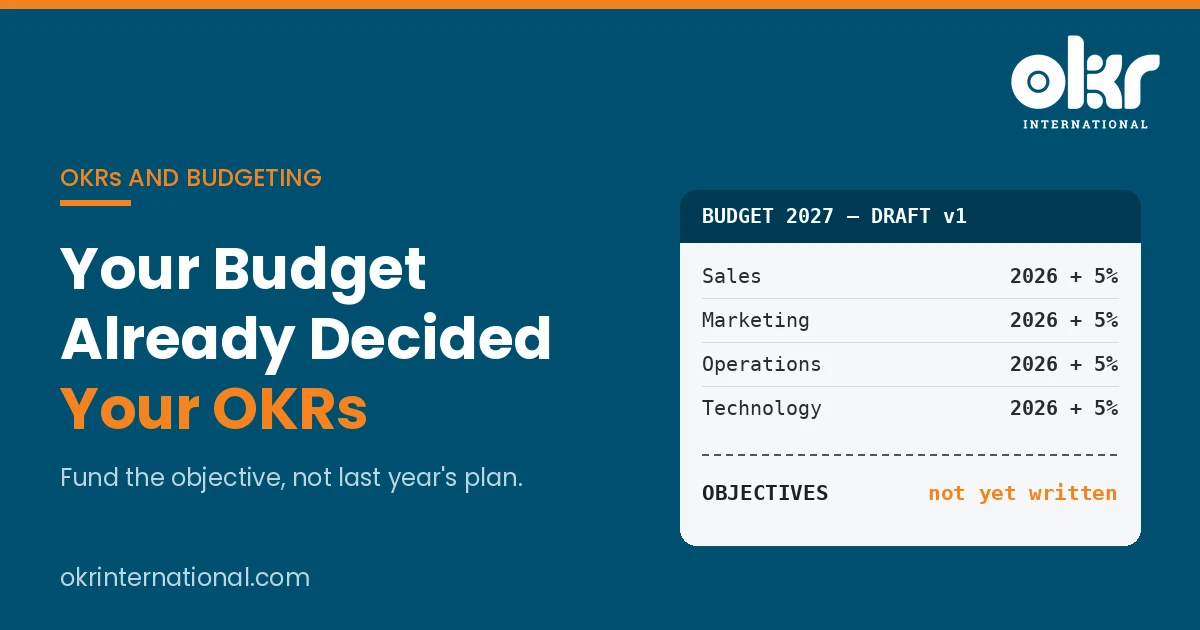
- When the budget comes before the objectives, the budget writes your OKRs for you.
- Fix the sequence: objectives first, stop list second, funding third.
- Fund initiatives tied to key results, not departments.
- Hold a reallocation reserve and review funding at every quarterly OKR review.
Most leadership teams treat OKRs and budgeting as two separate jobs. Finance builds the annual operating plan in one room. Leaders write objectives in another. By January, the numbers have already decided what the organisation can do. OKR resource allocation then becomes an argument about leftovers. Funding OKR initiatives means asking for scraps from a plan that was never built for them. Good strategic planning and budgeting runs the other way round. Objectives come first, and money follows them. This guide shows how to make the 2027 budget fund your objectives rather than last year’s plan. It draws on research into how companies really allocate money. It also draws on 500+ OKR implementations in India, the UAE and beyond.
Why OKRs and budgeting drift apart
Budgets have gravity. Each year’s numbers pull the next year’s numbers towards them.
McKinsey studied 1,616 US-listed companies between 1990 and 2005. For one-third of the businesses, the capital they received in a given year almost exactly matched the year before. The mean correlation for that group was 0.99. Across the whole economy, it was 0.92. You can read the research in How to put your money where your strategy is.
That pattern matters for OKRs and budgets. An objective that asks for change needs money that moves. A budget with a 0.99 correlation does not move. So leaders write the objective, applaud it and then starve it.
The cost is real. The same research found a clear reward for moving money. The top third of reallocators earned 30 percent higher annual returns to shareholders than the bottom third. McKinsey’s later discussion of how to be objective about budgets makes the same point: almost every company can do better if it reallocates more.
Strategy and budgeting are not two disciplines. They are one decision, made twice, often with different answers.
The sequence problem: budget first, objectives second
Most annual planning calendars look sensible on paper. Finance issues budget templates in September. Business units return them in October. Leadership signs off the annual operating plan in November. Objectives arrive in December, once the money has gone.
That order hides a quiet decision. By the time anyone writes an objective, the operating plan has already fixed headcount, projects and vendor contracts. Teams then write OKRs that fit the money they have.
We call these budget-shaped OKRs: objectives reverse-engineered from an approved spend. You can usually spot them in three ways:
- Key results describe spending, such as “Launch three campaigns” or “Hire 12 engineers”.
- Objectives match last year’s department names, one for one.
- No objective requires money to move from one unit to another.
When these signs appear, budgeting with OKRs has turned into budgeting first and labelling second. Our article on why OKRs fail sets out what that pattern costs over a full year.
OKRs vs the annual operating plan: what each one does
OKRs do not replace the operating plan. They do a different job. The annual operating plan keeps the business running. OKRs change it. Integrated planning works when each one knows its role.
| Question | Annual operating plan (AOP) | OKRs |
|---|---|---|
| Main purpose | Run the business predictably | Change the business deliberately |
| Time horizon | 12 months, mostly fixed | Annual objectives, quarterly key results |
| Unit of funding | Departments and cost centres | Initiatives linked to key results |
| Typical owner | CFO and the finance team | CEO, leadership team and OKR owners |
| Success measure | Variance against budget | Progress on outcomes |
| Change during the year | Rare and painful | Expected at each quarterly review |
The trouble starts when the AOP tries to do both jobs. A spend line cannot tell you whether customers stayed. A key result can. Strategy-led budgeting keeps the AOP for run costs and protects a separate pool of money for change. That pool is where OKR initiative funding lives.
A five-step sequence for linking OKRs to the budget
Here is the sequence we use with leadership teams during annual planning. It works for a 200-person firm in Dubai and for a 20,000-person group in Mumbai. The steps are simple. The discipline is not.
- Set company objectives before the budget envelopes. Agree three to five company-level objectives before finance issues a single template. Finance then budgets for those objectives, not around them. Our guide to annual OKR planning covers the seven decisions to settle first.
- Write the stop list and release its money. Funding OKR initiatives needs money that used to fund something else. Name what you will stop, and move its budget into the change pool. If nothing stops, nothing new gets money.
- Fund initiatives, not departments. List the initiatives behind each key result. Give each initiative an owner, a cost and a review date. Initiative-level budgeting makes every rupee or dirham traceable to an outcome.
- Hold a reallocation reserve. Keep part of the change pool unallocated, for example 10 percent. Release it at the first quarterly review to the initiatives that show traction. The reserve turns OKR resource allocation into a live decision rather than an annual event.
- Review funding at every quarterly OKR review. Put money on the agenda of the quarterly review. Ask which initiatives earned more funding and which should lose it. Without this step, funding OKRs stays a January promise.
OKR resource allocation during the year
Money is only one resource. People and leadership attention matter just as much. Good OKR resource planning covers all three, because allocating resources to OKRs means more than signing off a spend line.
Start with OKR headcount planning. Most operating plans fix headcount by department. Yet a cross-functional objective often needs people from four teams for one quarter. OKR capacity planning asks a different question. How many people-weeks does each key result need, and from where?
Next, separate committed and aspirational OKRs. Committed OKRs deserve full funding from day one. Aspirational OKRs can start with seed funding and earn more at the quarterly review. This split protects the budget without killing ambition. It also removes the temptation to pad targets, which we tested in sandbagging OKRs.
Finally, track OKR resource allocation alongside progress. A simple view of spend against each key result tells leaders where funding works. Monitoring and measurement sit inside the Process component of the OKR-BOK™ for exactly this reason.
Who owns what: the CEO, the CFO and the OKR champion
Strategic budgeting fails when ownership is vague. Three roles keep OKRs and financial planning connected:
- The CEO owns the objectives and the stop list. Only the CEO can tell a business unit that its favourite project is ending.
- The CFO owns the change pool and the reallocation rules. Finance decides how money moves, and how fast.
- The OKR champion owns the rhythm. The champion keeps funding on the agenda of every quarterly review.
When these three roles sit in the same planning room, OKR budget alignment stops depending on goodwill. Budget and strategy alignment becomes a standing agenda item, not an annual hope. It becomes part of the operating rhythm. The budget for OKR initiatives then has a clear owner, a clear rule and a clear date.
A worked example: funding one objective
Take a simplified example. A Dubai-based services firm sets this company objective for 2027: “Become the first choice for mid-market clients in Saudi Arabia.” Its key results describe outcomes. Saudi revenue grows from 4 to 12 percent of the total. The firm wins 15 new mid-market clients. Client retention in the region reaches 90 percent.
Under the old process, Saudi sales would receive last year’s budget plus five percent. Under strategy-led budgeting, the team costs the initiatives instead:
- Open a Riyadh office with two senior hires.
- Localise the service catalogue and pricing.
- Run a partner programme with three regional advisory firms.
Each initiative gets an owner and a cost. Together they need, say, AED 2.4 million. The stop list releases most of it. The firm ends a low-margin product line and pauses a second rebrand. The rest comes from the reallocation reserve after the first quarter, if the pipeline shows traction.
This is OKR resource allocation in practice. Funding OKR initiatives follows the outcome, not the org chart. The OKR initiative budget sits beside the key result it serves, so leaders see both on one page. OKR resourcing for the Riyadh hires comes from the same plan, not from a separate headcount round.
Now the quarterly review does real work. Suppose the partner programme stalls while the Riyadh office wins clients. Money moves to the office within weeks, not at next year’s budget round. That is strategic planning and budgeting working as one decision. It is also what integrated planning looks like when the OKRs, not the spreadsheet, set the direction.
Five mistakes that break OKR budget alignment
We see the same five OKR budgeting mistakes in almost every planning season:
- Finance finishes the budget before objectives exist. The objectives then inherit last year’s shape.
- Leaders fund departments and hope for the right initiatives. Departments protect their own work first.
- The operating plan stays untouchable for twelve months. Strategic initiatives starve while run costs stay safe.
- Key results measure spend rather than outcomes. Money goes out, and nobody checks what changed.
- Funding never reaches the quarterly review. Leaders discuss progress, but money never moves.
Each mistake has the same root. The planning and budgeting process treats money as fixed and objectives as flexible. Reverse that, and most of the problems disappear. Funding OKRs becomes a decision you revisit, not a number you defend.
Frequently asked questions
OKRs set the outcomes an organisation wants to change. The budget funds the initiatives that drive those outcomes. Set objectives first, build the budget around them, and review funding at each quarterly OKR review.
No. The annual operating plan funds run-the-business work. OKRs direct a protected pool of money and people towards change. Most organisations need both, with clear rules for how money moves between them.
Review funding every quarter, in the same meeting as the OKR review. Move money towards initiatives that show traction and away from those that stall.
Review funding every quarter, in the same meeting as the OKR review. Move money towards initiatives that show traction and away from those that stall.
The CEO owns the objectives and the stop list. The CFO owns the change pool and the reallocation rules. An OKR champion keeps funding on the quarterly review agenda.
Build the capability before the 2027 budget locks
Most 2027 budgets will lock within the next eight weeks. The people writing them need a shared standard for linking strategy to budget. The OKR-BOK™ gives them one.
The OKR Foundation Course builds fluency across the leadership team. The OKR-BOK™ Certified Practitioner builds the applied skill to run OKR budgeting and planning. The OKR-BOK™ Certified Coach programme, endorsed by the ICF and HRCI, builds the capability to guide others through it. The next Coach cohort runs on 27–28 November 2026. You can see every date on our certification dates page.
One question to take into your next planning meeting: which line in your 2027 budget would survive if you started from your objectives instead?