Key Takeaways
- Strategy execution often fails due to four hurdles: cognitive, resource, motivational, and political.
- These hurdles apply to OKRs, making it essential to diagnose which one is causing problems in implementation.
- OKRs help in overcoming these hurdles by increasing visibility, ownership, and accountability among teams.
- Leaders should focus on addressing specific hurdles instead of blaming the framework for failure.
- The OKR-BOK™ Certification trains leaders to effectively navigate these execution hurdles.
Most strategies do not fail in the boardroom. They fail in the ninety days after it. Chan Kim and Renée Mauborgne gave this failure a structure. They identified four hurdles to strategy execution: cognitive, resource, motivational, and political. These hurdles to strategy execution stop brilliant plans from becoming reality. At OKR International, we see the same pattern across 500+ organisations. Nearly every stalled rollout traces back to one of these four barriers. Yet there is good news. Strategy execution with OKRs clears each hurdle in turn. This article maps the framework onto the OKR implementation challenges leaders face every day. It also offers a practical path to overcoming execution hurdles, one quarter at a time.
Where the Four Hurdles Come From
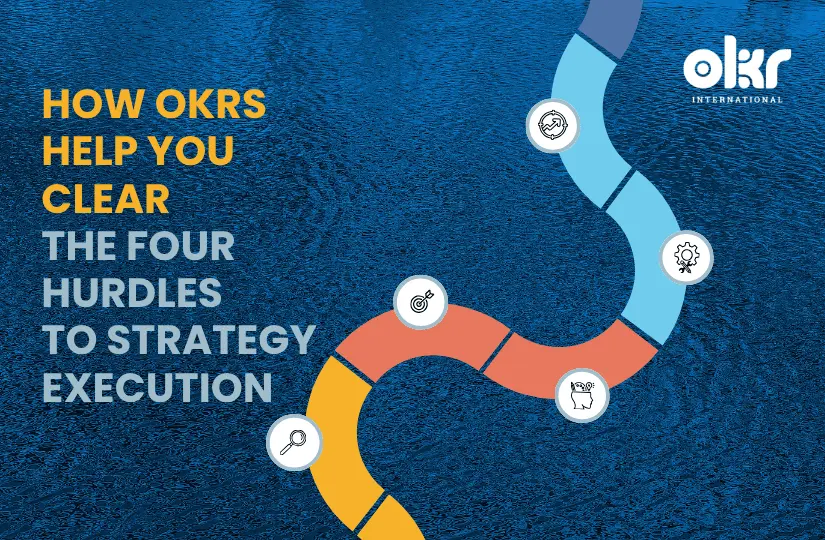
Kim and Mauborgne built the four hurdles to strategy execution framework while studying stalled transformations. Their observation was uncomfortable. The bigger the departure from the status quo, the higher the hurdles. So they named four. The cognitive hurdle: waking people up to the need for change. The resource hurdle: the belief that big shifts need big budgets. The motivational hurdle: energising key people to move fast. The political hurdle: navigating internal resistance. You can read the original framework on the Blue Ocean Strategy site.
Two decades of OKR consulting taught us something important. OKRs face exactly the same four hurdles. Why? Because OKRs are a strategy execution system. When leaders describe their OKR implementation challenges, they usually describe one of these hurdles in an OKR costume. Diagnose the hurdle first. Then the fix becomes obvious.
Hurdle 1: The Cognitive Hurdle — “Why Change What Works?”
The cognitive hurdle hides in plain sight. Nothing appears broken. Revenue looks fine. Reviews happen on schedule. KPIs glow green. So why would anyone change how the organisation executes strategy?
This creates the first of many OKR implementation challenges. Teams treat OKRs as admin on top of real work. Nobody has felt the cost of the old way. The strategy sits in a slide deck. Meanwhile, the work sits in a backlog. The two never meet.
How OKRs clear it. A strong OKR system makes the execution gap visible and undeniable. Ask every team to write two or three Objectives that ladder up to the strategy. Suddenly, the misalignment stops being abstract. We have watched leadership teams go silent at this moment. They discover that 60% of team priorities connect to nothing in the strategy. That sight — not a memo — wakes an organisation up. For this reason, the OKR-BOK™ Framework starts with Focus on Priority. Name the vital few before you touch anything else. People trust their own data faster than anyone else’s argument. And OKRs generate that data every quarter.
Hurdle 2: The Resource Hurdle — “We Don’t Have the Bandwidth”
The second of the four hurdles to strategy execution is an assumption. Bigger strategic shifts must demand bigger resources. In OKR terms, it sounds like this: “We can’t do OKRs this quarter — we’re too busy.” That logic resembles a driver too busy to stop for fuel.
Yet the resource hurdle is real. Teams carry genuine overload. Add an OKR cadence to an unexamined workload and you get the Treadmill effect. Motion without progress. Few OKR implementation challenges kill programmes faster.
How OKRs clear it. Kim and Mauborgne prescribe redistribution, not addition. OKRs mechanise exactly that. Writing Objectives forces the conversation nobody schedules voluntarily: what will we stop doing? The limit of three to five Key Results acts as a resource-allocation tool in disguise. Strategy execution with OKRs succeeds when leaders kill work every quarter. Sunset projects. Decline requests. Move people from low-leverage activity to the vital few. Has your OKR cycle never cancelled anything? Then you adopted the paperwork and skipped the point.
Hurdle 3: The Motivational Hurdle — “Nobody Owns This”
The third hurdle asks a hard question. How do you get key people to move fast and keep moving? Every stalled OKR programme we audit shows the same symptoms. Orphaned Key Results with no owner. Check-ins that decay from weekly to “when we remember.” Scores that drift into fiction by week eight.
Overcoming execution hurdles of this kind takes more than posters or launch events. Motivation follows visibility, ownership, and rhythm. Remove any one and it dies.
How OKRs clear it. Three mechanisms do the work. First, single-owner accountability. Every Key Result carries one name, never a committee. Second, the check-in cadence. A 15-minute weekly ritual keeps progress public. The Track Check stage of the OKR-BOK™ exists for this reason: untracked goals become unowned goals. Third, transparent scoring. When every team sees every other team’s confidence levels, momentum turns social. Kim and Mauborgne call the underlying principle fair process. People commit to plans they helped shape. Cascaded, dictated OKRs violate fair process. Co-created OKRs embody it. So we insist that teams draft at least 60% of their own OKRs bottom-up. We apply this rule in every deployment through our OKR consulting practice.
Hurdle 4: The Political Hurdle — “Shot Down Before You Stand Up”
The fourth hurdle works quietly. Internal opponents never argue with the strategy in the meeting. They never support it afterwards either. In OKR rollouts, this takes familiar shapes. One department “already has its own system.” One executive keeps their targets conveniently private. A middle layer complies in format while resisting in substance. Our Trap Atlas documents this pattern as Trojan OKRs.
Of all the hurdles to strategy execution, the political one kills programmes most slowly and most completely. It produces the appearance of adoption. Dashboards fill up. Nothing changes.
How OKRs clear it. Transparency starves politics. Put every team’s Objectives, owners, and scores in one visible system. Then the classic political moves become expensive. Private side-deals, selective reporting, and quiet non-participation all show. The playbook mirrors Kim and Mauborgne’s tipping point leadership. Secure a visible champion at the top. Ask them to publish their own OKRs first and score them honestly in public. Next, win over influential sceptics by giving them real authorship. Finally, make non-participation conspicuous rather than punished. One executive scoring a Key Result at 0.3 in an open forum clears more political ground than any mandate.
The Four Hurdles as a Diagnostic for Your OKR Programme
Here is the practical takeaway for leaders facing OKR implementation challenges. Stop asking “are OKRs working?” Instead, ask “which hurdle are we hitting?” The four hurdles to strategy execution give you a precise diagnostic language.
| Symptom in your OKR programme | Hurdle | First move |
|---|---|---|
| OKRs feel like HR admin; no urgency | Cognitive | Run an alignment audit; show teams the strategy–work gap in their own data |
| “Too busy for OKRs”; everything is a priority | Resource | Use the next cycle to stop three pieces of work explicitly |
| Orphaned KRs; check-ins decaying | Motivational | Assign one owner per KR; restore the weekly rhythm; publish scores |
| Compliance without change; private targets | Political | Get one senior leader scoring honestly in public; co-create, don’t cascade |
Strategy execution with OKRs is not a documentation exercise. Rather, it is the quarterly practice of overcoming execution hurdles before they compound. The organisations that sustain OKRs beyond year one do not own the best software. Their leaders simply learned to name the hurdle in the room.
Frequently Asked Questions
Chan Kim and Renée Mauborgne of Blue Ocean Strategy identified them. The cognitive hurdle: people do not see the need for change. The resource hurdle: the belief that change demands more resources. The motivational hurdle: key people lack the energy to act. The political hurdle: internal opposition blocks progress.
OKRs translate strategy into a few measurable, owned, time-boxed commitments. Teams then review them on a public cadence. This visibility clears the cognitive hurdle. Forced prioritisation clears the resource hurdle. Single-owner accountability clears the motivational hurdle. And public scoring clears the political hurdle.
Most failures trace to one unaddressed hurdle. Teams never felt the need (cognitive). Workload never shrank (resource). Key Results lost their owners (motivational). Or resistance went underground (political). Name the specific hurdle instead of blaming the framework. Recovery then follows quickly.
Yes — they complement each other naturally. Blue Ocean Strategy excels at formulating a differentiated strategy. OKRs excel at executing it. The four hurdles describe what blocks execution. A disciplined OKR system clears those hurdles quarter after quarter.
Expect the cognitive and resource hurdles to dominate the first two quarters. The motivational hurdle peaks around quarters two and three. The political hurdle persists until senior leaders model transparency consistently. Full embedding typically takes twelve to eighteen months.
Clear the Hurdles With a Proven System
The four hurdles to strategy execution are predictable. That makes them preparable. The OKR-BOK™ Certification trains leaders and coaches to diagnose and clear each one. We use the same playbook across 500+ organisations worldwide. Explore the next cohort. Or talk to our team about strategy execution with OKRs in your organisation.