
Key takeaways on OKR prioritisation
- Only one in seven US workers could name their organisation’s top three goals, according to a FranklinCovey survey of 26,500 people.
- In the famous jam study, only 3 percent of shoppers bought from a 24-jam table. At a six-jam table, 30 percent did.
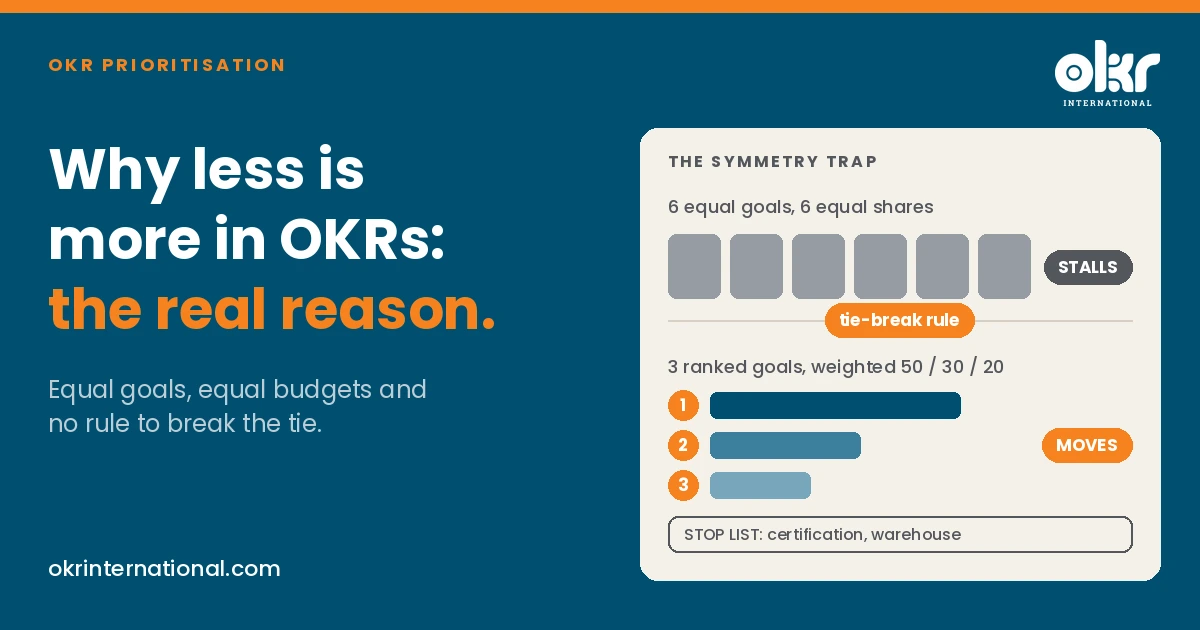
- The real failure is symmetry, not size: equal goals, equal budgets and no rule to break the tie. That is Buridan’s donkey.
- A 2010 meta-analysis found that choice overload is not universal. A clear ranking removes most of it.
- Fix OKR prioritisation in five steps: cap, rank, write an OKR stop list, weight resources, and decide by a date.
A donkey stands exactly halfway between two identical bales of hay. It finds no reason to pick one, so it starves. That is Buridan’s donkey, and it describes many leadership teams. They write eight objectives, rank none of them and split the budget evenly. Then they wonder why nothing moves. Most advice on OKR prioritisation blames the number of OKRs and stops there. The research on choice overload says something sharper. The real fault is symmetry: equal weight with no rule to break the tie. This article explains why less is more in OKRs, shows what the evidence says, and gives five steps, including an OKR stop list, to break the tie.
Why too many OKRs stall execution
Start with what leaders report about the number of OKRs they carry and how well people can name them. FranklinCovey ran its Execution Quotient survey with 26,500 US workers in more than 150 companies. Only one in seven could identify their organisation’s top three goals. A separate study of 12,182 workers across 18 industries found that just 14 percent said their team stays diligently focused on its most important goals. Both findings appear in a 2004 FranklinCovey press release. The data is old, but the pattern is familiar. Stephen Covey put the cause plainly: organisations “either have too many goals or they change them too often”.
Attention carries a cost too. Gloria Mark, a professor of informatics at the University of California, Irvine, found that people need an average of 23 minutes and 15 seconds to get back to a task after an interruption. She describes this in a Fast Company interview. Every extra live objective adds another reason to switch. Eight equal objectives give attention eight places to leak.
These findings share one theme. The number of OKRs grows faster than the capacity to rank them. Each new objective feels free on the day you add it. The cost arrives later, as conflicts, context switches and stalled decisions. A lower OKR count does not cure that cost on its own, but it shrinks the problem.
The best-known test of choice overload is the jam study. Psychologists Sheena Iyengar and Mark Lepper set up a tasting table in a supermarket. Some days it held 24 jams. On others it held six. The larger table drew more attention: 60 percent of shoppers stopped. But only 3 percent of shoppers bought jam there. At the six-jam table, 30 percent bought. A course summary of the study gives the figures. Our own guide to the 10 reasons why OKRs fail lists the same pattern as the “More is Less” fallacy.
Buridan’s donkey: the paradox behind the problem
Buridan’s donkey takes its name from Jean Buridan, a 14th-century French philosopher. He did not invent it. Wikipedia’s entry on Buridan’s ass traces the idea to Aristotle, who described a man equally hungry and thirsty. It also credits Al-Ghazali, who used a man facing two equally good dates.
Philosophers treat the donkey paradox as falsidical. ProofWiki explains why: perfect equality hardly ever exists, and a real animal would simply pick a bale. That flaw is the useful part. Real teams are never perfectly balanced. They stall because nobody has agreed how to break the tie.
Teams often call the result decision paralysis. We call the cause the symmetry trap. It has three faces, and each one feels reasonable from the inside:
- Goal symmetry. Eight objectives sit side by side. None outranks another, so every conflict becomes a debate.
- Resource symmetry. The team splits budget and people evenly “to be fair”. An even split guarantees that every objective is short of what it needs.
- Metric symmetry. Two key results look equally good. The team spends weeks hunting the perfect measure while the quarter ticks away.
The trap is also why too many objectives hurt. The extra objectives are not the poison. The missing order between them is. Our guide to Pomegranate OKRs shows a close cousin, where one objective hides a whole project plan.
What the research says about choice overload
Here the story needs care. Choice overload is not a law of nature, and analysis paralysis is not inevitable. Benjamin Scheibehenne and colleagues pooled 63 conditions from 50 experiments, with 5,036 participants. They found a mean effect size of virtually zero, but considerable variance between studies. You can read the abstract of the 2010 meta-analysis. A Psychology Today summary adds that well-defined, pre-existing preferences likely remove the problem.
Our reading is simple. Options become a burden when they look equal and no ranked preference exists. A team that knows its order can carry five objectives. A team without one can freeze at three. So the number of OKRs matters, but the order matters more. Good OKR prioritisation fixes the order first.
Published guidance still sets a ceiling. The What Matters site, run by John Doerr, recommends a maximum of three objectives, each with three to five key results. We suggest three to five company objectives with two to three key results each. The limits differ by a notch. The principle is identical: pick an OKR limit, then rank inside it. The OKR-BOK™ makes the same point in its first stage, Focus on Priority: an organisation that has not chosen what to deprioritise has not truly chosen its priorities.
How the symmetry trap compares with a tie-break rule
The table below sets a symmetric OKR set beside one that carries a tie-break rule. Use it as a quick audit of your current plan.
| Question | Symmetric OKR set | OKR set with a tie-break rule |
|---|---|---|
| Objectives | Eight or more, all equal | Three to five, ranked one to five |
| Conflicts | Debated until someone gives in | Settled by the rank |
| Resources | Split evenly across objectives | Weighted towards the top rank |
| Dropped work | Never named | Written on an OKR stop list |
| Metrics | Hunt for the perfect key result | Good-enough measure with a review date |
| Review question | “Are we busy?” | “Did the top objective move?” |
Five steps to break the tie
This sequence turns OKR prioritisation from a debate into a decision. It works for a 50-person firm and for a large group.
- Set the OKR limit before you list. Agree the maximum number of OKRs first, for example three to five objectives. An OKR limit stops the list growing one favour at a time.
- Rank every objective. Choosing OKR priorities means ranking OKRs, one to five, with no ties. Rank one is your North Star. When two objectives clash, the lower rank gives way. This is the tie-break rule.
- Write the OKR stop list. Name the work that stops, with an owner and a date. Say the OKR trade-offs out loud. If nothing stops, nothing new can start. Our article on OKRs and budgeting shows how to move the freed money.
- Weight resources on purpose. Give the top-ranked objective the most people and money. A split such as 50, 30 and 20 percent is an example, not a standard. The point is that equal shares are a choice too.
- Decide by a date. When two key results look equal, pick the one you can measure this week. Review it at the first check-in. A good-enough metric that exists beats a perfect one that does not.
Each step removes one face of the symmetry trap. The first two break goal symmetry. Step four breaks resource symmetry. Five breaks metric symmetry and three keeps the other four honest.
A worked example: from eight objectives to three
Take a simplified example, not a client case, to see OKR prioritisation in practice. A logistics firm in Singapore starts the quarter with eight objectives. They cover Gulf revenue, delivery speed, a customer app, cost cutting, customer satisfaction, 40 new hires, a quality certification and a new warehouse. Each objective gets an equal share of leadership time and budget. Eight is far above any sensible OKR limit.
By the first review, every objective shows some progress. None is finished. Teams argue about priorities in every meeting, and nobody can say which result matters most.
Now apply the tie-break rule. The leadership team ranks the objectives and cuts to three:
- Rank one, the North Star: cut average delivery time.
- Rank two: grow Gulf revenue.
- Rank three: launch the customer app.
The OKR stop list does the hard work in this example. The firm pauses the certification project until next quarter. It defers the warehouse decision. It folds customer satisfaction into the delivery-time key results. Resources shift to a 50, 30 and 20 percent split across the three ranks.
When a clash arrives, the rank settles it and choice overload ends. Suppose the app team wants the same engineers that the delivery team needs. Nobody has to argue, because rank one wins. The team picks a good-enough delivery measure in week one and reviews it at the first check-in. Our OKR examples show how to word key results like these.
Who owns the tie-break
A tie-break rule fails if nobody owns it. Three roles keep it alive:
- The CEO owns the ranking and the OKR stop list. Only the CEO can tell a business unit to pause its project.
- The leadership team owns the trade-off calls. Prioritising objectives is their job. They apply the rank when objectives collide, and they do it in public.
- The OKR champion owns the rhythm. The champion asks one question at every review: what did we stop this quarter? Good OKR coaching builds that habit.
When these three roles work together, OKR prioritisation stops depending on goodwill. It becomes part of how the organisation runs. Our overview of OKRs and strategy execution shows where this fits in the wider operating rhythm.
Five mistakes that rebuild the symmetry trap
We see the same five mistakes when teams try to follow the less-is-more advice:
- Cutting the number of OKRs without ranking what is left. Five equal objectives are still a tie.
- Splitting resources evenly to be fair. Fair shares guarantee that no objective gets enough.
- Waiting for the perfect key result. Analysis paralysis is Buridan’s donkey in a spreadsheet.
- Keeping the OKR stop list verbal. Work that is never written down never stops.
- Adding a new OKR mid-quarter without removing one. The ceiling then becomes a suggestion.
Each mistake has the same root. The team has chosen the number of OKRs but not how to choose between them, so choice overload returns. The 10 OKR traps atlas maps related failures if you want to check your own plan.
Frequently asked questions
Fewer OKRs help only when they are ranked. Too many equal objectives split attention, budget and metrics evenly, so none gets enough. A short, ranked set with an OKR stop list gives teams a rule for settling conflicts. That rule is the real reason less works.
The What Matters site, run by John Doerr, recommends a maximum of three objectives, each with three to five key results. OKR International suggests three to five company objectives with two to three key results each. Pick a ceiling, then rank every objective inside it.
Buridan’s donkey is a thought experiment about an animal that starves between two identical bales of hay. In OKRs it describes teams with equal-weight goals, even budgets and no tie-break rule. They stall because nothing ranks one option above the others.
No. A 2010 meta-analysis of 50 experiments found a mean effect of virtually zero, with large variation between studies. Well-defined, pre-existing preferences likely remove the problem. That is why ranking your objectives matters more than the exact count.
Build the capability before the next planning cycle
Most teams know they should do less. Few have a shared standard for how to choose. The OKR-BOK™ gives them one.
The OKR Foundation Course builds fluency across the leadership team. The OKR-BOK™ Certified Practitioner builds the applied skill to run OKR prioritisation, ranking and OKR stop list sessions. The OKR-BOK™ Certified Coach programme, endorsed by the ICF and HRCI, builds the capability to guide others through it. The next Coach cohort runs on 27–28 November 2026. You can see every date on our certification dates page.
One question to take into your next planning meeting: if your team had to rank this quarter’s objectives from one to five today, would you agree on the order?